A SoFi Stadium event ends. Seventy thousand people walk back to their cars. Half of them are driving EVs. The lot fills with tail lights, then slowly empties. The last few thousand drivers find their cars won’t wake. That’s when mobile EV charging near SoFi Stadium matters. A local operator brings 240-volt Level 2 to the lot.
Why SoFi Stadium lots produce this
SoFi Stadium sits in Inglewood, just south of the 405 and east of the 105. The stadium hosts NFL games, concerts, and the College Football Playoff. Intuit Dome next door hosts Clippers games and other arena events. Tens of thousands of cars park in the surrounding lots on event nights.
A driver who arrived with 80 percent charge and sat through a four-hour event returns to a car that needs a 12V jump. The traction pack still has range. The 12-volt battery that powers the screen, the lights, and the contactors is dead. Heat and accessory drain during a long sit do this.
The same lot at LAX produces the same pattern after a week of travel. A car that sat in Economy Parking for seven days often comes back to a drained 12V, not an empty pack. Dead EV at SoFi in Inglewood covers the broader Inglewood pattern.
What the operator brings
We’re a referral line for Los Angeles County. We match stranded EV drivers with independent local operators. The pros we connect you with are licensed and insured. We hold no license for the work. We own no trucks and employ no technicians. We set no prices and publish no arrival time.
The operator quotes you before they start. They bill you directly. No dollar figure belongs here. They quote you on the phone and confirm access before they roll.
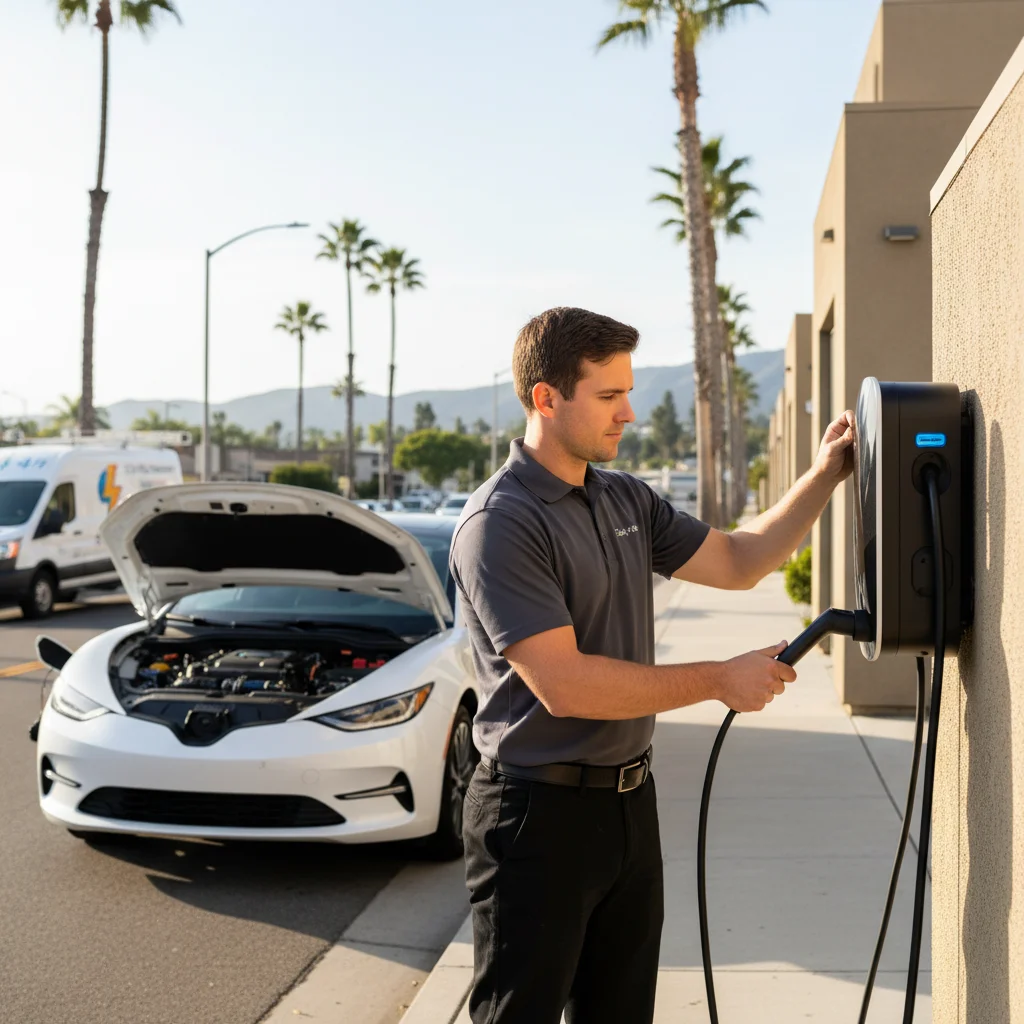
What they bring is a 240-volt Level 2 source to the car. Teslas take a native NACS plug. Other EVs use a CCS or J1772 adapter. A typical session adds 10 to 20 miles of range. Charging time is usually 15 to 30 minutes, and that clock starts when the plug is in. It isn’t a clock for when the truck shows up.
Operators also jump or replace a dead 12-volt battery on site. That covers Tesla and every major EV brand. After a four-hour event in the lot, that’s often the whole problem.
Two different dead cars, two different calls
The 12V version is the most common event-lot call. The traction pack still has range, often most of a full charge. The 12V died during the sit. The screen is dark. The handles stay locked. The operator jumps the 12V at the stall or replaces it on site. The driver leaves under their own power.
The empty-pack version is rarer but real. A driver who arrived with 20 percent charge and sat through a long event returns to a car at zero or close to it. The 12V still works. The traction pack is empty. The operator plugs in and adds 10 to 20 miles. That gets the driver to a charger on Prairie Avenue or Century Boulevard.
Most calls after events are the 12V version. The fix is fast.
Event-night dispatch
SoFi Stadium and Intuit Dome share the same operator network. The lot calls route to operators already covering Inglewood. Stadium nights run heavier demand. The wait time on event nights is longer than a Tuesday afternoon call.
The dispatch picks the operator already closest to your lot. We don’t publish a window. The operator quotes you on the call. If you want to compare against another operator, you can decline and wait. The match is the operator’s call to take or pass.
Pull as far right as you can in the lot aisle and set hazards. If you’re in a tight spot, leave a number where the operator can reach you. Don’t leave the lot to wait at a curb on Prairie Avenue. The car needs the operator at the stall.
Why a tow isn’t the answer here
A tow moves the car out of the lot. The driver waits on a hook. The car lands at a charger in Lawndale or on Century. The driver has to figure out a way home from the charger and back to the lot the next morning. The operator plugs in at the stall, runs the session, and the driver leaves under their own power.
AAA or a mobile charge: what actually gets an empty EV moving covers that comparison in more detail.
SoFi chargers in the lot
SoFi Stadium and the surrounding Hollywood Park development include public Level 2 chargers. Those chargers don’t keep a 12V alive while the car sits. They charge the traction pack when the car is plugged in. A driver who arrived at 80 percent and didn’t plug in returns to whatever charge they drove in with, minus accessory drain. That’s still a 12V call.
LAX terminal structures P1 through P7 and Economy Parking have EV chargers in the same condition. Lots of chargers, but the 12V still dies during a long sit. Dead EV at LAX parking covers the airport version of this pattern.
Stay safe in a stadium lot
Don’t walk between stalled cars. Set your hazards. Stay with the car if you can. The lot empties fast after an event, and walking alone in a half-empty structure at 11 PM isn’t safe. If the operator is taking longer than the window they gave you, call back and update your position.
CVC 22658 covers private property removal of vehicles. The SoFi lots are private property. A dead EV can be towed at the lot operator’s discretion. Don’t leave a dead EV overnight in the lot.
When a tow is still the honest answer
A crash or a bent wheel still needs a shop. So does a charge port that won’t accept power. On-site charging can’t fix that. If the car has physical damage from the lot, take the tow.
The number to call is (213) 410-1991. We’ll match you with a local operator. They quote before any cable goes in.