An EV that will not move after sitting at LAX does not automatically need a charge. If the screens stay dark and the car will not unlock normally, start with the low-voltage battery. If the displays work and the traction-battery level is empty, the car needs energy. If it wakes but reports a fault, it may need a model-approved tow.
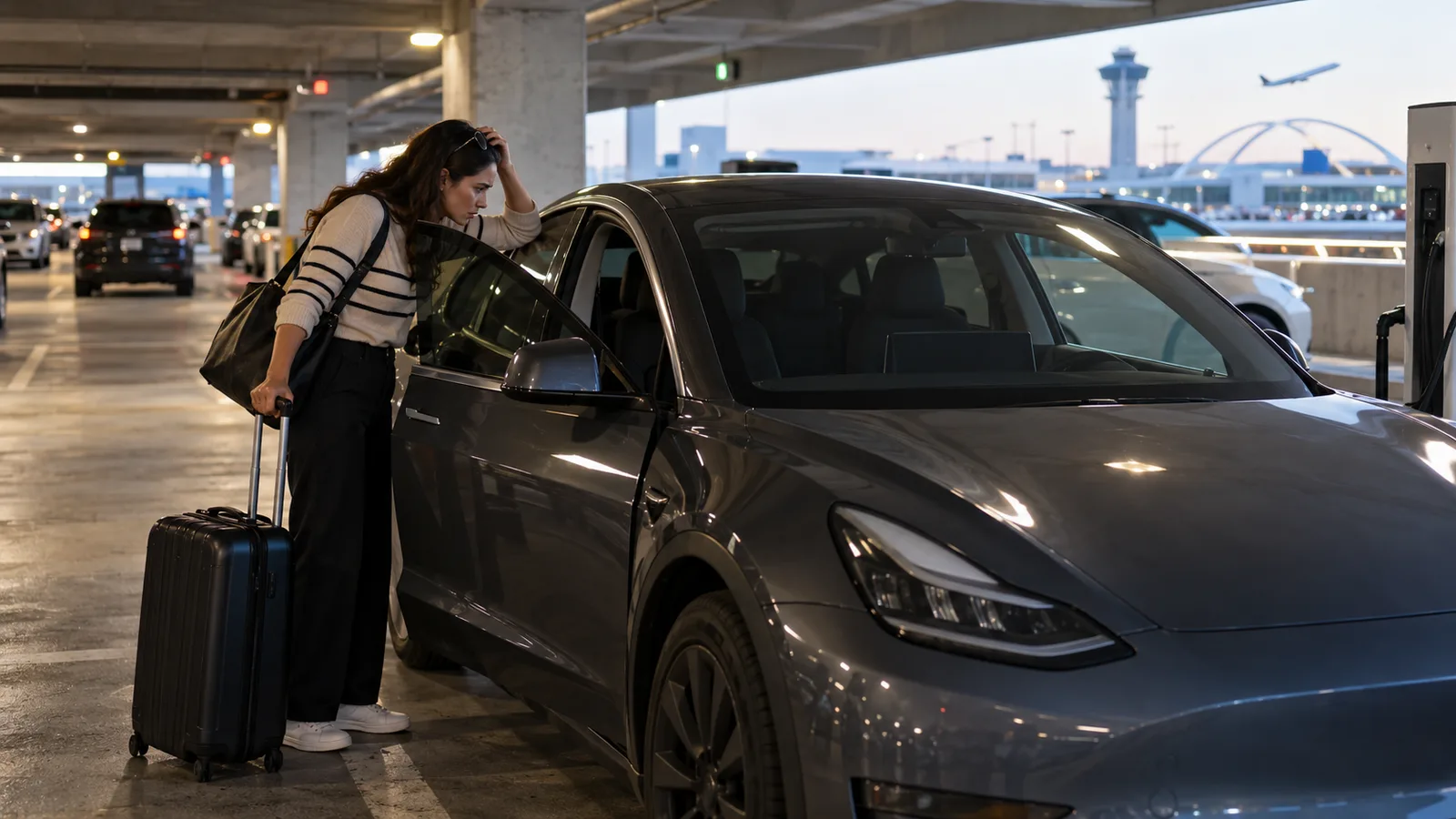
Identify the failure before requesting help
Use the symptoms you can see without taking anything apart.
The car is completely dark
A dark display, unresponsive electronic releases, and a vehicle that will not shift can point to the 12V or other low-voltage system. The traction pack can still contain driving range. The smaller battery has to wake the control systems before the vehicle can use that energy.
Request low-voltage help and give the exact model year. Jump procedures, access points, and voltage requirements differ by vehicle. Use the owner’s manual for the car in front of you.
The displays work and the range is at zero
That points toward an empty traction battery. The task is to add enough energy to reach a compatible working charger or move the car safely to one.
A typical mobile rescue charge adds 10 to 20 miles of range during 15 to 30 minutes of Level 2 charging. That is charging time, not an arrival estimate. Confirm the next charger’s compatibility and current availability before relying on that distance.
The car wakes but reports a fault
Record the complete message and follow the owner’s manual. Do not assume a jump or charge will clear a vehicle fault. If the car will not accept energy or select a drive mode, the next step may be service or a tow performed under the maker’s transport procedure.
EV died: should you charge, jump, or tow? gives the broader symptom map.
Chargers at LAX do not settle the diagnosis
Los Angeles World Airports lists Level 2 and DC fast charging in terminal parking structures P1 through P7. LAX Economy Parking has 514 active EV chargers.
That charging infrastructure is useful when the car can wake, release or open its charge port, and accept a session. A nearby charger does not wake a failed 12V battery. It also does not move a disabled car from an ordinary stall to the charging space.
If your EV is already connected, check whether the station and vehicle show an active session. A cable in the port does not prove that energy flowed. If the vehicle is awake but the session never started, use public charger connected but not charging before assuming the pack failed.
Do not unplug another driver’s vehicle or block a charging aisle while troubleshooting. Follow posted parking instructions and directions from airport staff.
Give an exact garage location
“At LAX” is not enough for an operator to find the car. Before calling, collect:
- Terminal structure P1 through P7, or Economy Parking
- Floor or level
- Row, section, or nearest marked pillar
- Stall number when posted
- The closest elevator, pedestrian bridge, or entrance
- Vehicle color, make, model, and license plate
- Any clearance or access restriction visible at the entrance
Send a location pin only after checking that it lands in the correct structure. Multilevel garages can place the pin above the right map point but on the wrong floor.
Meet the operator only where airport and garage rules allow. Do not walk into an active vehicle lane to flag down a truck. If access requires airport staff, parking assistance, or a specific entrance, arrange that before the operator arrives.
Jump, mobile charge, or tow
Each option solves a different problem.
Controlled low-voltage power
This can wake a vehicle whose traction pack still has energy. The operator must use the correct procedure for the model. A successful wake-up does not prove that the low-voltage battery is healthy. Preserve warnings and arrange the service the vehicle maker recommends.
For Tesla drivers, Tesla dead 12V or high-voltage pack? explains the distinction. Tesla also says a Model Y cannot be used to jump-start another vehicle because doing so can cause damage. Do not use a neighboring EV as an improvised donor.
Mobile EV charging
This fits an awake vehicle with an empty traction pack that can accept energy. The safe goal is enough range to reach a confirmed working charger. The operator should know the connector type before entering the garage.
Tow
A tow may be necessary when the vehicle reports a fault, will not accept a charge, cannot be safely accessed for roadside work, or cannot move under its own power after the correct low-voltage procedure. Use the manufacturer’s transport instructions. EV drivetrain and parking-lock requirements are model-specific.
Keep airport parking and roadside coverage separate
Parking assistance, an automaker program, and an insurance roadside add-on can have different limits. Ask what the dispatcher will actually send and where a tow may go. Do not assume that a listed jump means traction-battery charging, or that a covered tow ends at the charger you prefer.
Charge Pro LA is a referral service. We connect drivers with independent local operators. The operator performs the work, provides the quote, and bills the driver directly. Charge Pro LA does not own a truck, employ a technician, set a price, or promise an arrival time.
For the local referral path, see EV roadside assistance and mobile EV charging. If your EV is dead in LAX parking, call (213) 410-1991. Give the exact structure, level, stall location, vehicle model, and whether the screens are awake.