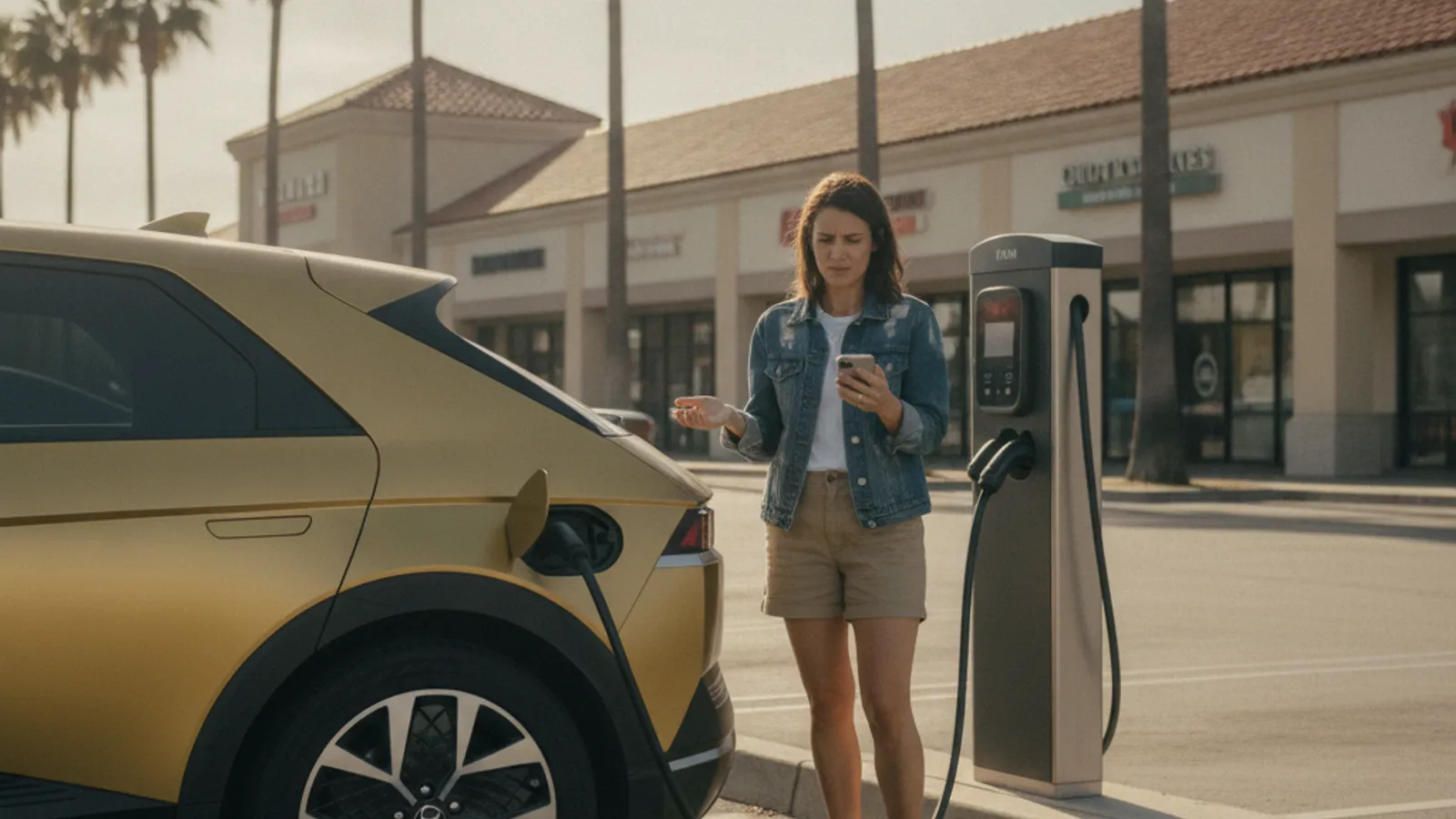
An LA County driver plugs into a public charger. The car says it’s connected. The charger says it’s connected. The session never starts. The kWh counter stays at zero. Hours pass. The driver calls for help. Here’s what to do when a public charger won’t start a session and when to call for a mobile rescue.
What “connected but not charging” actually means
The handshake between the car and the charger is the first step of every charging session. The car sends a signal that says “I am here, this is my connector, please send power.” The charger acknowledges. If the handshake fails, the charger says connected but doesn’t start the session.
The most common handshake failures are bad cables, dirty connectors, payment system glitches, and account authorization problems. Software updates on the car or the charger can also break the handshake temporarily.
A driver who stares at the connected indicator for ten minutes and sees no kWh flowing has a failed handshake. The fix is usually on the driver’s side. Sometimes the fix is on the charger’s side.
First checks before you call
Confirm the cable is fully seated. Pull the connector out and push it back in until it clicks. A loose connector doesn’t complete the handshake. The car and the charger both think they’re connected, but the data pins aren’t making contact.
Look at the connector for dirt or debris. A pocket full of sand or a corroded pin blocks the handshake. Wipe the connector with a dry cloth. Look at the car’s charge port too. Same problem on the car side.
Try a different stall. Most public charging sites have multiple stalls. One stall may have a hardware fault that the others don’t. Move the car and try a different connector.
Open the charger’s app or screen. Confirm the session is authorized. Some networks require a tap or a swipe before the session starts. A driver who plugs in but doesn’t authorize the session through the app waits forever.
Try a different network if the site has one. Some sites host two networks, like a Tesla Supercharger post with a CCS adapter or a shared site with both EVgo and Electrify America. If one network is down, the other may work.
When the charger itself is the fault
Some chargers stay in a connected state but never start the session. The hardware is broken, or the network is offline. The driver can do everything right and still not charge.
Look for an error message on the charger’s screen. Most public chargers display a fault code or a network status. A “charger offline” or “network error” message means the stall is dead. Move to a different stall or a different site.
Report the broken charger through the network’s app. The network needs the report to dispatch a repair. Your report helps the next driver who pulls up.
When the car itself is the fault
A car with a dirty or damaged charge port fails the handshake on the car side. Look at the port pins. Look for corrosion or damage. A car that’s been parked at the coast may have corrosion from salt air.
A car with a software bug may need a reset. Some cars have a charge-port reset in the infotainment menu. Some need a full power cycle. A driver who can’t charge on multiple networks may have a car-side problem, not a charger-side problem.
A car with a charge port that’s been physically damaged needs a shop. The port has to be replaced. The driver can’t fix that in a parking lot.
When to call for a mobile rescue
A driver who’s spent 30 minutes trying different stalls and different networks and still can’t charge has a problem that a public charger can’t solve. The next move is a mobile operator.
We’re a referral line for Los Angeles County. We match stranded EV drivers with independent local operators. The pros we connect you with are licensed and insured. We hold no license for the work. We own no trucks and employ no technicians. We set no prices and publish no arrival time.
The operator quotes you before they start. They bill you directly. No dollar figure belongs here. They quote you on the phone and confirm access before they roll.
What they bring is a 240-volt Level 2 source to the car. Teslas take a native NACS plug. Other EVs use a CCS or J1772 adapter. A typical session adds 10 to 20 miles of range. Charging time is usually 15 to 30 minutes, and that clock starts when the plug is in. It isn’t a clock for when the truck shows up.
That boost is enough to reach a working charger. The operator’s equipment is independent of the public network. If the public network is broken, the operator’s truck isn’t.
Public EV charger not working, what to do covers more of the troubleshooting path.
What to do with the broken public charger
Report it through the network’s app. Leave the stall if you can. Don’t leave the car plugged into a broken stall if you’re driving away. A car parked at a broken stall blocks the next driver from using the working stalls.
If the broken stall is the only one at the site, the network may have an outage map. Check the app for nearby working sites before you drive.
The combined answer
A public charger that says connected but doesn’t charge is usually a handshake failure. The fix is on the driver side: reseat the cable, check the connector, try a different stall, authorize the session through the app. If none of that works, the charger or the car has a fault. The next move is a mobile rescue.
The number to call is (213) 410-1991. We’ll match you with a local operator. They quote before any cable goes in.