A Tesla that won’t wake has one of two problems. Either the 12V is dead, or the traction pack is empty. The two failures look different from the driver’s seat, and the fix is different. Here’s how to tell which one and what each fix looks like in LA County.
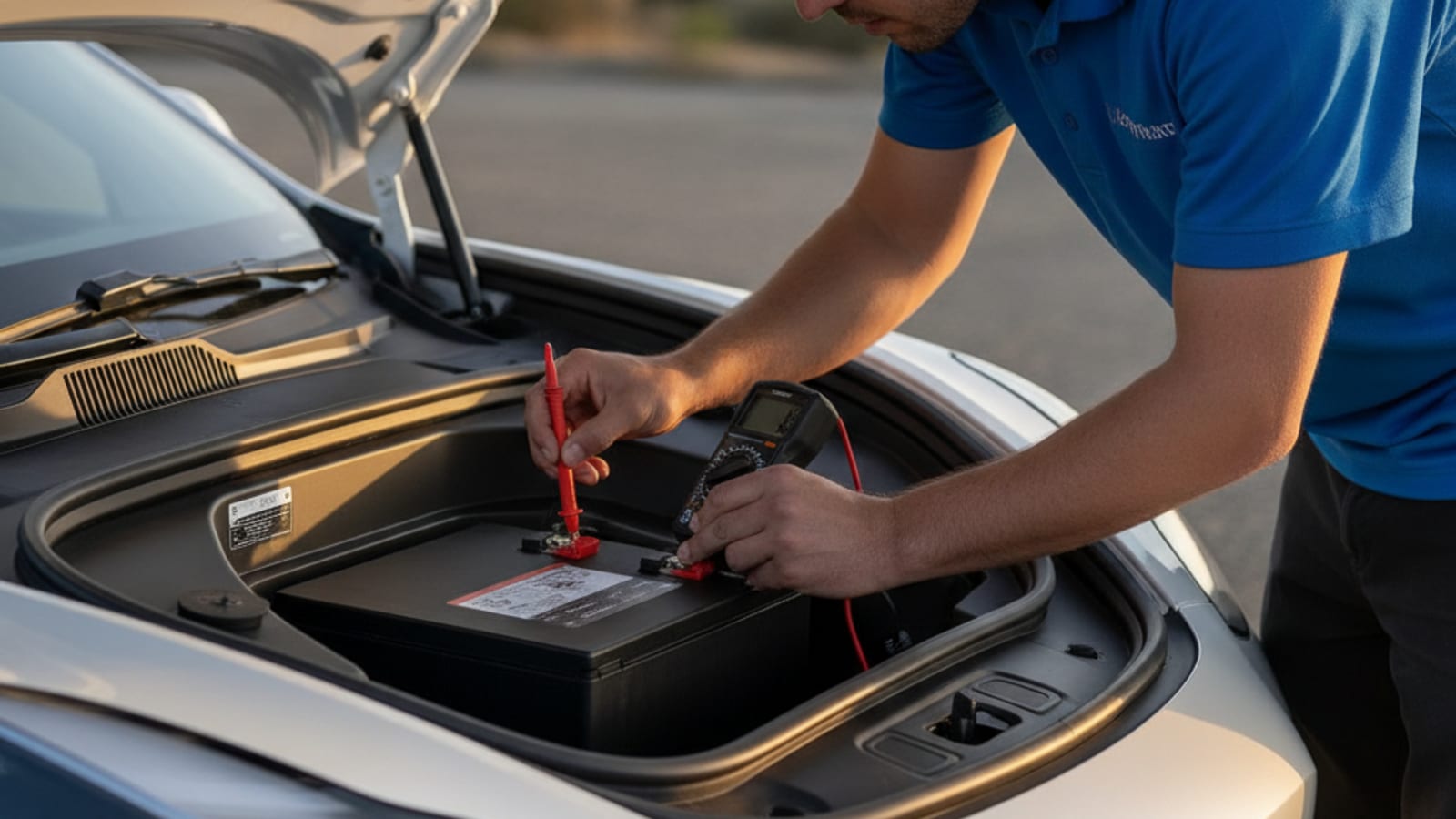
The 12V failure
A 12V failure looks like this. The dashboard stays dark. The Tesla logo doesn’t appear on the center screen. You press the brake and the start button and nothing happens. The car is awake enough to beep the key fob, but the contactors don’t close. The brake may feel stiff because the brake booster needs 12V to operate normally.
The traction pack is fine. The Tesla’s high-voltage system won’t close its contactors when the 12V can’t power the computer. The car acts bricked even though the big pack is fine.
The fix is a jump at the 12V terminals or a 12V replacement. A mobile operator handles both on site.
The traction pack failure
A traction pack failure looks different. The dashboard wakes. The Tesla logo appears. The screen reads zero percent. The car refuses to drive because the pack is empty. The 12V is fine in this case. The traction pack is the problem.
The fix is electrons at the charge port. A mobile operator brings a 240V Level 2 source. They plug in at the stall. They add 10 to 20 miles of range. The driver leaves under their own power.
How to tell which one
Look at the screen. If the screen is dark and the Tesla logo doesn’t appear, the 12V is the problem. If the screen wakes but reads zero percent and the car refuses to drive, the traction pack is the problem.
Press the brake and the start button. If nothing happens and the screen stays dark, the 12V is the problem. If the screen wakes but the car refuses to drive, the traction pack is the problem.
Check the Tesla app. If the app shows the car as offline, the 12V may be the problem. If the app shows the car as online but the screen reads zero, the traction pack is the problem.
Look at the headlights. If the headlights are off and the Tesla logo doesn’t appear, the 12V is the problem. If the headlights come on and the screen reads zero, the traction pack is the problem.
What the operator brings
We’re a referral line for Los Angeles County. We match stranded EV drivers with independent local operators. The pros we connect you with are licensed and insured. We hold no license for the work. We own no trucks and employ no technicians. We set no prices and publish no arrival time.
The operator quotes you before they start. They bill you directly. No dollar figure belongs here. They quote you on the phone and confirm access before they roll.
For a 12V failure, the operator brings a portable jump pack and a replacement 12V battery. They jump the existing battery first. If the jump wakes the car and the battery holds a charge, you drive off. If the jump wakes the car and the battery won’t hold, they replace it on site.
For a traction pack failure, the operator brings a 240V Level 2 source. Teslas take a native NACS plug. A typical session adds 10 to 20 miles of range. Charging time is usually 15 to 30 minutes, and that clock starts when the plug is in.
Why this matters in LA County
Heat ages 12V batteries faster than mild weather. LA County summers hit 90F and above. A Tesla parked on a driveway in the sun all day in August loses 12V capacity faster than the same car parked in a garage. The 12V failure is more common in LA County than in milder climates.
The traction pack failure is more common on long-distance trips, on hot days, and on routes with sustained grades. The Sepulveda Pass over the 405 chews miles the dash still treats as flat. The 101 through Cahuenga Pass does the same. Drivers who plan around those grades run short on the climb.
Tesla 12V is dead: how to tell, then how to jump it covers the 12V version in more detail. Tesla at zero on the road: charge in place or wait for a tow covers the traction pack version.
What about both at once
A Tesla that sat for a month in a garage may have both problems. The traction pack drains slowly during a long sit. The 12V drains faster. A car that sat for a month may return with a dead 12V and a low pack.
The operator handles both. They jump the 12V first. Then they plug in the 240V Level 2 source. The car wakes up and charges. The driver leaves with a working Tesla and a partial charge.
What mobile EV charging can’t fix
A crash or a bent wheel still needs a shop. So does a charge port that won’t accept power. On-site charging can’t fix that. A Tesla with a high-voltage fault is a flatbed to a Tesla Service Center. The operator quotes and confirms before they start.
The combined answer
A Tesla that won’t wake has either a dead 12V or an empty traction pack. The 12V failure shows a dark screen and a car that won’t respond. The traction pack failure shows a working screen that reads zero. The fix for the 12V is a jump. The fix for the traction pack is a charge. Both are mobile operator jobs in LA County.
The number to call is (213) 410-1991. We’ll match you with a local operator. They quote before any cable goes in.