You have a Tesla, a gas car has a dead battery, and jumper cables are nearby. Don’t connect them yet. Tesla’s Model Y manual says the vehicle cannot jump-start another vehicle, and no approved source confirms a safe donor procedure for other Tesla models.
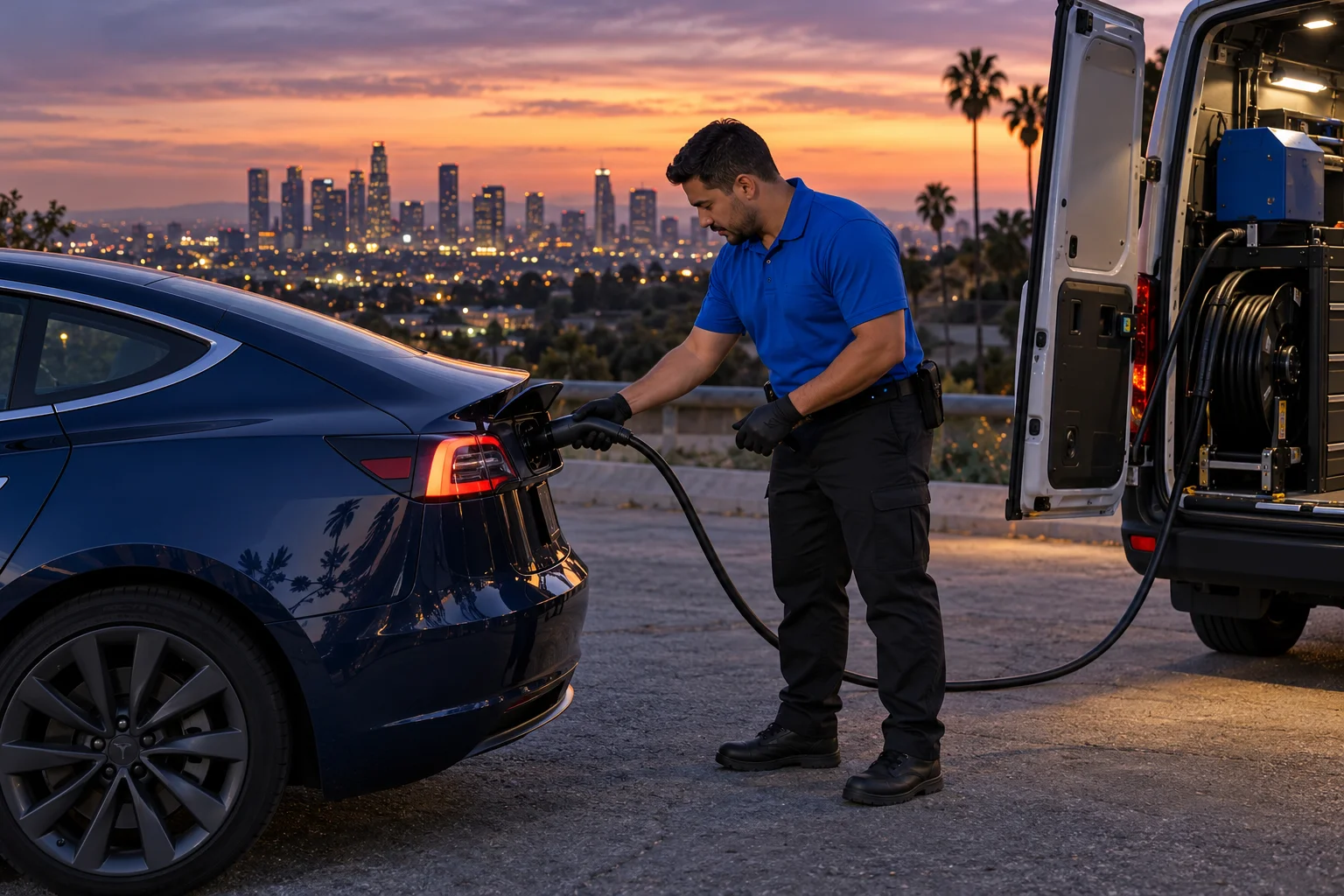
Why the Tesla 12V is the only jump source
A Tesla has a traction battery for driving and a separate low-voltage system. Drivers often call that second system the Tesla 12V battery. However, the exact battery design and voltage can vary by vehicle. Check the owner’s manual tied to your Tesla’s model and build before treating any terminal as a jump source.
The approved claims ledger contains no Tesla procedure authorizing owners to connect jumper cables to the high-voltage drive pack. If the regular low-voltage points aren’t clearly identified in your manual, stop.
There’s also a difference between receiving and providing a jump. Tesla’s Model Y instructions discuss using an external low-voltage supply, such as a portable jump starter, when the Tesla needs help. The same manual states: “Model Y cannot be used to jump start another vehicle.” Providing power to a gas car is therefore not the reverse of Tesla’s receiving procedure.
That distinction answers the search directly. If you’re asking how to jump a car with a Tesla Model Y, don’t use the Tesla as the donor. For another model, a donor procedure could not be confirmed from the approved Tesla material. Read the model-specific manual rather than transferring instructions between Model 3, Model S, Model X, and Model Y.
Our related guide gives the shorter answer to whether a Tesla can jump-start another car. This page focuses on what to do next when the gas car still needs help.
Official clamp points, and what not to touch
There isn’t one approved clamp diagram for using every Tesla as a donor car. The verified Tesla material supplied for this guide identifies no universal donor clamp points. That means we can’t responsibly publish a red-clamp and black-clamp sequence for this job.
The points used to open a powerless Tesla or support its low-voltage system aren’t automatically donor terminals. A connection point can serve a narrow purpose without being approved to crank another vehicle. Don’t treat a visible stud, cable, or chassis component as permission to connect jumper cables.
Start with the Tesla owner’s manual. Match the manual to the exact model and configuration. Find its jump-starting section and read whether the Tesla is receiving outside power or supplying it. Those are different operations. If the manual only explains how to supply power to the Tesla, don’t reverse the directions.
The gas car’s manual matters too. Its battery location and approved connection sequence come from that vehicle’s manufacturer. Charge Pro LA can’t confirm those points without the exact make, model, and manual. An operator should also inspect damaged, loose, wet, or corroded connections before attaching equipment.
No approved source in the claims ledger provides an owner procedure for using the drive battery as a jump source. A forum diagram or unlabeled video doesn’t replace the Tesla manual.
If the Tesla itself won’t unlock or wake, that’s a different problem. See our Tesla 12V battery jump service and the model-specific instructions before connecting outside power.
Portable packs versus cables from the Tesla
A portable jump pack keeps the Tesla out of the gas car’s starting circuit. That matters most with a Model Y because Tesla expressly says not to use it for jumping another vehicle. The approved material doesn’t give us a Tesla donor procedure for other models either.
Choose a pack only after checking its instructions against the gas car’s manual. We can’t publish a universal amperage, battery chemistry, or pack size because those specifications aren’t confirmed in the claims ledger. The correct equipment depends on the vehicle and the equipment manufacturer’s directions.
The practical sequence is simple:
- Leave the Tesla disconnected from the gas car.
- Confirm the gas car is in a safe place.
- Identify its approved jump points in its owner’s manual.
- Follow the portable pack manufacturer’s connection instructions.
- Stop if the battery or cables appear damaged.
- Call an operator when the instructions don’t match the vehicle.
This isn’t a substitute for either manual. It’s a way to avoid inventing a cable procedure that Tesla hasn’t approved in the material available here.
The setting also affects the decision. A Westside apartment garage may have tight clearance, concrete columns, and access rules. A San Fernando Valley driveway may offer more working space but still leave two vehicles poorly positioned. Don’t stretch cables across a traffic lane or move either car into an unsafe angle merely to make short cables reach.
If no suitable portable pack is available, request roadside help instead. Charge Pro LA connects drivers with licensed, independent local operators. The operator performs the work, quotes the service, and bills the customer directly. Charge Pro LA doesn’t set the price or promise an arrival time.
Damage risks to both cars if you get it wrong
Tesla’s stated Model Y warning is direct. Using a Model Y to jump another vehicle can result in damage. The approved Tesla material doesn’t provide a confirmed repair price, a safe donor specification, or a warranty decision for this situation. Those details must come from Tesla and the warranty supplied with the vehicle.
Cable mistakes can also leave you with two disabled vehicles instead of one. We won’t publish a universal Tesla clamp order because the necessary donor instructions aren’t verified. Wrong assumptions about model, voltage, or connection points can turn a simple dead-battery call into a diagnostic problem.
Stop before connecting anything when:
- The Tesla manual prohibits donor use.
- The manual doesn’t describe donor use at all.
- You can’t positively identify the approved connection points.
- A cable, clamp, battery case, or terminal appears damaged.
- The vehicles can’t be positioned without blocking traffic.
- The portable pack instructions conflict with the gas car’s manual.
- The Tesla is also showing a low-voltage warning.
Tesla says a vehicle that needs low-voltage battery replacement will display an alert directing the owner to schedule service. If your Tesla shows that alert, don’t ask its low-voltage system to help another car. Arrange the proper service for the Tesla.
Tesla’s service note also gives narrow limits for certain vehicles with lead-acid 12V batteries. Those details concern servicing that battery, not using the Tesla as a donor. They shouldn’t be converted into jumper-cable specifications for another vehicle.
For a fuller discussion, read the risks of jumping a gas car with a Tesla. The safest decision is the one supported by both vehicle manuals, not a procedure copied from a different Tesla model.
When a local operator should handle the jump
Call a local operator when the Tesla manual doesn’t authorize donor use. That includes Model Y, whose manual expressly says it can’t jump-start another vehicle. An operator is also the better choice when the gas car’s jump points aren’t clear or the battery area appears damaged.
Location can make a routine jump harder. Westside parking structures often leave little room to reposition two cars. Valley driveways may be easier to access, but sloped surfaces and street traffic can still complicate cable placement. Give the operator the garage level, gate instructions, vehicle models, and parking position.
A disabled vehicle on a freeway needs a different response. Metro Freeway Service Patrol provides free help on designated Los Angeles County freeway beats. Its published services include jump-starting cars and towing disabled vehicles to designated safe locations. Dial 511 and say “Motorist Aid.” Its published schedule and service area apply, so confirm current availability through Metro.
For a Tesla problem, use Tesla roadside rescue instead of experimenting with unfamiliar terminals. Charge Pro LA is a referral service. We connect drivers with licensed, independent local EV operators, but we don’t perform the jump, own the equipment, set the operator’s price, or warrant the work.
Before accepting service, ask the operator what vehicle they’ll work on. Explain that the Tesla was considered as the donor and hasn’t been connected. Share any warnings shown on the Tesla display. If the gas car has an unusual battery location, provide its exact model so the operator can bring appropriate equipment.
When to call us
Call when the Tesla can’t be used as a donor, its low-voltage system also has trouble, or the vehicles can’t be positioned safely. Charge Pro LA will refer you to an independent operator who can assess the gas car or provide local Tesla roadside help.
Call us at (213) 410-1991 and we’ll connect you with a local EV rescue operator.