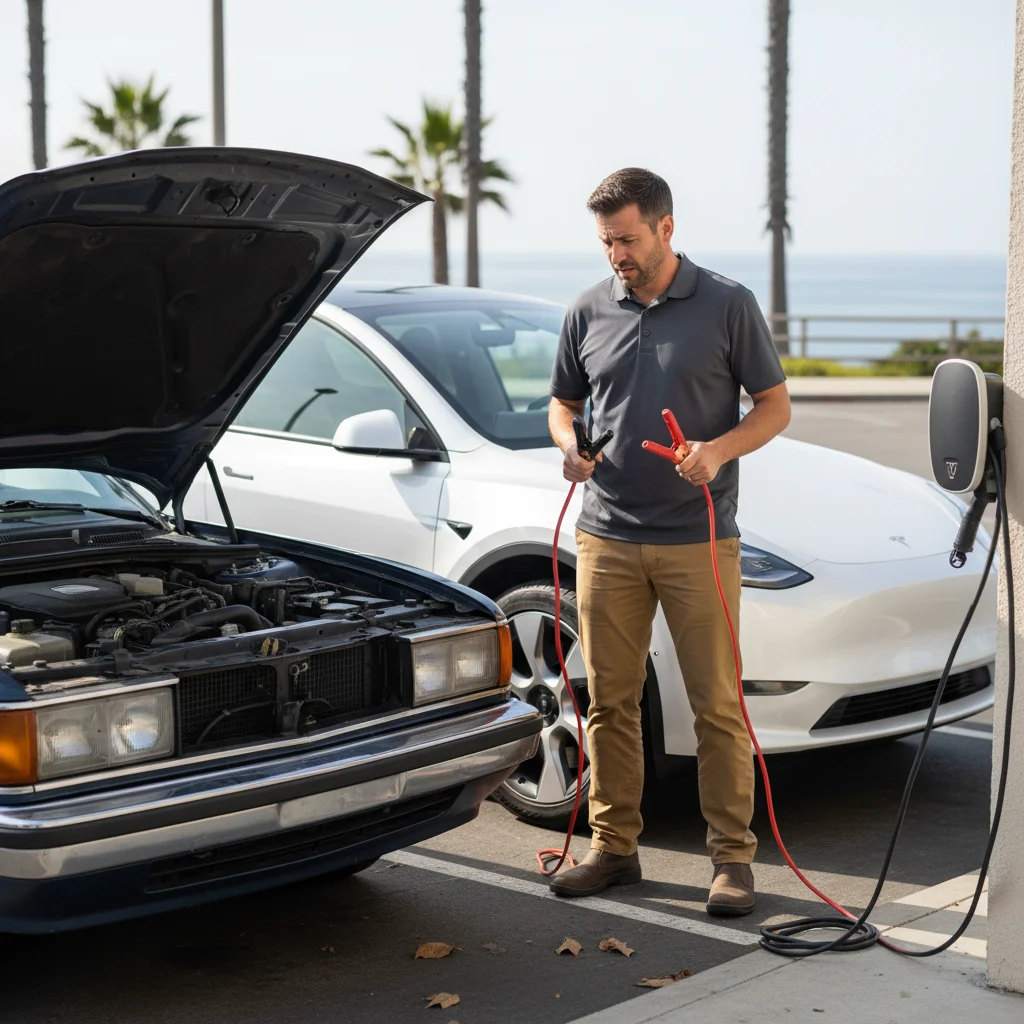
A driver at a Los Angeles County parking lot has a dead gas car and a friend with a Tesla. The first instinct is to jump the gas car from the Tesla. Don’t. The Tesla’s 12V is small, not designed for jump-starting another car, and the failure modes aren’t worth the convenience. Here’s why and what to do instead.
Why a Tesla 12V isn’t built for this
A Tesla 12V battery is sized to run the lights, the screen, the contactors, and the infotainment computer. It’s a small absorbed glass mat (AGM) or, in some newer models, a lithium-ion 12V. The capacity is roughly 30 to 50 Ah depending on the model.
A gas car’s starter draws 200 to 600 amps for a few seconds during cranking. The Tesla 12V isn’t designed to deliver that current. The voltage sag during a starter pull can drop the Tesla 12V below the threshold its own computer needs. The Tesla may refuse to wake when you reconnect the cables.
The Tesla’s 12V also doesn’t have the same protection circuits as a gas car’s 12V. A reverse polarity hookup or a short during the jump can blow fuses in the Tesla’s low-voltage distribution box. That repair is several thousand dollars at a Tesla Service Center.
The other direction is also risky
A driver who jumps the Tesla from a gas car is also taking a risk. The Tesla’s 12V management is more sensitive than a gas car’s. A gas car alternator can deliver 14 to 15 volts when running. A Tesla 12V expects a tightly regulated voltage from its DC-DC converter. A gas car alternator connected directly to the Tesla 12V can overcharge it and damage the battery management electronics.
Tesla’s manual is explicit. Don’t use the Tesla 12V to jump another car. Don’t use a gas car’s charging system to bring the Tesla 12V back up. Use a proper 12V battery charger or a portable jump pack rated for EVs.
What to do instead
If your gas car is dead in a parking lot, call for a tow or a mobile jump from a service that handles gas cars. AAA covers gas car jumps. Many tow companies do too. The dispatch is faster than the Tesla version because the gas car 12V is built for this.
If your Tesla 12V is dead and the car won’t wake, call for a mobile jump from an EV-aware operator. Tesla 12V battery dead: how to tell, then how to jump it covers the right path.
What the EV-aware operator brings
We’re a referral line for Los Angeles County. We match stranded EV drivers with independent local operators. The pros we connect you with are licensed and insured. We hold no license for the work. We own no trucks and employ no technicians. We set no prices and publish no arrival time.
The operator quotes you before they start. They bill you directly. No dollar figure belongs here. They quote you on the phone and confirm access before they roll.
For a Tesla 12V, the operator brings a portable jump pack rated for EV low-voltage systems. They connect it to the Tesla’s 12V jump points under the hood. The pack wakes the Tesla’s computer. The DC-DC converter takes over once the contactors close.
For a gas car, the operator brings standard jumper cables and a portable jump pack rated for gas car starters. Same idea, different equipment.
The NACS connector isn’t a charging port
A common confusion: a driver thinks the Tesla charge port is a place to plug in a charging cable for another car. It isn’t. The NACS connector on a Tesla is for AC or DC charging into the Tesla’s traction pack. It doesn’t output power to another car.
Tesla’s mobile connector bundle includes a 120V outlet that draws from the Tesla’s traction pack. That’s not a jump-starting outlet. It’s a slow AC outlet for appliances or another EV at a very slow rate. It doesn’t help a gas car with a dead 12V.
Some Teslas have a bidirectional charging capability through the Wall Connector. That requires a specific bidirectional setup at home. It’s not the same as a roadside jump.
What about other EVs jumping a Tesla
A driver who wants to jump a Tesla 12V from another EV’s 12V is asking the same question. The answer is the same. Most EV 12V batteries are too small to safely deliver gas-car starter current. Some EVs have a “jump start” mode in the infotainment menu that primes the 12V system. That mode doesn’t output current to another car.
The right tool is a portable jump pack rated for EV low-voltage systems. The wrong tool is another car’s 12V.
What if you have to do it anyway
If you’re in a remote area and there’s no other option, use a portable lithium jump pack designed for both gas and EV applications. Follow the polarity carefully. Connect positive first, negative last. Disconnect in reverse order. Don’t let the cables touch each other.
After the jump, drive the Tesla for at least 30 minutes to let the DC-DC converter recharge the 12V. If the 12V was drained because the battery is at end of life, replace it before the next failure.
The combined answer
Don’t jump a gas car from a Tesla 12V. The Tesla 12V isn’t built for it, the failure modes are expensive, and the right tool is a portable jump pack designed for the job. Don’t jump a Tesla from a gas car’s charging system. The Tesla 12V management is too sensitive for a raw alternator.
The number to call for a Tesla 12V jump in LA County is (213) 410-1991. We’ll match you with a local operator. They quote before any cable goes in.