A Tesla Mobile Connector for home charging can be a practical option, but only after you confirm the current equipment and electrical requirements. It also can’t solve every overnight charging failure or restore a Tesla that has already run out of usable range.
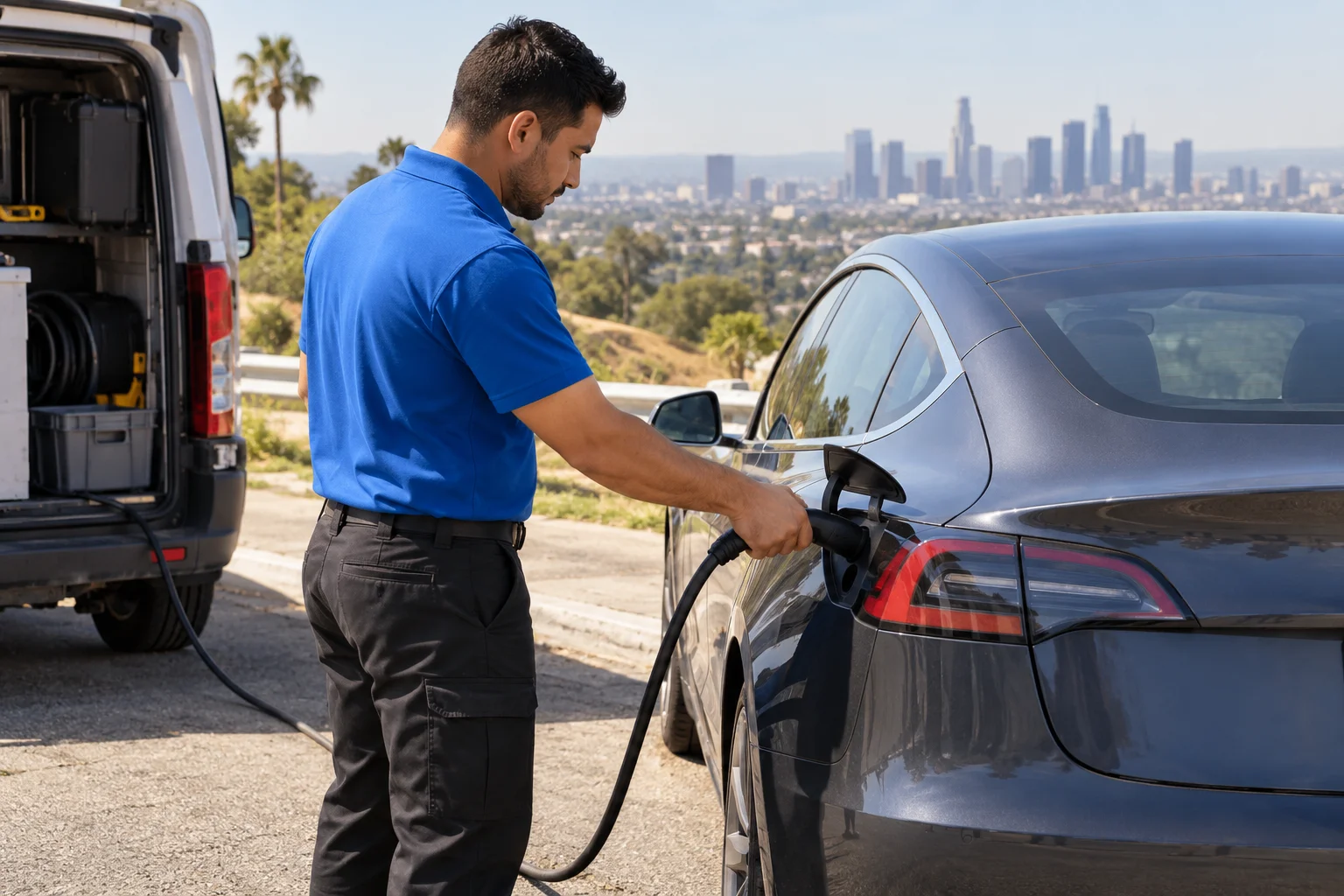
What the Tesla Mobile Connector is designed to do
Tesla’s current Mobile Connector specifications aren’t recorded in our approved claims ledger. That includes its compatible outlets, available adapters, charging rates, circuit requirements, and warnings. Check the documentation supplied with your connector and Tesla’s current manual before using it.
That verification matters because the product name alone doesn’t describe your setup. The connector, adapter, wall outlet, electrical circuit, and car must all match the manufacturer’s current instructions. A photo of another owner’s installation isn’t enough to confirm yours.
Start by identifying the exact connector and adapter you have. Then compare their markings with Tesla’s documentation for your vehicle and equipment. Don’t treat an adapter that physically fits as proof of electrical compatibility. If anything differs or remains unclear, ask a qualified electrician to inspect the outlet and circuit.
This page also doesn’t publish an expected Tesla charging rate. No Mobile Connector rate has been verified in the ledger for this article. For context, the U.S. Department of Energy reports that AC Level 2 equipment can range from 2.9 to 19.2 kW. That broad range doesn’t establish what a specific Tesla Mobile Connector will deliver at your home.
Think of the connector as one part of the charging arrangement. It isn’t evidence that an outlet is suitable. It also isn’t confirmation that the available charging time will cover tomorrow’s driving.
If you’re comparing this option with basic overnight charging, read our guide to whether a Level 1 charger is enough for LA County nights. Your normal mileage and parking window should shape that decision.
Outlet and circuit details owners must confirm
Los Angeles homes vary sharply by location and age. Census data shows that 71 percent of Los Angeles housing was built before 1980. The share reaches 86.2 percent in East Los Angeles. In newer areas, only 19.7 percent of Palmdale housing predates 1980.
Those figures don’t reveal an individual home’s wiring condition. They do explain why a setup copied from another LA County garage may not transfer safely to yours. A detached Palmdale garage and an East Los Angeles driveway can present very different questions.
Before relying on Tesla home charging, confirm the following with Tesla’s current manual and a qualified electrician:
- The exact Mobile Connector generation and adapter
- The outlet type and its condition
- Whether that outlet matches Tesla’s current instructions
- Which circuit supplies the outlet
- Whether other equipment shares that circuit
- Whether the electrical panel and circuit are suitable
- Which charging setting applies to the confirmed setup
This list is a verification checklist, not an electrical specification. The ledger doesn’t contain Tesla’s compatible-outlet list, circuit sizing, or installation rules. It also doesn’t contain Los Angeles permit requirements for this equipment. Ask the electrician and the authority responsible for the property about current requirements.
Renters and condominium residents may need property approval before changing electrical equipment. The exact approval process couldn’t be confirmed for every Los Angeles County property. Check your lease, association documents, and local requirements before arranging work.
Utility programs also depend on the property’s address. LADWP serves the City of Los Angeles and publishes a Residential EV Charger Rebate Program for a Level 2 home charger and dedicated EV meter. Southern California Edison serves most of the county outside municipal-utility cities and publishes Charge Ready Home.
Clean Power Alliance serves many LA County communities, while SCE still delivers the power there. Confirm the serving utility from your bill. Then ask that utility whether your equipment and proposed work meet its current program rules.
Why overnight charging may not restore enough range
An overnight connection doesn’t guarantee enough range for the next drive. The result depends on the energy delivered during that parking window and the amount the car needs. This article can’t assign a Tesla-specific rate because that figure isn’t verified in the claims ledger.
Start with the trip, not the connector’s product name. A short neighborhood drive places a different demand on home charging than a cross-county day. Travel from Lancaster or Palmdale can also create a different margin than local driving in Santa Monica or Culver City.
Your dashboard and Tesla app can show what happened during a specific session. Record the starting range, ending range, connection time, and any message displayed. Those observations give Tesla support or an electrician a clearer starting point. They also help separate a slow session from one that never began.
If the car gained some range but not enough, don’t immediately label the connector defective. First compare the session with Tesla’s current documentation and your confirmed electrical setup. A qualified electrician can address outlet or circuit questions. Tesla can address vehicle or charging-equipment messages.
If the car gained nothing, preserve the exact warning text. Note whether charging ever appeared to start. Don’t repeatedly clear messages or change several settings before recording them. Changing many variables at once makes the original failure harder to describe.
Our guide to why an EV didn’t charge overnight offers a broader symptom checklist. It doesn’t replace Tesla’s instructions or an electrical inspection.
Plan around usable range rather than assuming one night will erase every deficit. If tomorrow’s route exceeds what the confirmed setup can restore, consider a verified charging alternative before the battery becomes too low to reach it.
Home charging trouble versus an empty drive pack
A Tesla that didn’t charge overnight isn’t automatically out of energy. Likewise, a car that won’t wake doesn’t prove the high-voltage drive pack is empty. These situations can look similar from outside, but the next call may differ.
Begin with what you can directly observe. Does the screen wake? Does the app connect? Is usable range displayed? Is there a charging message, low-voltage warning, or other alert? Record the exact wording rather than translating it into a diagnosis.
Tesla states that when the low-voltage battery needs replacement, the vehicle alerts the owner on the touchscreen to schedule service. That doesn’t mean every unresponsive Tesla has a low-voltage battery problem. It means a saved alert can help Tesla or a qualified operator understand the condition.
If the car works normally but rejects home charging, the issue may belong with Tesla support or a qualified electrician. Which one should go first depends on the message and the verified condition of the outlet, circuit, connector, and vehicle. Don’t ask a roadside charging operator to diagnose residential wiring.
If the car shows no usable range and can’t reach another charging option, the immediate problem is mobility. Out-of-charge EV recovery may be the appropriate path. The matched operator can assess whether mobile charging fits the location or whether another recovery method is needed.
Location matters across Los Angeles County. A Tesla sitting in a private driveway presents a different access problem than one stopped on a freeway. If the vehicle is disabled on a designated LA County freeway beat, Metro Freeway Service Patrol is free. Its published assistance list doesn’t include mobile EV charging.
California Vehicle Code 21718 prohibits stopping on a freeway, with an exception for a disabled vehicle when help has been summoned. Treat a freeway stop as a roadside safety event, not a home-charging experiment.
When a mobile charging operator is the next call
Mobile charging becomes relevant when the Tesla has too little usable range to move and the location allows an operator to work. It isn’t a substitute for repairing a questionable outlet, evaluating a circuit, or resolving a recurring vehicle fault.
Charge Pro LA is a referral service. We connect drivers with licensed, independent local EV charging professionals. The customer contracts with and pays the matched operator directly. We don’t perform charging, electrical work, towing, or vehicle repairs.
When requesting mobile EV charging, share facts the operator can use:
- Your Tesla model
- The displayed usable range
- The exact location and access instructions
- Whether the car is in a garage, driveway, lot, or roadway
- Any charging or low-voltage messages
- Whether the vehicle can wake, unlock, or shift
- What happened during the failed home session
Don’t promise yourself that an on-site charge will resolve the underlying fault. A typical rescue charge can provide 10 to 20 miles of range during 15 to 30 minutes of Level 2 charging. That is charging time, not an arrival estimate. The actual recovery decision belongs to the independent operator after reviewing the situation.
If usable range remains but home charging failed, another verified charging option may be more appropriate. If the car can’t accept a charge, a different recovery path may be necessary. Tell the operator exactly what the vehicle displays and avoid guessing at the cause.
After the immediate recovery, address the home setup separately. Compare the connector and adapter against Tesla’s current documentation. Have a qualified electrician confirm the outlet and circuit. A repeated failure deserves a documented diagnosis, not another uncertain overnight attempt.
When to call us
Call when your Tesla remains stranded after a failed home charging session and can’t reach another charging option. Charge Pro LA can connect you with an independent operator who will assess whether mobile charging fits the situation.
Call us at (213) 410-1991 and we’ll connect you with a local EV rescue operator.