Most Bellflower drivers don’t plug in at home. About 71.6% of the city’s housing went up before 1980, packed into a dense Gateway Cities grid. A dedicated 240-volt circuit is rare on those lots. EV roadside assistance in Bellflower is the backup when a public stall is full, down, or not where you actually stopped.
Why Bellflower EV owners live on public charging
Bellflower covers a little more than six square miles. The Census ACS count is 77,396 people. Downtown Bellflower and Somerset grew as tight postwar blocks. Garages are small, street parking is common, and shared driveways show up on a lot of these streets.
Southern California Edison delivers power here. That still doesn’t put a Level 2 plug in every driveway. Older panels and alley access both block a home install. So most owners already plan the day around a public stall. When the day runs long, that plan breaks.
Neighboring Lakewood is older still, with 88.8% of its housing built before 1980. Norwalk sits at 84.3%. Bellflower’s 71.6% is the same Gateway story at a slightly lower share. None of these streets were wired for home charging when they were laid out.
For the panel problem itself, read old electrical panel, no home charger.
Heat, crawl, and the range you thought you had
Inland Basin summers run hot and dry. Air-conditioning on a 90-degree-plus day is a real range drain. So is crawl on the 605 and the 91. Winters are mild, so cabin heat isn’t the main hit. The hit is summer AC plus stop-and-go on the ramps.
You leave a stall with a buffer. Then Alondra Blvd traffic eats it. Or you add a stop on Bellflower Blvd and the estimate drops. The car wasn’t wrong. The trip changed.
Stalling on the 605 or the 91
The 605 and SR-91 frame the city’s east and south edges. Through-commuters stall there more than on residential streets. Residents heading toward Downey, Compton, South Gate, or Lakewood use the same ramps.
If the pack hits zero on the freeway, get to the shoulder and turn on the hazards. Stay in the vehicle if lanes are close. California Vehicle Code 21718 bans stopping on a freeway. A disabled car that has already called for help is an exception. CVC 21809 is the move-over rule. Other drivers must change lanes or slow for a stopped vehicle with flashing lights.
Don’t count on Metro Freeway Service Patrol to charge you. FSP is free, and it roams congested LA County freeways. Peak coverage is typically weekday commute hours, with more hours on the busiest corridors. It can change a tire, offer a gallon of gas, or tow you to a CHP-chosen safe spot. Its published list doesn’t include mobile EV charging. An empty pack is outside that program, other than the free tow off the lanes. Dial 511 and say Motorist Aid if you need that tow. Call a mobile operator if the car needs energy at the port.
Downtown, Somerset, and the boulevard grid
Bellflower Blvd is the spine through downtown. Alondra Blvd and Artesia Blvd cut east-west through the same older grid. Downtown lots fill on weeknights. Somerset streets are residential and tight. The 605/91 district is where freeway noise and surface streets mix.
If you stall in a lot, stay there. Don’t try to limp onto the 91 with a single-digit percentage. A parking stall is safer than the freeway shoulder.
Empty pack or a dead 12-volt
Two failures look the same from outside. The car won’t wake and the screens stay dark. Door handles may not work the way they did this morning.
An empty traction pack needs energy at the charge port. A dead 12-volt is a different job. That small battery runs the computers and the switches that let the car wake. Jump or replace it on site and the car may start. The big pack can still have range.
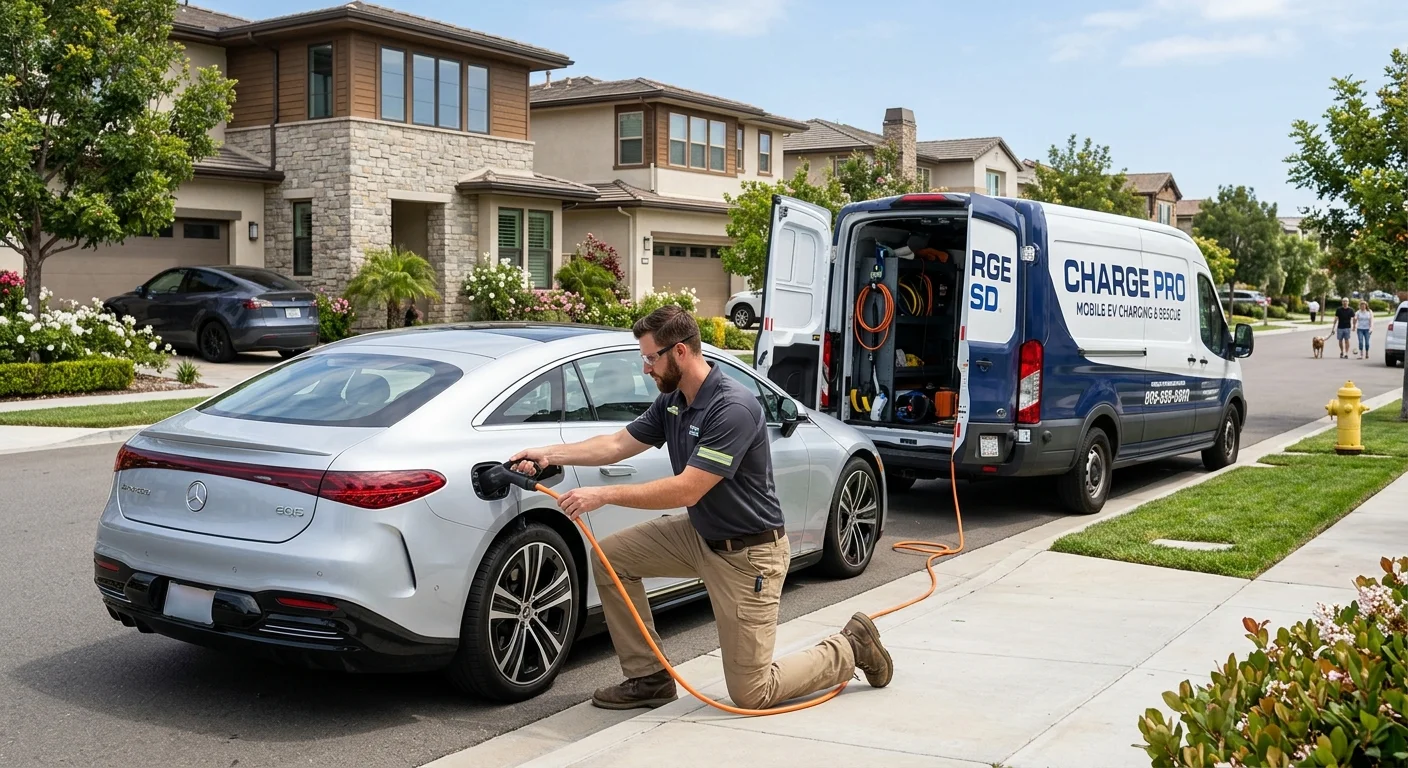
Operators in this network handle both. They bring a 240-volt Level 2 source. Tesla gets a native NACS plug. Non-Tesla EVs use a CCS or J1772 adapter. They also jump or replace a failed 12V on site.
Tell the dispatcher which warning you saw. A falling range number points at the pack. A sudden brick after a parked afternoon often points at the 12V. Heat in a closed cabin is hard on that small battery. Don’t let a passerby clamp jumper cables onto unknown posts under the hood. Tesla and most EVs hide the 12V jump points. The high-voltage pack isn’t a jump-start target. If you don’t know the post, wait for the operator.
What mobile charging does, and what it does not
Mobile EV charging brings the charger to the car. It’s not a Supercharger on a truck. The operator quotes you before any cable goes in. Then that operator bills you directly.
Charge Pro LA is a referral line. It matches you with an independent local operator. It doesn’t own trucks and employs no technicians. It sets no prices and publishes no arrival time.
Once the cable is on, a typical session adds about 10 to 20 miles. That usually takes 15 to 30 minutes of charging. Those minutes are charging time, not a clock on the dispatch. The goal is enough range to reach a working public stall or a home outlet you already have.
Out-of-charge recovery is the same idea when the pack is already at zero. Tesla, Hyundai, Kia, Ford, Chevy, Rivian, and other major brands are in scope. The plug has to match, so make and model matter on the call.
Tow only after the car can’t take a charge
A tow is the last clean option. Many EVs can’t roll on their drive wheels. That means a flatbed, then a second wait at a charger. On the 605/91 district that can mean sitting in heat while the hook is arranged.
If you’ve called for help, you already fit the disabled-vehicle exception. Leaving the car unattended on a freeway for hours is how CVC 22651 removals start. Stay with it if you can do that safely.
For the longer case against a first-call tow, read why towing a dead EV in Los Angeles County is the last call.
How to call this in
Get out of the live lane and turn on the hazards. If you’re in a lot off Bellflower Blvd, stay put. Give a cross street, a ramp, or a downtown name when you call. Add the make, the model, and whether the car still unlocks. That tells the operator if this is a Level 2 boost or a 12V job.
Local background lives on the Bellflower EV charging page. The housing pattern is shared with Lakewood, Norwalk, and Downey. The freeways are shared too.
Call (213) 410-1991 and we’ll connect you with a local operator. That operator quotes before starting and bills you directly.