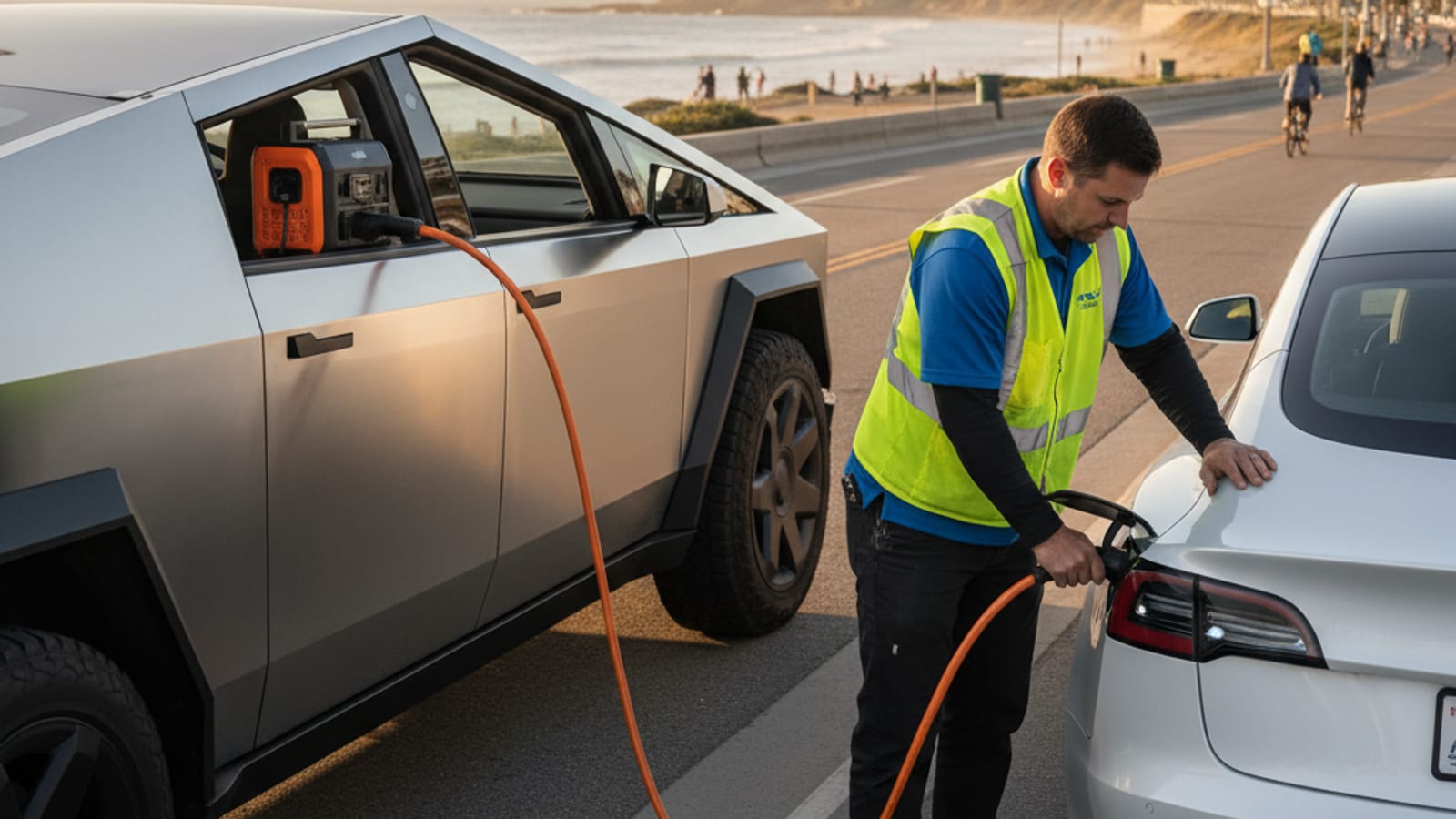
A Topanga canyon driver who runs low on PCH or on Topanga Canyon Boulevard doesn’t get a gas station at the next light. They get grade, switchbacks, and a long walk out. That’s when EV roadside assistance in Topanga matters. A local operator brings 240-volt Level 2 to where the car sits.
Topanga is canyon country
Topanga sits between the Santa Monica Mountains and Pacific Coast Highway. Topanga Canyon Boulevard climbs from the beach up through the state park. The grade on the canyon side is sustained. A driver who climbs it at 65 mph on a hot day can lose 20 percent or more of the rated range.
The Pacific Coast Highway stretch through Topanga State Beach adds its own drain. Stop-and-go beach traffic, summer crowds, and a narrow shoulder make a stall here a serious problem. There’s no place to pull off in many of those sections. Drivers who misjudge the climb up from PCH find out at the top.
The community itself sits on narrow, winding roads. Driveways climb short, steep pitches. Cars that park for a week while owners travel wake up to a dead 12V more than drivers expect. Heat on those grades wears batteries faster than a flat neighborhood lot.
What the operator brings
We’re a referral line for Los Angeles County. We match stranded EV drivers with independent local operators. The pros we connect you with are licensed and insured. We hold no license for the work. We own no trucks and employ no technicians. We set no prices and publish no arrival time.
The operator quotes you before they start. They bill you directly. No dollar figure belongs here. They quote you on the phone and confirm access before they roll.
What they bring is a 240-volt Level 2 source to the car. Teslas take a native NACS plug. Other EVs use a CCS or J1772 adapter. A typical session adds 10 to 20 miles of range. Charging time is usually 15 to 30 minutes, and that clock starts when the plug is in. It isn’t a clock for when the truck shows up.
That boost is enough to clear the canyon and reach a charger in Malibu or on the Westside. It’s the job mobile EV charging is built for.
Operators also jump or replace a dead 12-volt battery on site. That covers Tesla and every major EV brand. After a week on a Topanga driveway, that’s often the whole problem.
PCH has its own version of this
PCH through Malibu and Topanga State Beach is regular stranding territory. Beach parking lots along the bluffs fill on summer weekends. A driver who plans the day around one stall finds that stall occupied or out of service. The next one is miles away, on the wrong side of the canyon.
Stalled on PCH in Malibu walks through that corridor in more detail. The same operator network that covers Malibu covers Topanga. The dispatch is the same call.
Two different dead cars, two different calls
The empty-pack version shows up after a canyon climb or a long beach day. The driver sees the dash dropping, finds a turnout, and calls for a charge. The traction pack is at zero, but the 12V still works. The screen still wakes. The operator plugs in and adds 10 to 20 miles.
The 12V version shows up after a long sit. The car won’t unlock. The screen is dark. The operator jumps the 12V at the stall or replaces it on site. The traction pack still has whatever range it had before the car parked.
A canyon car that sat in the sun all week is more often the second version. Heat sits in Topanga driveways longer than it does on the coast. The 12V quits first.
AAA versus a mobile operator on a canyon call
AAA covers tows, and their dispatch is broad. An EV that needs electrons, not a flatbed, doesn’t get that from a tow truck. The tow moves the car to a charger the driver could have driven to in 20 miles. The mobile operator moves electrons to the car.
AAA or a mobile charge: what actually gets an empty EV moving covers the side-by-side. On a canyon call, the answer leans toward the operator. The canyon adds miles the tow charges for, and the car still needs a charge at the other end.
Stay with the car on a canyon shoulder
PCH and Topanga Canyon Boulevard have narrow shoulders and blind curves. California Vehicle Code 21809 is the move-over law. Other drivers must change lanes or slow when a service vehicle has lights on. Stay with the car if you can do so off the travel lane. If the shoulder is too narrow, get out on the uphill side and stay visible.
Pull as far right as you can and set hazards. Stay clear of traffic while you make the call. We’ll confirm your position on the canyon or on PCH and match a local operator.
Metro Freeway Service Patrol doesn’t reach Topanga
On a Los Angeles County freeway, Metro Freeway Service Patrol is one free option. Dial 511 and say Motorist Aid. FSP’s published list is a gallon of gas, a radiator refill, and a tire change. It also tows a disabled car to a safe CHP-chosen spot, free.
FSP runs on freeways. Topanga Canyon Boulevard is a state route, not a freeway, and PCH is a state route too. FSP won’t reach a stalled canyon car. The operator network does.
When a tow is still the honest answer
A crash or a bent wheel still needs a shop. So does a charge port that won’t accept power. On-site charging can’t fix that. If CHP is already there, take the safe tow. Private garages can remove a car under CVC 22658 when the posted rules are met.
City of Los Angeles impound rules apply when a car ends up at an Official Police Garage. Release steps and fees weren’t confirmed for this page. Check lapdonline.org before you assume a process.
Make the call without waiting it out
If AAA is sending a tow you don’t want, say so and switch. If they’re sending a 12-volt jump and that’s the diagnosis, let them try. If the pack is at zero, ask for out-of-charge recovery instead of another wait.
The number to call is (213) 410-1991. We’ll match you with a local operator. They quote before any cable goes in.