A West Hollywood EV driver who runs out on Santa Monica Boulevard or the Sunset Strip doesn’t get a garage with a charger at the curb. They get a tight street and a long walk home. That’s when EV roadside assistance in West Hollywood matters. A local operator brings 240-volt Level 2 to where the car sits.
West Hollywood runs on street parking
The city of West Hollywood is one square mile. There are almost no private garages. Most residents park on the street along Santa Monica Boulevard, Sunset Boulevard, or one of the residential side streets. Census ACS data puts 80.5 percent of West Hollywood housing before 1980. The housing stock is older rentals and small condos, not new construction with chargers.
Drivers charge at public stalls on Santa Monica, at the West Hollywood Park garage, or at workplace chargers in the office buildings off Sunset and Beverly. Stretch a charge between those sessions and a missed stall becomes a curb stall.
The Sunset Strip climbs slightly through the city. Santa Monica Boulevard runs flat. The 101 and the 10 sit just outside the city limits. Late-night crawl from the bars and clubs leaves cars sitting on the curb all night. The 12V often doesn’t survive that sit.
What the operator brings
We’re a referral line for Los Angeles County. We match stranded EV drivers with independent local operators. The pros we connect you with are licensed and insured. We hold no license for the work. We own no trucks and employ no technicians. We set no prices and publish no arrival time.
The operator quotes you before they start. They bill you directly. No dollar figure belongs here. They quote you on the phone and confirm access before they roll.
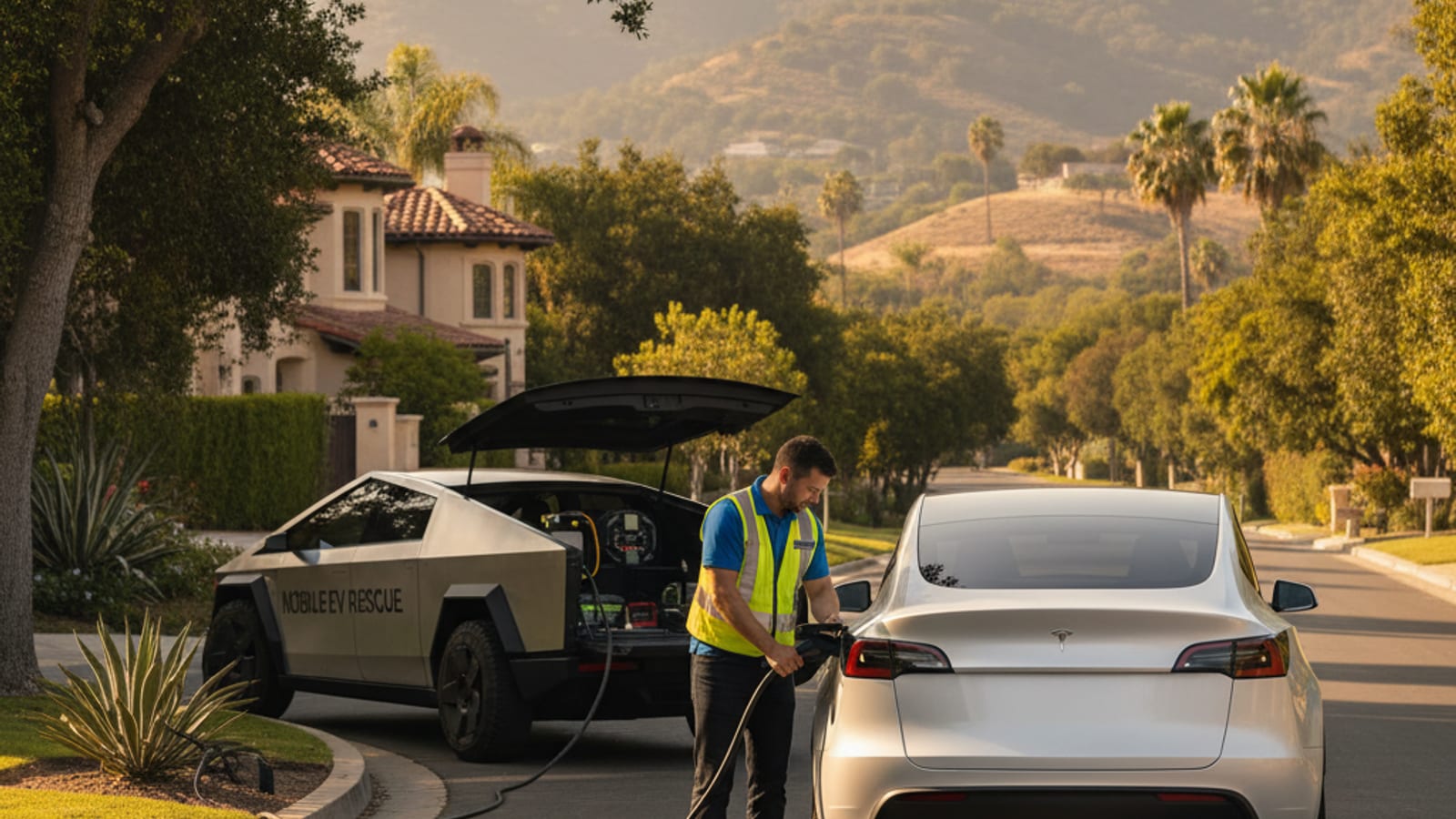
What they bring is a 240-volt Level 2 source to the car. Teslas take a native NACS plug. Other EVs use a CCS or J1772 adapter. A typical session adds 10 to 20 miles of range. Charging time is usually 15 to 30 minutes, and that clock starts when the plug is in. It isn’t a clock for when the truck shows up.
That boost is enough to reach a Supercharger on Sunset or a workplace stall the next morning. It’s the job mobile EV charging is built for.
Operators also jump or replace a dead 12-volt battery on site. That covers Tesla and every major EV brand. After a Saturday night on the Strip, that’s often the whole problem.
Two different dead cars, two different calls
The empty-pack version shows up after a missed stall on Santa Monica or a hot day on Sunset. The driver sees the dash dropping, finds a legal spot, and calls for a charge. The traction pack is at zero, but the 12V still works. The screen still wakes. The operator plugs in and adds 10 to 20 miles.
The 12V version shows up after a late-night sit. The car won’t unlock. The screen is dark. The operator jumps the 12V at the curb or replaces it on site. The traction pack still has whatever range it had before the car parked.
Strip cars that sat through a Friday night out are more often the second version. A Tesla that parked at 11 PM and tries to leave at noon the next day won’t always wake. The fix is a jump or a 12V swap.
The same pattern applies across the broader Westside and Beaches region. Beverly Hills, Santa Monica, and Culver City renters hit the same wall.
AAA versus a mobile operator on a street call
AAA covers tows, lockouts, and tire changes. Their dispatch is broad. An EV that needs electrons, not a flatbed, doesn’t get that from a tow truck. The tow moves the car to a charger the driver could have driven to in 20 miles. The mobile operator moves electrons to the car.
AAA or a mobile charge: what actually gets an empty EV moving covers the side-by-side. On a West Hollywood street call, the answer leans toward the operator. The car doesn’t need to move. It needs power at the curb.
Curb calls and the parking rules
West Hollywood parking enforcement runs during posted hours. A dead EV on a red curb is a tow risk. A dead EV in a green-striped space or a metered spot with time still on it is a different story. Move the car to a legal spot if you can do it safely. If you can’t, stay with it and call for help.
California Vehicle Code 22500 covers curbside stopping. CVC 22658 covers private garage removal of a vehicle. Check the curb color before you leave the car.
When a tow is still the honest answer
A crash or a bent wheel still needs a shop. So does a charge port that won’t accept power. On-site charging can’t fix that. If CHP is already there, take the safe tow. The dispatch for a shop visit is different from the dispatch for a charge.
The strip’s overnight crowds can also turn a disabled car into a hazard. Don’t leave a dead EV on the Strip at 2 AM. Call while you can stay with it.
Make the call without waiting it out
If AAA is sending a tow you don’t want, say so and switch. If they’re sending a 12-volt jump and that’s the diagnosis, let them try. If the pack is at zero, ask for out-of-charge recovery instead of another wait.
The number to call is (213) 410-1991. We’ll match you with a local operator. They quote before any cable goes in.