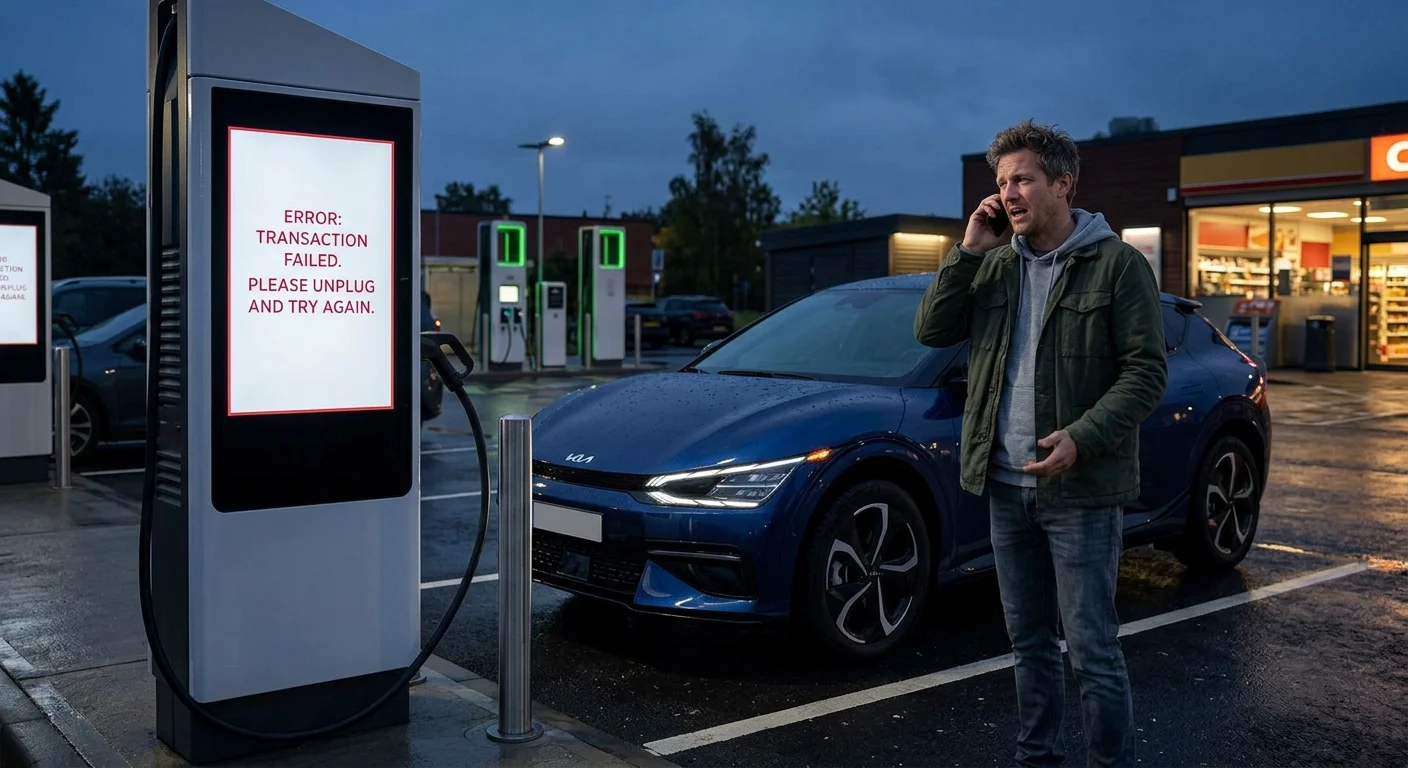
The Kia EV6 won’t take a charge at a public stall in Los Angeles County. Shared renter lots see the same dead session. Plenty of owners here rent. Plenty of the housing went up before 1980. When the plug never wakes the car, you’re parked. Next you sort the stall, the 12-volt battery, or a mobile Level 2 boost.
Why a failed stall strands renters first
East Los Angeles still has 86.2% of its housing from before 1980. Whittier sits at 88.9%. Culver City is 85.5%, and West Hollywood is 80.5%. Long Beach is 79.6%. Those buildings were wired for ovens and window units, not a dedicated 240-volt EV circuit. If you rent, you usually can’t add a wall charger even when you want one.
So the EV6 lives on public stalls, workplace plugs, and whatever the apartment lot already has. One failed session is not a small delay. It’s the gap between leaving and waiting. That’s the local pattern. A Kia EV6 that won’t charge becomes a roadside problem faster here. A house with a wall unit has a fallback. A renter without a wall unit has no private fallback.
The City of Los Angeles runs on LADWP power. Most of the rest of the county is Southern California Edison territory. Santa Monica, West Hollywood, Culver City, and Redondo Beach buy generation through Clean Power Alliance. SCE still delivers the power and reads the meter. None of that explains a dark stall. It only matters later if you chase a home charger rebate from LADWP or SCE.
Treat the stall as guilty until it isn’t
Seat the CCS handle until it clicks and stays. A connector that looks locked can still sit a few millimeters short. Press it in once more, then wait for the car to start charging. If the port door fights you, stop pulling. A stuck latch is a different job, and forcing it can break the door. Look at the pins before you force anything. Moisture in the port can block a session. Dry it, then plug in again.
Read the station screen before you blame the EV6. A dark panel, a frozen payment wheel, or a fault code is the stall talking. Try the next stall on the same island if it’s open. If that one also refuses, move to another site while you still have range. One dead unit is common. Two in a row still happens. A downtown Los Angeles garage stall can fail the same way a South Bay mall stall fails. The checks don’t change. See public EV charger not working for the stall-side path.
If the screen says connected and the percent never moves, the car and the stall never agreed to start. Apps lie. The cable can report a lock and never pass current. Public charger connected but not charging covers that exact stall.
Don’t debug from a travel lane. On a freeway, California Vehicle Code 21718 lets a disabled vehicle stay put once you’ve called for help. Other drivers must move over or slow under CVC 21809 when a service vehicle has lights on. Hazards on. People out of the lanes.
Rule out a setting before you blame the pack
Open the EV6 screen and find the charge schedule. A timer you set in January will sit there and refuse a noon session. Same with a charge cap left at 80% when the pack is already there. Clear the schedule. Raise the limit. Plug in again.
If this is a home Level 2 on the wall, walk to the panel. Breakers for EV circuits trip more than people expect, especially in older Culver City and West Hollywood buildings. Flip that breaker fully off, then back on. Confirm the wall unit has lights before you unplug and reseat the cable.
A scheduled home charge is not the same problem as a public stall that never woke. Sort which lot you’re standing in before you start swapping handles. A workplace stall in Burbank or Glendale fails the same way. The car doesn’t care who owns the charger.
Heat can pause a session on purpose
Los Angeles County is not one climate. The coast around Santa Monica and Redondo Beach runs cooler. The San Fernando and San Gabriel Valleys run hotter. Lancaster and Palmdale in the Antelope Valley take the hardest heat and the coldest nights. Recurrent Auto’s published work shows summer heat and heavy air-conditioning cut real range. Cold cuts it further. The EV6 battery management can slow or stop a charge to protect the pack.
That pause looks like a failure. It often isn’t. Give the car a few minutes if you can park in shade. Don’t keep starting and canceling the session. If the dash shows a temperature warning, believe it.
Grades make leftover range worse. Sepulveda Pass on the 405 is the Westside-to-Valley climb. The Grapevine north of Castaic is a long sustained grade. A session that stopped at a random percent on a hot afternoon can leave you short of where you meant to go. That’s when a failed public charge becomes a shoulder problem.
The 12V that pretends the EV6 is empty
The drive pack can be half full and the car still won’t charge. The EV6 uses a separate 12-volt battery to wake the computers that talk to the charger. If that 12V is low, the car never talks to the stall. The stall looks dead. The pack is fine.
Watch for a dark or flickering screen, slow door unlocks, or a charge port that never opens. A Check EV System lamp after a failed plug-in is another hint. What happens when an EV 12V battery dies explains why the car acts like a brick.
You can jump the 12V the way you’d jump a gas car. Use a pack or another vehicle. Read the EV6 manual for the jump points before you clip on. The 12V is not always where a gas Kia puts it. If the car wakes and then takes a charge, the 12V was the problem. Plan on replacing it. A jump is a wake-up, not a repair. Can roadside assistance jump-start an EV, or only the 12V? is the short version of that limit.
The same pattern shows up after a trip. LAX terminal structures P1 through P7 offer Level 2 and DC fast charging. The Economy Parking garage has 514 active EV chargers. You can still come back to a car that won’t wake. A week of drain on the 12V kills it even when the pack still has range. Chargers in the garage do not protect a dead 12V.
Read the dash before you reset anything
A charging fault, a battery lamp, or Service EV System is the car filing a report. Open the owner’s manual and match the lamp. Don’t clear a warning you haven’t read.
Some codes sit in the computer and never print in plain English. An OBD-II reader can pull them, and some parts stores will read them. A stored code is a clue, not a repair. Clearing it without fixing the cause just brings the same stall next time.
Persistent lamps after a new stall, a new cable, and a 12V jump mean stop DIY. High-voltage work is not a parking-lot job.
Reset the 12V only if you’re comfortable
A software glitch can block charging. Cutting 12V power and waiting lets the modules reboot. It’s the same idea as restarting a phone. It’s not magic, and it’s not your first move.
Park on level ground. Set the parking brake. Power the car fully off. Find the 12V in the manual, not from a forum photo. Loosen the negative clamp first, the one with the minus mark. Lift the cable off the post. You can lift the positive too if you want extra isolation.
Wait five to ten minutes. Capacitors need that time to drain. You may hear faint clicks. That’s leftover power leaving, not a new failure. Reconnect positive first if you took it off, then negative. Snug the clamps. Close everything. Start the car. Try the charger again.
If you don’t want to pull cables, skip this step. A botched 12V disconnect can leave you with a car that still won’t wake. Call for help instead.
Metro Freeway Service Patrol will not charge the EV6
If you stalled on a congested LA County freeway, Metro Freeway Service Patrol is free. Caltrans, CHP, and LA Metro run it. Dial 511 and say Motorist Aid. Their published help list is a gallon of gas, a radiator refill, and a taped hose. They’ll also change a tire and tow you to a CHP-chosen safe spot. It does not list mobile EV charging or an out-of-charge pack boost.
An empty EV6 on the 10, the 110, or the 405 can get a tow off the lanes. It will not get a Level 2 session from FSP. Plan on a separate call for that. Metro ExpressLanes on the I-10 and I-110 need a FasTrak account. Don’t sit in an express lane debugging a charger.
When the checks fail, bring the charge to the car
If the stall is dead, try the next one. If the 12V jump did nothing and the dash still complains, the charge has to come to you. Charge Pro LA is a referral line. We match you with independent local operators. We don’t own the trucks, and we don’t set the price. The operator quotes you before work starts and bills you directly.
Those operators bring a 240-volt Level 2 source to the EV6. For a Kia they use a CCS or J1772 adapter. A typical session adds about 10 to 20 miles of range in 15 to 30 minutes of charging time. That’s time on the plug, not a promise of when someone arrives. They can also jump or replace a dead 12V on site. Non-Tesla EV rescue is the path for the EV6. Mobile EV charging is the Level 2 boost itself.
Have the basics ready when you call. Say where you’re sitting, whether the dash still lights, and whether a second stall already failed. That’s often enough to reach a working public stall or a home plug, including in West Hollywood renter lots. If the 12V is the real failure, get moving, then get the battery replaced. Repeated jumps mean the 12V is done.
If these checks did not start a charge, call (213) 410-1991. We’ll connect you with a local operator who can quote an on-site boost or a 12V jump.