A mobile EV charger for roadside use is not the suitcase brick in your trunk. On the 405 through Sepulveda Pass, a portable unit still needs a wall outlet. The same is true on PCH in Malibu and on the Grapevine north of Castaic. A freeway shoulder doesn’t have one. Charge Pro LA is a referral line. We match stranded EV drivers with independent local operators. Those operators bring a 240-volt Level 2 source to the car.
That’s the distinction this page exists to make. Owners search this phrase after a near-stall. They want to know whether to buy a portable unit. They also want to know who to call for a boost where they sit.
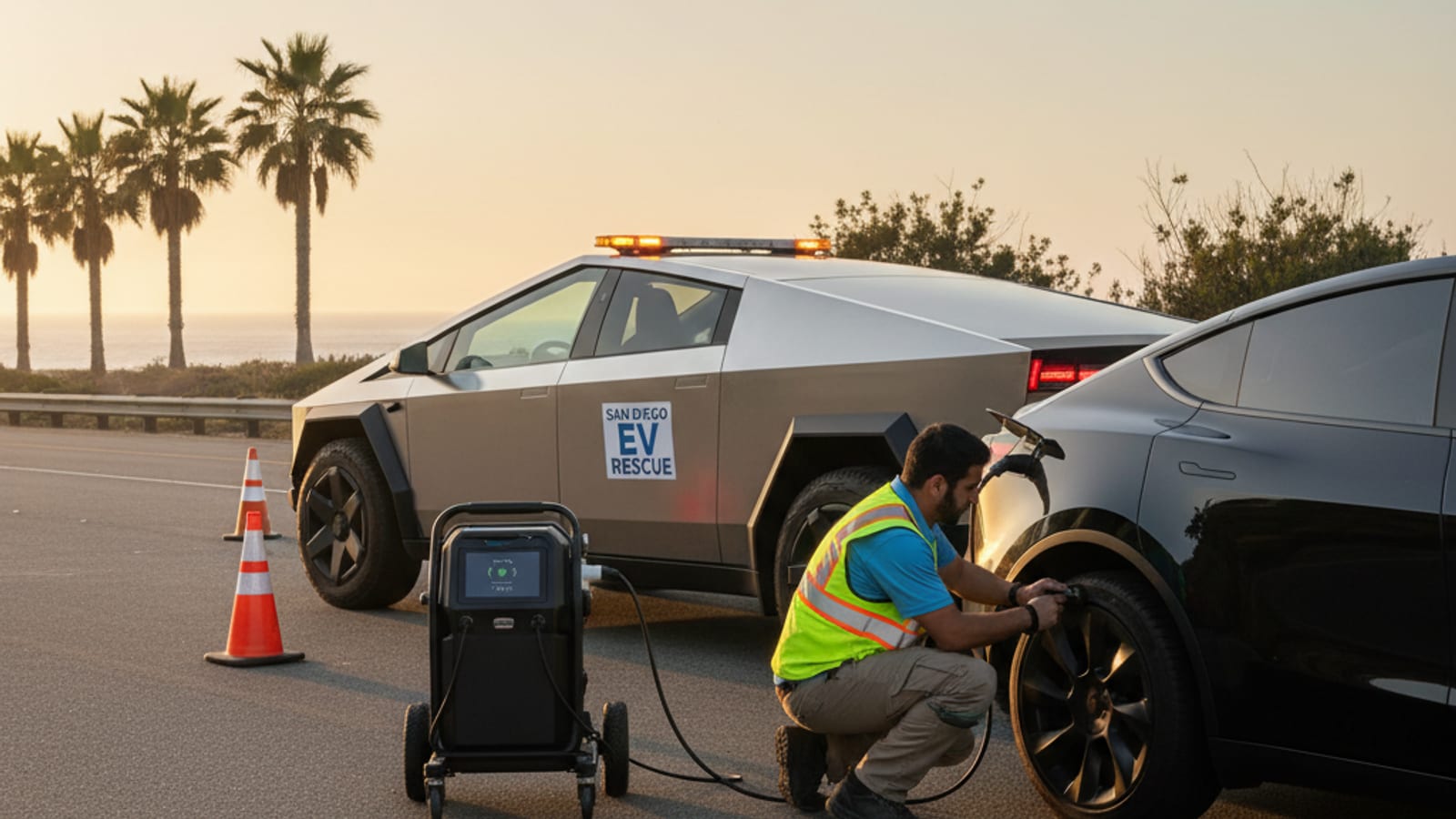
Two products share one search phrase
People use “mobile EV charger for roadside use” for two different things. One is a personal portable charger. You plug it into someone else’s outlet. The other is an operator vehicle that carries its own 240-volt supply. Mixing them up leaves you on a shoulder with a cord. You’ve got nowhere to plug it.
A personal unit belongs at a house, a garage, or an RV pedestal. It can save a weekend at a friend’s place in Pasadena. It can cover a night in a Santa Clarita driveway. It can’t invent a 240-volt receptacle on the Sepulveda Pass climb. An operator vehicle is built for that second job. It doesn’t live in your frunk. You call, and an independent pro comes to the car.
Charge Pro LA doesn’t own those trucks. We don’t employ the technicians. We don’t set the price. The operator quotes you before any cable goes in, and bills you directly.
What a personal portable charger actually is
Most trunk chargers fall into two electrical classes. The difference is the outlet, not the brand on the handle.
A 120-volt Level 1 brick
This is the slow unit that came with many cars. It plugs into a household receptacle. It adds a trickle of range. Overnight at a house, that can be enough to leave in the morning. On a shoulder, it isn’t a plan. You’d need hours, and you’d still need a working outlet. There’s no household receptacle on I-5 through Castaic. There’s none on the 10 through El Monte. There’s none on PCH where the pavement pinches down.
Level 1 is for a garage, a guest house, or a long wait on private property. Don’t treat it as roadside rescue.
A 240-volt portable Level 2
Some owners buy a harder-sided portable Level 2. It wants a 240-volt outlet, the kind a dryer or an RV pedestal uses. At a home with the right receptacle, it adds range much faster than the 120-volt brick. Some kits include NEMA adapters for different sockets.
That still leaves the roadside problem. You have to find the outlet. A dryer plug doesn’t appear on the 405. An RV pedestal doesn’t appear on the Grapevine grade. An industrial 240-volt socket doesn’t appear in a Malibu turnout. Traffic can stack behind you while you hunt for a building. If you’re already on the shoulder, the portable Level 2 is a cable looking for a wall.
Why the suitcase fails on the 405, PCH, and the Grapevine
Los Angeles County isn’t one driving environment. The Westside climb, the coast, and the I-5 north grade each tax an empty pack differently. A portable charger doesn’t solve any of them from the dirt.
Sepulveda Pass on the 405
The 405 through Sepulveda Pass is the climb between the Westside and the San Fernando Valley. Grade, heat, and air conditioning turn a sticker number into a low-pack warning. If you stall on that climb, you’re in live traffic. California Vehicle Code 21718 generally bars stopping on a freeway. A disabled vehicle that’s already summoned help fits an exception. Standing there to hunt for an outlet doesn’t.
Other drivers have a duty under CVC 21809, the move-over law. They must change lanes away from a stopped emergency or service vehicle with flashing lights. If they can’t change lanes, they have to slow. That law protects you once help is on scene with lights. It doesn’t make a suitcase charger safe to unroll into a travel lane.
If this is the corridor you commute, read Out of charge on the 405 at Sepulveda Pass: what to do. The play there is a called-in boost or a proper tow, not a cord from the trunk.
PCH through Malibu
Pacific Coast Highway through Malibu is a different trap. The road is narrow. Turnouts are short. You may have ocean on one side and a bluff on the other. Unrolling a 240-volt cable across that pavement isn’t a rescue. It’s a hazard. Ran out on PCH in Malibu with nowhere to pull over walks through that layout. A portable unit still needs power you don’t have.
The highway is the destination as much as the town. Drivers come from Santa Monica, from the Valley, and from the Westside. They burn range on the twists and the climbs. Then they look for a plug that isn’t sitting on the asphalt.
The Grapevine north of Castaic
The long grade north out of Castaic on I-5 is the county’s defining EV-range corridor. That’s where a planned run at the Grapevine turns into an empty pack. Cabin climate control on a hot day cuts real range. Recurrent Auto published testing across more than 30 models. EVs kept about 78 percent of range at 32F. They kept about 70 percent at 20F. Cabin heating was the main driver. Heat and heavy air conditioning cut range in the other direction. A heat pump helped by roughly 10 percent at 32F versus a resistive heater. None of that’s a Tesla-only number. It’s pack physics plus climate load.
A portable charger doesn’t cancel a grade. It still needs a receptacle the mountain doesn’t provide. For the empty-pack case on that corridor, Empty pack on the Grapevine north of Castaic: what to do is the local walkthrough.
Santa Clarita sits just south of that climb. Newer houses don’t flatten the grade through Stevenson Ranch and Castaic. The pack still does that math.
What Metro’s freeway patrol will actually do
Metro Freeway Service Patrol is a joint program of Caltrans, the California Highway Patrol, and LA Metro. It’s free to motorists. It roams congested county freeways to clear incidents. You reach it by dialing 511 and saying Motorist Aid.
What FSP publishes is written for a gasoline car. The list includes a gallon of gas. It covers a radiator refill and taped hoses. It covers a flat-tire change. It will tow a disabled vehicle at no charge to a safe CHP-chosen spot. The published motorist-assistance list doesn’t name mobile EV charging. It doesn’t name an out-of-charge pack boost. An empty EV can still get the free tow to a safe location. It can’t get a Level 2 charge from FSP based on what those pages currently list.
That’s why owners search for a mobile EV charger for roadside use. It isn’t a charging truck.
Confirm current hours on metro.net before you count on a patrol truck.
What an operator vehicle brings that a suitcase can’t
Independent operators in this network bring a 240-volt Level 2 source to the car. They carry a native NACS plug for Tesla. They carry a CCS or J1772 adapter for non-Tesla EVs. They typically add 10 to 20 miles of range in 15 to 30 minutes of charging. That 15 to 30 minutes is charging time. It isn’t an arrival time. Charge Pro LA doesn’t promise when someone shows up.
Ten to twenty miles isn’t a full pack. It’s a buffer to reach a public stall or a home plug you already know. The point of mobile EV charging is to move the car off the shoulder under its own power. It isn’t to replace your home circuit.
Plugs, not brand loyalty
Tesla owners get NACS. Ford, GM, Hyundai, Kia, BMW, Mercedes, Rivian, and most other current EVs use CCS or J1772 at Level 2. The operator matches the inlet on your car. You don’t need the right adapter in the trunk for the boost to start. That’s the difference from a personal kit, which only works if you also find the wall.
The truck is the power source
A personal Level 2 still borrows power from a building. An operator vehicle carries the source. That’s why it can work on a shoulder. It can work in a garage with no working stall. It can work in a lot where the public unit is down. For a plain-language look at the hardware, What’s an EV charging truck, and how does mobile rescue actually work? stays on that question.
Charge Pro LA doesn’t own a fleet. We don’t warehouse parts. We connect you with a local operator who already does this work. The operator quotes before the session starts.
Empty pack or a 12-volt that won’t wake the car
A lot of dead-EV calls aren’t an empty drive pack. They’re a 12-volt battery that dropped out. The high-voltage pack can still have range. The car won’t wake, unlock, or close contactors. A portable Level 2 cable does nothing in that case. The car won’t accept a charge until the 12-volt side is up.
Operators in this network can jump or replace a dead 12-volt on site. That’s a different job from a pack boost. If the dash is dark and the handles are dead, start with the 12-volt. Don’t reach for the suitcase charger.
This pattern shows up after long sits. LAX terminal structures P1 through P7 offer Level 2 and DC fast charging. The Economy Parking garage has 514 active EV chargers. A traveler can still return to a car that won’t wake. A 12-volt failure isn’t an empty pack. Chargers in the structure don’t prevent it.
The same 12-volt stall happens in a Culver City garage, a Burbank studio lot, or a Santa Monica street overnight. The portable wall unit in your trunk doesn’t diagnose that. An operator who does both jobs can.
Heat, cold, and grades around this county
Los Angeles County runs from marine layer on the beaches to high desert in the Antelope Valley. Range isn’t the window sticker in any of those belts.
Coastal cities like Santa Monica, Redondo Beach, and El Segundo see May Gray and June Gloom. Cabin heat is less of a winter story there. Inland valleys run hotter. Lancaster and Palmdale see hard summer heat and near-freezing winter nights. The San Fernando Valley and the San Gabriel Valley run hotter than the coast. Santa Ana winds dry the air and load the climate system. Recurrent’s heat work is clear. Summer heat plus air conditioning reduces range. Cold plus a resistive cabin heater reduces it more.
Those Antelope Valley drives sit on the 14. A portable charger in the trunk still needs a building. The high desert doesn’t hand you a dryer outlet on the shoulder.
A portable Level 1 in the trunk doesn’t fix an old panel. It also doesn’t fix a shoulder.
Don’t plan a Grapevine or high-desert run on sticker miles. Cabin load and grade are real. A mobile EV charger for roadside use, in the operator-vehicle sense, is the backup when the plan misses.
Who sells your home electrons isn’t who charges the car on the 405
Los Angeles County has no single electric utility. The City of Los Angeles is LADWP territory. LADWP publishes home and commercial EV charger rebates, a used-EV rebate, and a dedicated EV time-of-use rate that needs a separate EV meter. Confirm current terms on ladwp.com. We don’t publish dollar amounts.
Most of the rest of the county is Southern California Edison for delivery. SCE publishes a Pre-Owned EV Rebate, Charge Ready Home, and EV rate plans on sce.com. Clean Power Alliance buys generation for many cities while SCE still delivers the power. Two line items on the bill don’t change a shoulder rescue.
Glendale, Burbank, Pasadena, and Azusa run their own municipal power utilities. Name the utility when you talk about a home plug. A rebate for a wall charger isn’t a mobile EV charger for roadside use.
Tow, charge, or wait for a patrol truck
When the pack is at zero, you have a short list.
You can wait for Metro FSP on a corridor it actually covers. It can tow you at no charge to a CHP-designated safe spot. That moves the car. It doesn’t add range.
You can call a rotation tow. CHP dispatches freeway tows from a rotation list. California doesn’t publish one statewide tow-rate cap we can verify. CVC 22651 lets an officer remove a vehicle left more than four hours unattended on a freeway. Don’t leave an empty EV sitting on the 405 for half a day.
You can call for a Level 2 boost where the car sits. That’s only if an operator can reach you and work the scene safely. Out-of-charge recovery is that job. The car stays put. The operator adds 10 to 20 miles. You drive to a stall you can actually use.
Towing a dead EV is the last call for a reason. Many EVs need a flatbed. A 12-volt-dead Tesla may not roll into Neutral the way a driver expects. A boost that leaves the car on its wheels avoids that handling. It isn’t always possible. A blocked lane, a wreck, or a CHP order can still mean a tow.
We don’t quote a cheaper-than-tow figure. The operator on scene quotes the boost. Compare that number to a tow yourself. How mobile EV charging gets quoted in Los Angeles County explains the conversation.
Express lanes, airports, and other places a suitcase can’t help
Metro ExpressLanes run on the 10 through El Monte and on the 110 Harbor Freeway. A FasTrak transponder tied to a funded account is required to enter. Vehicles without one are billed by plate under Pay-As-You-Go. Metro’s published FAQ doesn’t spell out a disabled-vehicle procedure inside those lanes. Don’t unroll a portable charger there. Get to a safe spot, or wait for directed help.
LAX, run by Los Angeles World Airports, has Level 2 and DC fast charging in terminal structures P1 through P7. Economy Parking has more than 4,000 stalls and 514 active EV chargers. That doesn’t prevent a 12-volt death after a week on travel. A portable Level 2 in the trunk doesn’t wake a car that won’t close contactors. Call for a 12-volt jump on site, then decide if the pack also needs a boost.
Hollywood Burbank, Long Beach, and Van Nuys airports can produce the same 12-volt-after-a-trip pattern. We didn’t verify stall counts at those three for this page.
What to do before you’re on the shoulder
A mobile EV charger for roadside use, meaning an operator, is a backup. It isn’t a substitute for leaving with a real buffer.
Use the car’s navigation and a second app before a grade. PlugShare and the Department of Energy’s Alternative Fuels Data Center locator are the usual public maps. Check them before the Grapevine, before PCH through Malibu, and before the 14 toward Acton, Palmdale, and Lancaster. Top off when you can. Don’t wait for the last bar on a climb.
Watch cabin load. Heat in the Antelope Valley and air conditioning on a long grade both tax the pack. Recurrent’s work is the citation for that, not a rumor on a forum.
A working home Level 2 is the usual way to avoid this page. Confirm rebate and rate details with LADWP, SCE, or your municipal utility. We aren’t your utility.
Save a local rescue number before you need it. Charge Pro LA is the matchmaker, not the truck. The operator still has to reach you. The operator still has to work the scene. The operator still has to quote you first.
How a roadside boost is quoted in this county
There’s no price on this page. Charge Pro LA doesn’t set one. The independent operator quotes before starting, then bills you directly. Ask what the session includes. Ask what happens if the car won’t take a charge.
If the quote isn’t acceptable, say no. You aren’t on the hook until you agree.
Coverage is Los Angeles County. A portable charger doesn’t care which city you’re in. It still needs a wall. An operator vehicle is the thing that doesn’t.
When a portable unit is still worth owning
This page isn’t a lecture against owning a portable charger. A Level 1 or portable Level 2 is worth keeping if you visit houses without a hardwired EVSE. It’s worth keeping if you rent in older Eastside or Gateway Cities stock and can’t add a 240-volt circuit. A guest-house weekend in Pasadena or a driveway in Glendale is exactly what those kits are for.
They aren’t for the 405 shoulder. They aren’t for PCH. They aren’t for the Grapevine. Buy the kit for the house. Call an operator for the road.
If the car is already stopped, skip the experiment. Hazards on, as far right as you can get, and a call for help. CVC 21718 is the disabled-vehicle rule you’re standing on. CVC 21809 is the move-over rule that should protect the scene once lights are out. Don’t walk the travel lane with a charging cable.
Frequently asked questions
What is a mobile EV charger for roadside use?
Owners use the phrase for two products. A personal portable charger is a cable and brick you carry, and it needs a wall outlet. A roadside operator brings a 240-volt Level 2 source on a vehicle, with a NACS plug or a CCS or J1772 adapter.
Will a portable Level 2 unit work on a freeway shoulder?
A portable Level 2 still needs a 240-volt receptacle. Freeway shoulders on the 405, PCH, and the Grapevine don’t have one. The practical roadside option is an operator who carries the power, or a tow to a safe spot.
How much range does an operator add on site?
Operators typically add 10 to 20 miles of range in 15 to 30 minutes of charging. That window is charging time, never an arrival time. It’s usually enough to reach a public stall or a home plug you already trust. The operator quotes before the cable goes in. For a match in Los Angeles County, call (213) 410-1991.