“Mobile EV charging near me” gets typed into a phone in a parking lot when the dash reads zero. In Los Angeles County that search returns a mix of apps, networks, and referral lines. The job is the same. Bring 240-volt Level 2 to where the car sits. Mobile EV charging near me in Los Angeles County is the referral we run, and here’s how it actually works.
What mobile EV charging actually is
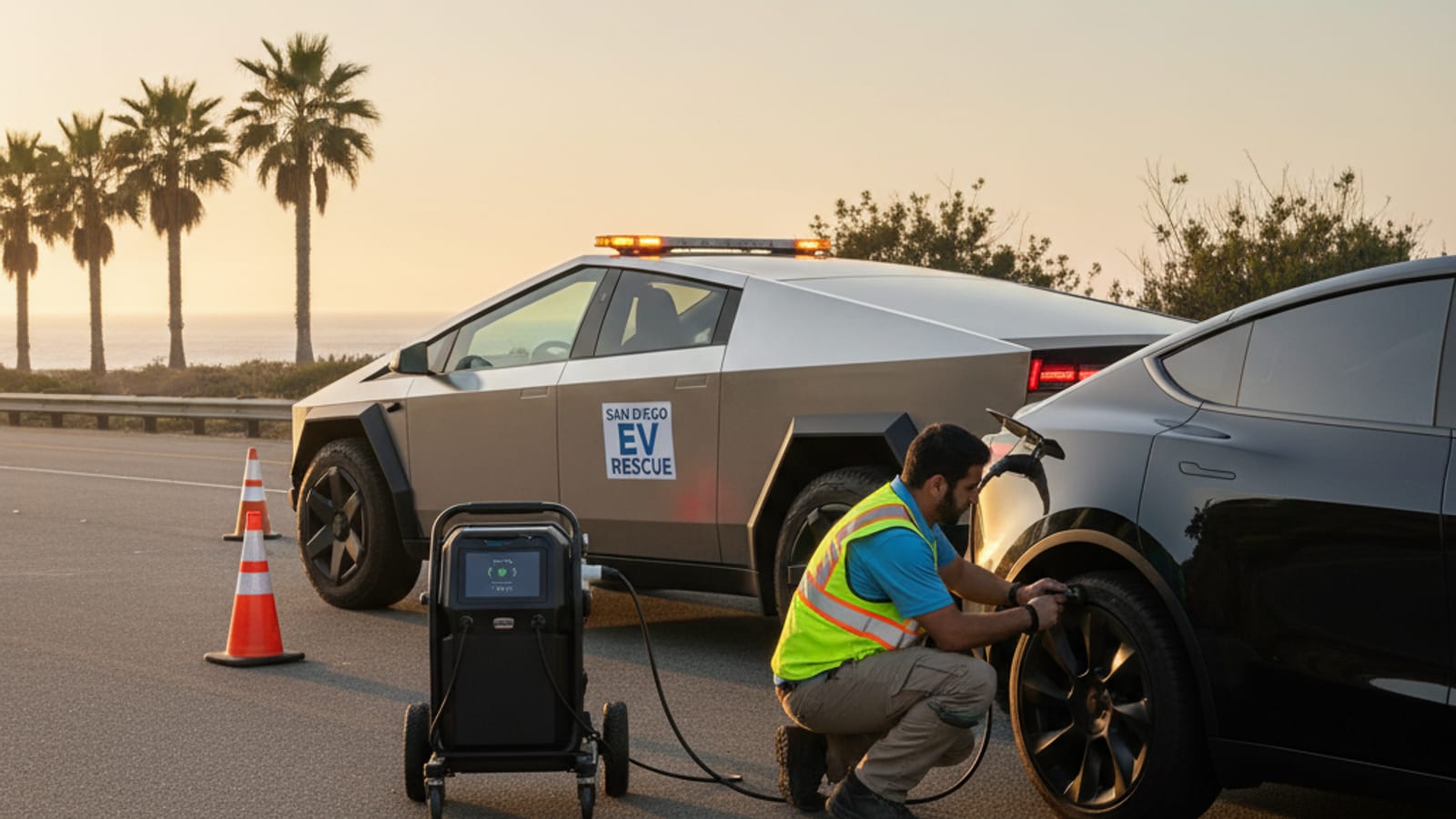
A mobile EV charging operator drives a van or pickup to where your car sits. They plug a 240-volt Level 2 source into the car’s charge port. The car charges from the operator’s battery, not from the grid at your curb. The session adds 10 to 20 miles of range. Charging time is usually 15 to 30 minutes.
It’s not a tow. The car stays put. It’s not a roadside DC fast charger. The truck doesn’t carry a 50 kW stack. It’s Level 2, the same speed as a home wall connector, but on wheels.
The job is the gap between “I have to move now” and “I can reach a real charger.” That gap is what gets most LA County EV drivers through a bad day.
What the operator brings
We’re a referral line for Los Angeles County. We match stranded EV drivers with independent local operators. The pros we connect you with are licensed and insured. We hold no license for the work. We own no trucks and employ no technicians. We set no prices and publish no arrival time.
The operator quotes you before they start. They bill you directly. No dollar figure belongs here. They quote you on the phone and confirm access before they roll.
Native NACS covers Tesla at the port. A CCS or J1772 adapter covers the rest. That means Rivian, Ford Lightning, Mustang Mach-E, Hyundai Ioniq 5 and 6, Kia EV6 and EV9, Chevy Bolt, Polestar, Nissan Leaf, and most other North American EVs. Tell us your model when you call and we confirm the connector before the operator sets off.
Why LA County needs it more than most places
Los Angeles County is 88 incorporated cities plus unincorporated areas. The City of Los Angeles is one municipality of about 3.9 million. Census ACS data puts 71.0 percent of City of Los Angeles housing built before 1980. East Los Angeles is older still, at 86.2 percent pre-1980 stock.
Older housing stock means older apartment buildings without chargers in the garage. It means street parking as the daily plan. It means public stalls at a strip mall or a city garage, and those stalls fail or sit full more often than people expect. When that math fails, the car stops at zero.
The county also runs hot. Summer afternoons at 90F or above pull range out of any EV through cabin cooling. The Sepulveda Pass over the 405 chews miles the dash still treats as flat. The 101 through Cahuenga Pass does the same. The 110 carries harbor-to-basin traffic that pulls range in stop-and-go. Inland basin heat on the 605 and the 10 makes AC load worse.
A driver who plans the day on a 70F morning runs short on a 95F evening. That’s the LA County problem mobile EV charging exists to solve.
What you actually do when you’re stuck
Pull as far right as you can and set hazards. Stay clear of traffic while you make the call. If you’re on a freeway shoulder, get out on the side away from traffic. CVC 21718 bars stopping on a freeway. A disabled vehicle that has summoned help is an exception. CVC 21809 is the move-over law.
Call (213) 410-1991. Leave your cross street or your mile marker. Leave your vehicle make and model. We’ll match you with a local operator covering that part of the county. They’ll contact you directly with the quote.
How the dispatcher picks an operator
We don’t dispatch a Charge Pro truck. We match your pin to an operator who already covers that part of LA County. The Westside gets a Westside operator. The Valley gets a Valley operator. The South Bay gets a South Bay operator. The dispatch picks by coverage, not by a rotating queue.
That matters because the operator’s arrival time depends on where they already are when you call. We don’t publish an arrival time. The operator quotes you before they roll and gives you a window on the call. If you want to compare against a different operator’s window, you can decline the first match and wait for another. The match is the operator’s call to take or pass.
Why a referral instead of just calling AAA
AAA handles flats, lockouts, and gas for any car. They handle 12V jumps too, depending on your plan. They do not always bring a mobile EV charger. A tow to a public charger is the answer AAA gives when the dispatch is a tow truck.
A mobile EV operator brings the charger to the car. The car doesn’t move. AAA or a mobile charge: what actually gets an empty EV moving compares the two in more detail.
Tesla, AAA, or a local mobile rescue: how the three actually differ adds a third column. Tesla’s own roadside works through the Tesla app, with a third-party contractor at the other end. That contractor may bring a tow truck or a charger depending on what they have on the truck.
What mobile EV charging can’t fix
A crash or a bent wheel still needs a shop. So does a charge port that won’t accept power. On-site charging can’t fix that. A battery that’s been physically damaged, or a car with a high-voltage fault, is a flatbed to a certified shop. The operator quotes and confirms before they start. If they can’t charge your car, they tell you on the call.
A dead 12V is different. The operator jumps or replaces the battery on site. That’s the more common call in many LA County garages. A car that sat in a structure for a week often comes back to a dead 12V, not an empty pack.
How the call ends
The operator plugs in, runs the session, and bills you directly. No dollar figure belongs on this page. They quote on the call. They bill you on the call. Charge Pro LA doesn’t take a cut and doesn’t see the operator’s invoice. We just made the match.
If the operator replaced a 12V battery, keep the receipt. Most warranties on the battery are between you and the battery maker. The install labor is between you and the operator.
If the operator charged your car enough to reach the next charger, you drive off. That’s the end of the call. No membership, no annual fee, no app to install. Pay the operator, save the number for the next time you misjudge a charge.
The number to call is (213) 410-1991.