A Los Angeles County homeowner who just installed a Powerwall or a FranklinWH asks a fair question. Can that home battery fill my EV when I run low? The honest answer is no. A home battery runs your house circuits during an outage. It doesn’t reverse-charge your car. Here’s the mobile EV charging vs home battery breakdown that goes with it.
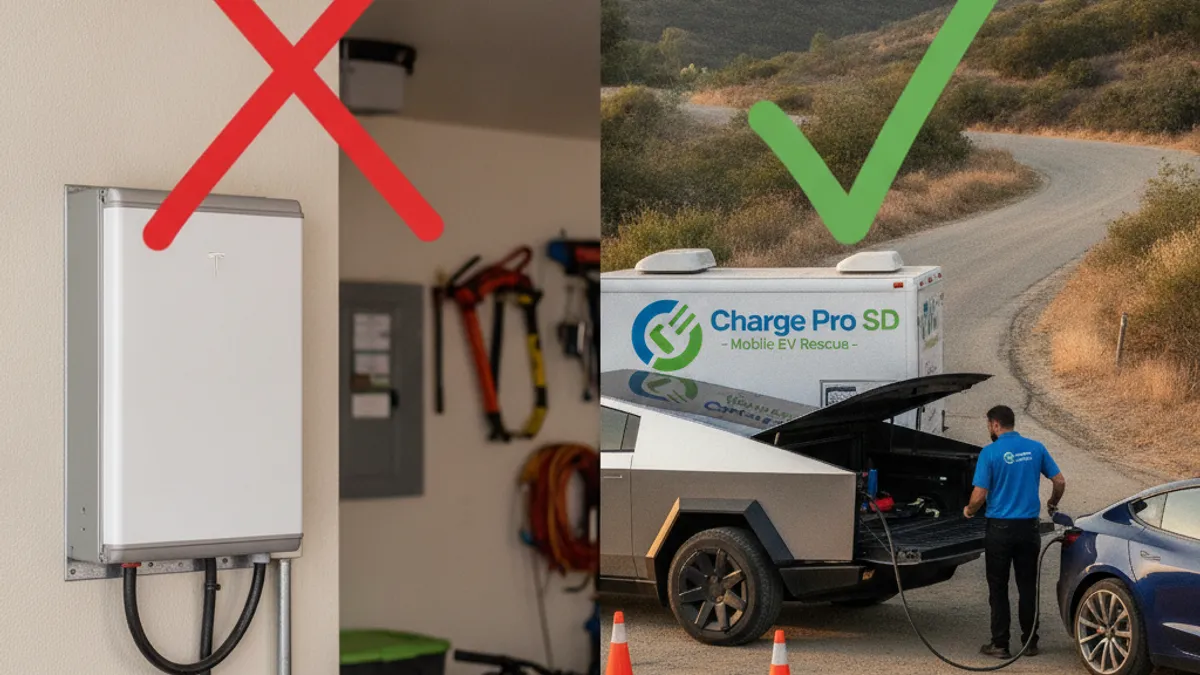
What a home battery actually does
A Tesla Powerwall, a FranklinWH, a Span, or a similar home battery stores electricity from solar panels or the grid. When the grid goes out, the battery powers your house circuits. Lights, fridge, internet, and a few outlets stay on. The battery’s capacity runs from about 10 kWh to 40 kWh depending on the unit and how many you stack.
A Powerwall does not have a charge port plug. It does not run a cable to your car. It does not feed electricity back into your EV’s traction pack. The battery’s job is your house, not your car.
There is one technical exception. Some bidirectional chargers can theoretically draw from a home battery and feed a car, but those aren’t common in Los Angeles County residential installs. If you have a specific bidirectional setup, your installer should have walked you through how it works.
What mobile EV charging actually does
A mobile EV charging operator drives a van or pickup to where your car sits. They plug a 240-volt Level 2 source into the car’s charge port. The car charges from the operator’s battery on the truck, not from the grid at your curb. The session adds 10 to 20 miles of range. Charging time is usually 15 to 30 minutes.
The job is the gap between “I have to move now” and “I can reach a real charger.” That gap is what gets most LA County EV drivers through a bad day.
The outage scenario
Los Angeles County has rolling outages during heat waves and high fire danger. A homeowner with a Powerwall keeps their fridge and internet on during the outage. Their EV still has whatever charge it had when the grid dropped. If the grid was down because of a regional event, public chargers may also be down. The car doesn’t get electrons from the wall battery.
What does help in that scenario is charging the car before the grid event. A full EV pack is a lot of stored electricity. Most EVs have a 60 kWh to 100 kWh pack. That’s more storage than a stack of three Powerwalls. The car is its own battery when the grid is up.
If the grid is down and your EV pack is low, the answer isn’t the home battery. The answer is a mobile operator with their own battery on a truck. The operator plugs in regardless of grid status.
LADWP and SCE service areas
The City of Los Angeles gets power from LADWP. Most of the rest of the county gets power from SCE. Clean Power Alliance is a generation choice in many SCE cities, but SCE still delivers the power. None of that changes what a home battery does during an outage. None of it changes what mobile EV charging does during a stall.
The home charger circuit question
A home battery is one piece of a home energy system. A home Level 2 charger is a separate piece. Most homeowners install a Level 2 charger on a dedicated 240-volt circuit. That circuit draws from the house panel, which draws from the grid or the solar or the home battery. The charger doesn’t care where the power comes from.
If your house panel is from the 1960s and the available amperage is tight, you may not have room for a charger circuit. That’s a panel upgrade conversation, not a battery conversation. Mobile EV charging covers the dispatch while the panel upgrade is in progress.
When a home battery helps an EV owner
It doesn’t fill the EV. What it does is keep the home power on during an outage, which means the EV charger still works when the grid comes back up. It also means the garage door opener works, the fridge stays cold, and the house is livable while the car is parked.
If your driving pattern is mostly home charging and you have solar, a home battery paired with a Level 2 charger covers nearly every daily scenario. The only gap is the rare day you run the pack down to zero mid-trip. That’s the gap mobile EV charging fills.
When a home battery doesn’t help at all
If you rent, you don’t install a home battery. If you live in an apartment without a dedicated panel, you don’t install a home battery. If you live in an older building with shared electrical infrastructure, you don’t install a home battery. For these drivers, mobile EV charging is the entire solution.
The same is true if your house has a panel but no solar. A Powerwall without solar charges from the grid at night and discharges during the day. It keeps your house on during an outage. It doesn’t help your car.
The combined answer
A homeowner with a Powerwall plus a Level 2 home charger has nearly everything they need for daily driving. The remaining gap is the rare mid-trip zero. Mobile EV charging fills that gap. The two technologies do different jobs.
A renter or apartment dweller without home charging relies on public stalls and workplace charging. The same gap exists, but mobile EV charging is a larger share of the solution. The home battery isn’t an option.
What the operator actually brings
We’re a referral line for Los Angeles County. We match stranded EV drivers with independent local operators. The pros we connect you with are licensed and insured. We hold no license for the work. We own no trucks and employ no technicians. We set no prices and publish no arrival time.
The operator quotes you before they start. They bill you directly. No dollar figure belongs here. They quote you on the phone and confirm access before they roll.
Native NACS covers Tesla. A CCS or J1772 adapter covers Rivian, Ford, Hyundai, Kia, Chevy, Nissan, and most other North American EVs.
The number to call is (213) 410-1991. We’ll match you with a local operator. They quote before any cable goes in.