A Polestar 2 driver in Los Angeles County who runs out of charge or hits a dead 12V has two paths. Polestar’s own roadside through the app, or a local mobile rescue. They aren’t equivalent. Here’s how Polestar roadside assistance and local rescue compare in LA County.
What Polestar roadside covers
Polestar roadside assistance is included for the first four years of ownership or a set mileage, whichever comes first. The dispatch goes through a third-party call center. The third party decides what to send based on the failure and the location.
Polestar roadside covers tows to a Polestar service point or a certified Volvo shop. It covers lockouts, tire changes, and fuel delivery for gas cars. For EVs, it covers tows to a charger or service point.
Polestar roadside does not always send a mobile charger. The third-party contractor decides on the call whether to bring a tow truck or a charging van. In LA County, the dispatch usually sends a tow truck.
Polestar 2 won’t start: the 12V checks to try covers the most common no-start version for the Polestar 2.
What a local mobile rescue covers
We’re a referral line for Los Angeles County. We match stranded EV drivers with independent local operators. The pros we connect you with are licensed and insured. We hold no license for the work. We own no trucks and employ no technicians. We set no prices and publish no arrival time.
The operator quotes you before they start. They bill you directly. No dollar figure belongs here. They quote you on the phone and confirm access before they roll.
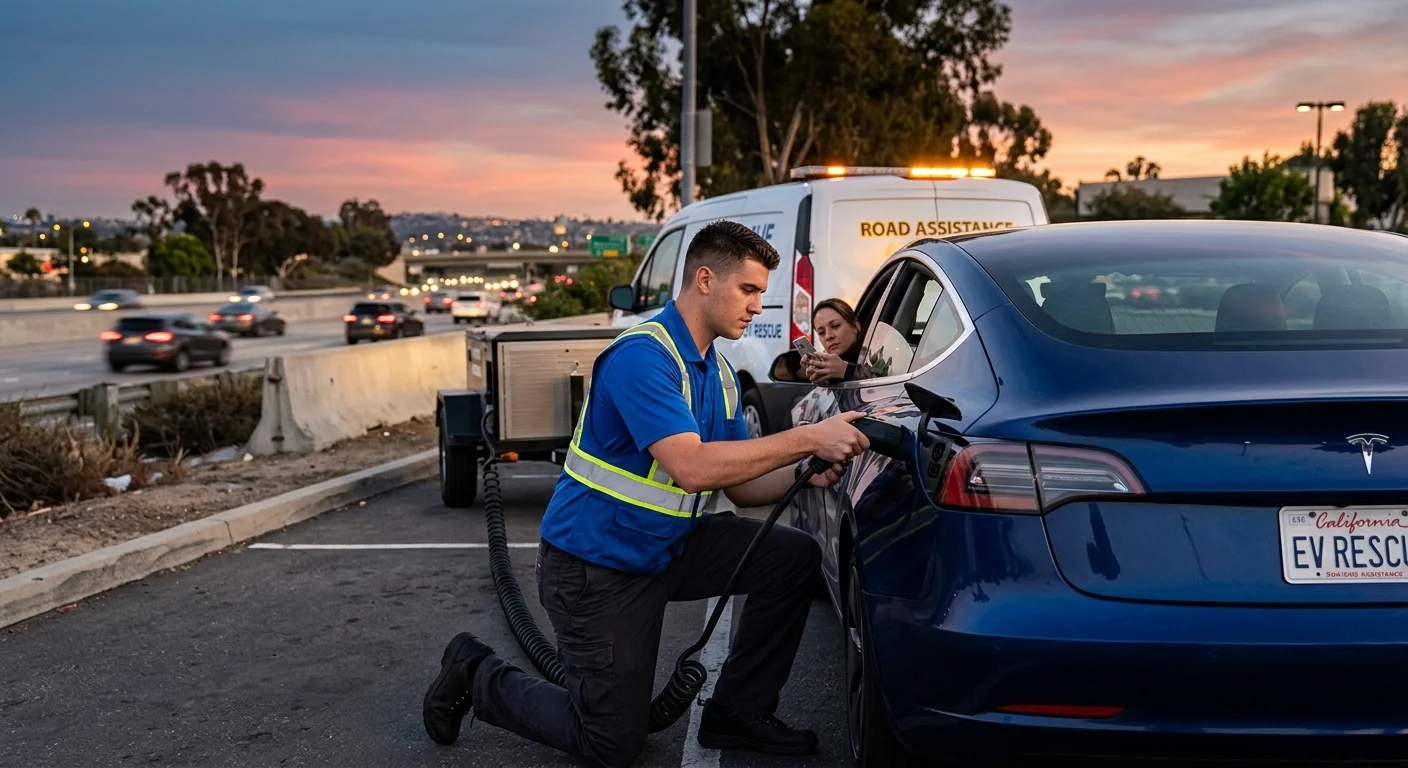
What they bring is a 240-volt Level 2 source to the car. The Polestar 2 uses CCS. The operator’s van carries a CCS cable. A typical session adds 10 to 20 miles of range. Charging time is usually 15 to 30 minutes, and that clock starts when the plug is in. It isn’t a clock for when the truck shows up.
That boost is enough to reach a charger in Santa Monica, Culver City, or wherever the Polestar driver needs to get. It’s the job mobile EV charging is built for.
Operators also jump or replace a dead 12-volt battery on site. That’s the more common call for Polestar 2 drivers in LA County. A car that sat for a week often wakes up to a dead 12V, not an empty pack.
The dispatch difference
Polestar’s dispatch is a phone call or a button in the Polestar app. The third-party call center routes to a contractor. The contractor’s vehicle depends on what they have on the truck. Some contractors carry a mobile charger. Most carry a flatbed.
A local mobile rescue is a phone call to us. We match the pin to an operator already covering that part of LA County. The operator brings a CCS cable and a 12V jump pack. The dispatch picks by coverage, not by a rotating queue.
The arrival time depends on where the operator already is when you call. We don’t publish an arrival time. The operator quotes you on the call.
When Polestar’s program is the right call
A crash or a bent wheel needs a flatbed. Polestar’s program tows to a Polestar service point. The driver gets the right shop for the car. A local mobile rescue isn’t a substitute for a tow to a dealer.
A charge port fault needs a dealer. Polestar’s program tows to a Polestar service point. The driver doesn’t pay out of pocket for the tow if it’s covered under the program.
A car with a high-voltage fault needs a dealer. Same answer.
When a local mobile rescue is the right call
An empty pack or a dead 12V at a curb or in a lot. The car doesn’t need to move. The driver needs electrons at the pin. Polestar’s program sends a tow to a charger. The driver waits on a hook. The local operator plugs in at the stall.
A Polestar 2 in a Hollywood garage that won’t wake after a week. The driver needs a 12V jump at the stall, not a tow to a Volvo shop. The local operator brings a jump pack and handles it on site.
A Polestar 2 on the shoulder of the 405 climbing the Sepulveda Pass. The driver needs 10 to 20 miles to clear the grade. The local operator plugs in at the shoulder.
What mobile EV charging can’t fix
A crash or a bent wheel still needs a shop. So does a charge port that won’t accept power. On-site charging can’t fix that. A Polestar 2 with a high-voltage fault is a flatbed to a Polestar service point. The operator quotes and confirms before they start.
A dead 12V is different. The operator jumps or replaces the battery on site. That’s the more common call for Polestar 2 drivers in LA County.
Combining the two
A Polestar driver can call Polestar’s program first and request a mobile charge. If the contractor brings a charger, the call is covered. If the contractor brings a flatbed, the driver can decline and call us. The tow can be declined before it hooks up.
The Polestar program and a local mobile rescue aren’t mutually exclusive. The driver picks the dispatch that fits the failure. A mobile charge fits empty-pack and dead-12V calls. A tow fits crash, charge port, and high-voltage fault calls.
The number to call for a local mobile rescue is (213) 410-1991. We’ll match you with a local operator. They quote before any cable goes in.