A Rivian R1T or R1S driver in Long Beach who runs out of charge on the 405 or the 710 doesn’t get help from Highway Assist. Highway Assist is a driver aid, not an emergency service. The car disengages it as the pack drains. The driver is on their own. Here’s what mobile Level 2 dispatch covers for Rivian in Long Beach.
Why Long Beach Rivian drivers hit this
Long Beach sits between the harbor and the Westside. The 405, the 710, and the 605 all meet inside the city. The 710 ends at the Port of Long Beach. That corridor funnels fleet traffic onto local streets.
A Rivian driver who misjudges a hot-day climb up the 405 from the harbor or down from the 605 sits on the shoulder with the pack at zero. AC on a 95F day plus the grade pulls range out of any EV. The dash reads one number, and the actual range trails it.
EV rescue in Long Beach covers the broader Long Beach pattern. Rivian drivers hit the same stalls as every other EV in the city.
What Highway Assist does and doesn’t do
Highway Assist is a Level 2 driver aid. It combines adaptive cruise control with lane centering on mapped highways. The driver keeps their hands on the wheel. The car handles speed and lane position.
Highway Assist is not self-driving. The driver is responsible for the car at all times. The system disengages if the driver takes their hands off the wheel for too long. It disengages in construction zones and on roads that aren’t in the map database.
Highway Assist doesn’t dispatch a tow when the car breaks down. It doesn’t deliver electrons. It doesn’t take over braking in a fault condition. A Rivian driver who runs out of charge with Highway Assist engaged sees the system disengage as the car dies.
Rivian Highway Assist vs roadside assistance: what each covers covers the distinction in more detail.
What Rivian’s own roadside covers in Long Beach
Rivian roadside assistance is requested through the Rivian app. The dispatch routes to a Rivian service van or a third-party contractor depending on the location. Long Beach is partially inside Rivian’s service zone. The dispatch varies by neighborhood and time of day.
Rivian’s program covers tows to a Rivian service center or to a charger for an out-of-charge Rivian. The contractor decides on the call whether to bring a mobile charger or a flatbed.
A Rivian driver who needs electrons at the pin may get a tow under Rivian’s program. The driver waits on a hook. The car lands at a charger the driver could have driven to in 20 miles. That’s the gap a local mobile rescue fills.
What a local mobile rescue brings
We’re a referral line for Los Angeles County. We match stranded EV drivers with independent local operators. The pros we connect you with are licensed and insured. We hold no license for the work. We own no trucks and employ no technicians. We set no prices and publish no arrival time.
The operator quotes you before they start. They bill you directly. No dollar figure belongs here. They quote you on the phone and confirm access before they roll.
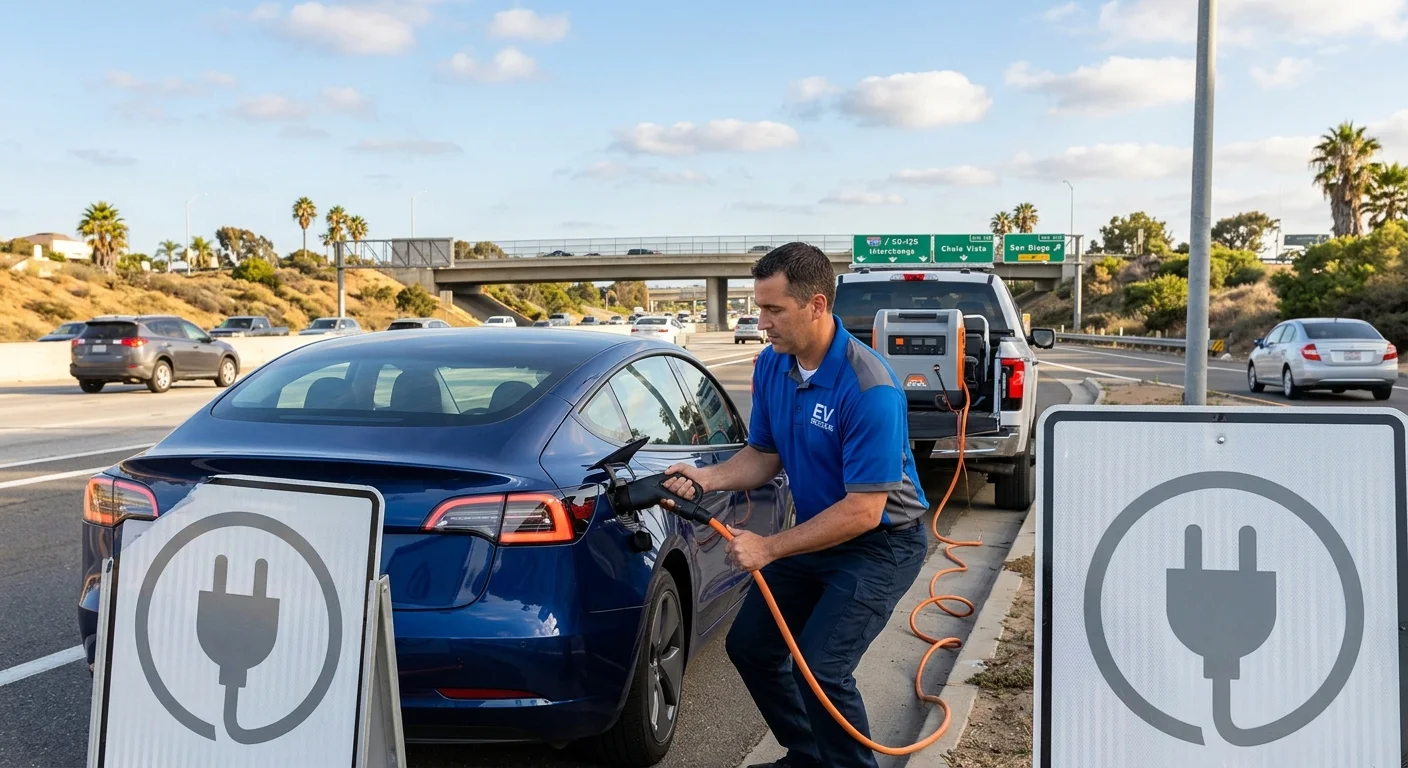
What they bring is a 240-volt Level 2 source to the car. The Rivian R1T and R1S use CCS. The operator’s van carries a CCS cable. A typical session adds 10 to 20 miles of range. Charging time is usually 15 to 30 minutes, and that clock starts when the plug is in. It isn’t a clock for when the truck shows up.
That boost is enough to reach a charger on Ocean Boulevard, PCH, or in Signal Hill. Operators also jump or replace a dead 12-volt battery on site.
Long Beach corridors that stall
The 405 through Long Beach catches Westside-to-South Bay traffic. The 710 catches harbor-to-Downtown traffic. The 605 catches Riverside-to-Long Beach traffic. All three have long uphill sections on the basin side.
Surface streets add their own pattern. Ocean Boulevard along the beach stacks cars at every signal. Pacific Coast Highway through Belmont Shore catches beach traffic. Seventh Street through Downtown catches local traffic.
A driver who climbed out of the LA Basin via the 405 or the 605 in summer arrives with the pack lower than the morning dash showed. AC load at 95F and the grade take real range. The math fails. The car stops.
Two different dead cars, two different calls
The empty-pack version shows up after a long climb or a hot AC day. The driver sees the dash dropping, finds a shoulder on the 405 or a side street in town, and calls for a charge. The traction pack is at zero, but the 12V still works. The operator plugs in and adds 10 to 20 miles.
The 12V version shows up after a long sit. A car that parked for a week in a Long Beach garage wakes up dead. The operator jumps the 12V at the stall or replaces it on site.
Both versions happen in this part of the South Bay. The operator’s van covers Long Beach from the same dispatch.
Stay safe on a Long Beach shoulder
California Vehicle Code 21718 bars stopping on a freeway. A disabled vehicle that has summoned help is an exception. CVC 21809 is the move-over law. Other drivers must change lanes or slow when a service vehicle has lights on.
The 405 and the 710 are high-speed corridors. Pull as far right as you can and set hazards. Stay with the car if you can do so off the travel lane.
When a tow is the honest answer
A crash or a bent wheel needs a shop. So does a charge port fault. On-site charging can’t fix that. If CHP is already there, take the safe tow.
The number to call is (213) 410-1991. We’ll match you with a local operator. They quote before any cable goes in.