The cables in your trunk were built for a gas car’s flooded 12V. A Tesla still has a small 12-volt battery that runs locks, computers, and the charge port, so Tesla jumper cables only wake that battery. The drive pack does not take a jump.
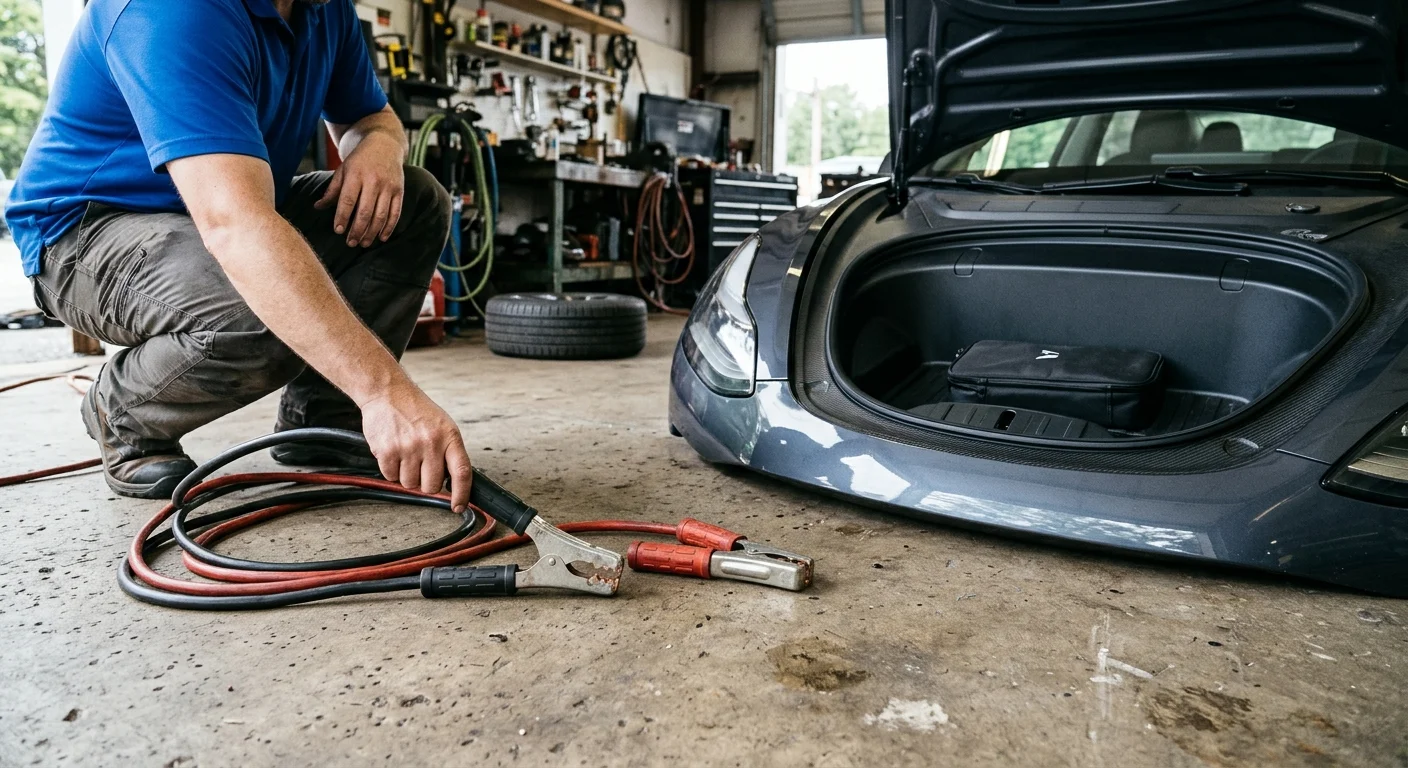
Why a Tesla 12V needs a different jump than a gas car
On a Camry you pop the hood, find two posts, and clamp. That 12V is the battery that cranks the starter. A Tesla splits the job. The drive pack is a high-voltage battery that moves the car. The 12V, sometimes called the low-voltage battery, keeps the computers, latches, lights, and charge electronics alive.
The U.S. Department of Energy treats light-duty EVs as high-voltage machines with a separate 12-volt system for accessories. Jumper cables belong only on that small system. The orange high-voltage lines and the pack under the floor are a different circuit. Clamping there is a hazard, not a start.
When the 12V is flat, the car can look fully dead even if the drive pack still holds miles. Doors may not unlatch. The screen stays black. The charge port may ignore a plug. That is the moment people search tesla jumper cables and grab the same 8-foot set they keep for a gas SUV. That set can wake a 12V if you land on the right posts. It cannot put range in the pack. If the pack is empty after the computers come back, you still need a charge, a tow to a charger, or a local operator who can tell a 12V wake from an empty drive pack.
Los Angeles County makes the mix worse. A Model Y in a Santa Monica subterranean garage can sit for days between highway trips. A Model 3 on a Lancaster driveway bakes in dry heat. A Model S left in a downtown structure over a long weekend can drain the small battery while the pack still shows miles. Same cables. Same 12V job. Different parking, different heat, different access to a second hood.
A gas-car jump also assumes a donor that can take a load. Tesla’s published rule on using one Tesla to jump another car could not be confirmed from Tesla’s site for this page. The donor-car question lives on our note about using a Tesla to jump another car. Treat the Tesla as the car that needs the 12V wake, not as a rolling jump box.
If you need the step-by-step, use the diagnose-and-jump walkthrough. This page is the gear: what to bring, what to skip, and when to put the clamps down.
Clamp points and what not to touch
Tesla’s current published clamp diagram could not be confirmed from tesla.com for this article. Clamp points also change by model and by year. The only safe map is the owner’s manual for your VIN.
On many Teslas the 12V jump points sit in the front trunk, under a maintenance panel. They are not a classic pair of top posts in an engine bay. That is why the gas-car habit of “find the red post up front” fails. Some cars hide a positive post under a red cover. Some use a chassis ground instead of a battery negative. Some need the hood open first, which is a problem when the 12V is too flat to release the frunk.
Do not invent a workaround. Internet tricks that tell you to probe a bumper cavity or short a latch are not in the verified record here. They are a fast way to hit the wrong circuit. If the frunk will not open, that is a job for a Tesla roadside rescue operator, not for a flashlight and a guess in a stacked Hollywood garage.
Leave these alone every time. The orange high-voltage cables that feed the drive pack. The drive pack itself, under the floor. It is not jumpable with jumper cables. Random bolts, brake lines, and aluminum frunk structure unless your manual names that exact ground. The charge port pins. A charging cable is not a jumper cable, and the port is not a 12V post.
Tesla does not publish a jumper-cable gauge or amp number that we could confirm. If a pack or cable set prints a huge amp rating, that number is the maker’s claim, not Tesla’s spec. In a tight West Hollywood garage or a street spot in Huntington Park, short, well-insulated clamps and a clear look at labeled posts matter more than a long set meant for two trucks on a wide Palmdale driveway.
Wrong polarity is the other failure. A red clamp on a ground stud can cook electronics. If you cannot see a labeled positive and a labeled ground, stop. The Model 3, Y, S, and X jump guide walks the model families. It still defers to the manual in your car for the exact stud.
Portable packs versus cables from another car
You have two common tools. A portable 12V jump pack. Or jumper cables to a second car.
A pack wins in most Los Angeles County spots. There is often no second car you can park nose-to-nose. Curb space in East Los Angeles, a single-loaded alley in South Gate, and a stacked garage in Century City all make a donor hood a pain. A pack also keeps you from pulling a stranger’s 12V down. That matters when the only other car in the structure is another EV.
Cables to a gas car can wake a Tesla 12V if the posts are the ones in the manual. You still need a donor with a healthy 12V, room to open both hoods, and the connection order in your book. Tesla’s published instruction on that order could not be confirmed here. Follow the manual for your car. If the manual is silent, do not improvise on a lithium 12V.
Skip the charging cable in this decision. A Tesla charging cable, Mobile Connector, or Supercharger cord does not jump a 12V. People mix those searches up. Jumper cables move 12-volt current between two 12-volt systems. A charging cable feeds the high-voltage pack through the charge port. Different plug, different job.
We also could not confirm a Tesla-approved jump-pack brand, peak-amp rating, or lithium-versus-lead-acid setting. Pack makers print large amp numbers. Those numbers are not a Tesla spec. A compact 12V jump pack with reverse-polarity protection is what most owners actually carry. That is a consumer pattern, not a tested endorsement. If the pack has a lithium 12V mode, read that booklet before you clamp a newer Model 3 or Y.
On Pacific Coast Highway through Malibu, the city spans 21 miles of coastline, and the PCH stretch through the city is a 21-mile section. A dead 12V there, with no second hood and no room to play with long cables, is a pack-in-the-frunk problem or an operator problem. It is a poor place to learn clamp points.
On a freeway, cables plus a donor is the worse picture. California Vehicle Code 21718 bars stopping on a freeway, with an exception for a disabled vehicle once help has been summoned. California Vehicle Code 21809 is the move-over law for stopped emergency, tow, or Caltrans vehicles with flashing lights. Metro Freeway Service Patrol will jump-start cars on designated beats, Monday through Friday 6am to 7pm and weekends 10am to 6:30pm. Dial 511 and say Motorist Aid. FSP’s published list names gas, radiator refill, tire change, and jump-starting cars. It does not include mobile EV charging. A Tesla 12V jump on the 405 is still a specialized clamp job. If you are in the lane, stay out of traffic and call for help.
Lithium 12V packs on newer Model 3 and Y
Some Model 3 and Model Y cars use a lithium low-voltage battery instead of a classic lead-acid 12V. Tesla’s published model-year split could not be confirmed from Tesla’s site for this page. Do not guess from a forum post about a cutoff year. Open the owner’s manual for your VIN. If the car’s software screen lists the low-voltage battery type, use that. If you cannot tell, treat the pack as unknown and stop.
Lithium 12V and lead-acid 12V are not the same load. A lead-acid battery can take a crude jump from a gas car. A lithium 12V can refuse to recover if you hold an external supply on it too long, or if you use the wrong ground. Writeups online quote Tesla time limits in seconds. Those figures are not in our verified ledger, so they are not repeated here. Your manual is the only timer that counts.
Ground points can change with pack type. Some procedures put the negative on the battery. Some put it on a chassis bolt near the brake reservoir. Clamp the wrong bolt and you are on painted aluminum, not ground. That is why a generic tesla jumper cables kit with two big clamps is incomplete. You need the labeled point, not a bigger clamp.
Heat in the San Fernando Valley and the Antelope Valley is hard on any 12V. Cold snaps still happen in Acton and on the Grapevine. Recurrent Auto’s winter testing across dozens of EV models found cars kept about 78% of range at 32F, and about 70% at 20F, with cabin heat the big drain. That is pack range, not 12V health. It still explains why a car that sat overnight in Palmdale can wake ugly even when the drive pack is not empty.
If a lithium 12V will not hold after a brief wake, the car needs a replacement, not a second jump. Repeated jumps are how people end up locked out on a Monday in a Burbank studio garage. An operator who does Tesla 12V battery jump work can tell a wake from a battery that is done.
When a local operator should handle the jump
Put the cables down in these cases. The frunk will not open and you cannot see labeled posts. You cannot tell lithium from lead-acid. You are on a freeway, a Metro ExpressLane on I-10 or I-110, or a shoulder with live traffic. California Vehicle Code 22651(f) lets a peace officer remove a vehicle left more than four hours on a full-access freeway if it cannot move under its own power. You do not want to spend those hours hunting a ground stud. The car is in a structure with no donor access and you have no pack. You already jumped it and it died again. Orange cables are in the way, or you are not sure what you are looking at.
Charge Pro LA is a referral service. We do not own trucks, we do not jump cars, and we do not sell cables. We connect you with licensed, independent local operators who do Tesla 12V work across Los Angeles County. The operator quotes you and bills you. The brand sets no price and promises no arrival window.
If the 12V wakes and the drive pack is empty, that is a charge problem. A typical rescue charge from operators in this network is 10 to 20 miles of range in 15 to 30 minutes of Level 2 charging. That figure is charge time on site, not a promise about when someone shows up. Jumping the 12V does not replace that charge.
Insurance roadside is a mixed bag. GEICO Emergency Road Service, when you bought it, lists battery jump starts, towing to the nearest qualified repair facility (in most states up to 15 miles), tire changes with a working spare, lockout help, winching near a public road, and fuel delivery. That page does not name electric vehicles or mobile EV charging. A Tesla 12V jump may look like a battery jump to a dispatcher and like a specialized EV job to the driver who arrives. Ask what they will actually clamp.
For the procedure itself, stay with the dead 12V diagnose-and-jump post and the Model 3, Y, S, and X jump page. This page’s job was the kit: cables versus a pack, 12V versus the drive pack, and the moment the kit is the wrong tool.
When to call us
If the 12V is dead, the frunk is shut, or you are on an LA County freeway with clamps and no labeled posts, skip the guesswork. Call us at (213) 410-1991 and we’ll connect you with a local EV rescue operator. That operator handles the 12V wake, and can tell you if the car still needs a charge after the computers come back.