Newer Tesla Model 3 and Model Y cars use a lithium-ion 12V battery instead of a lead-acid 12V. The jump procedure is different. A lithium 12V that drains to zero won’t recover with a simple jump. Here’s what to do when a lithium 12V won’t wake the car in LA County.
Which Teslas use a lithium 12V
Tesla introduced the lithium-ion 12V battery on the Model 3 in 2021. The lithium 12V spread to the Model Y in 2022. Most Model 3 and Model Y cars built after 2022 use the lithium 12V. The Model S and Model X still use a lead-acid 12V on most builds.
The lithium 12V is smaller and lighter than the lead-acid 12V. It also has different voltage characteristics. A lithium 12V holds a higher voltage under load than a lead-acid 12V. The voltage drops more sharply when the lithium 12V is near depletion.
Why a lithium 12V fails differently
A lead-acid 12V that drains to zero can usually be revived with a slow charge or a jump. A lithium 12V that drains to zero goes into a protection mode. The battery management system disables the output to protect the cells from damage.
A traditional jump pack doesn’t work on a lithium 12V in protection mode. The jump pack sees the protection circuit and refuses to push current into the battery. The Tesla stays asleep.
The fix is a slow charge that brings the lithium 12V back up gradually. A mobile operator who knows the difference brings a lithium-compatible charger and runs it for 10 to 30 minutes.
How to tell which 12V your Tesla has
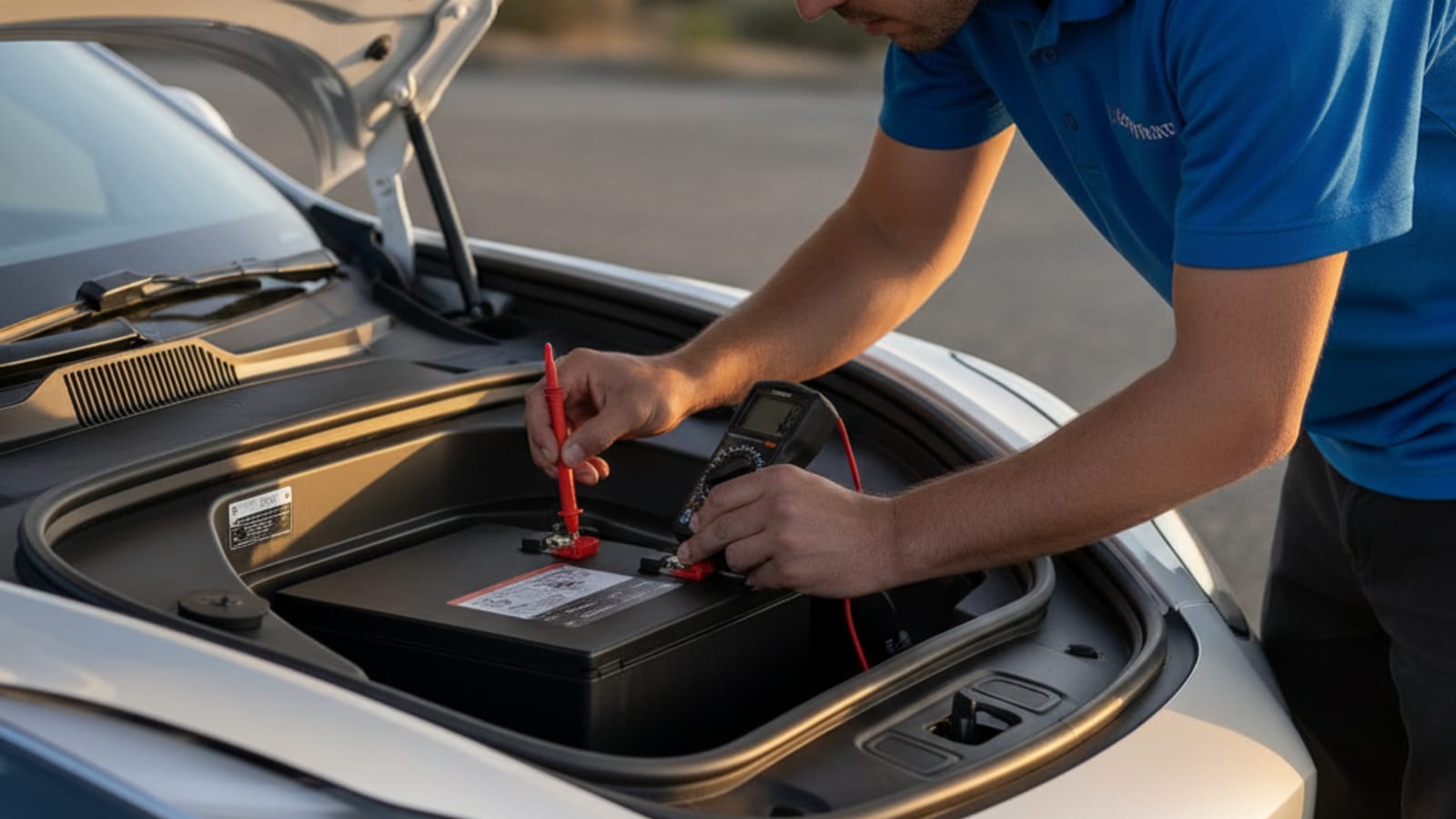
Open the hood and look at the 12V battery. A lead-acid 12V is a rectangular block with two terminals on top. A lithium 12V is a smaller rectangular block with a different shape and a different label.
The Tesla app may also tell you. The 12V health reading in the app shows the battery type. The 12V replacement notification in the app includes the part number, which tells a service center or operator which battery to bring.
A driver who isn’t sure can describe the battery to the operator on the call. The operator confirms which type it is.
What the operator brings
We’re a referral line for Los Angeles County. We match stranded EV drivers with independent local operators. The pros we connect you with are licensed and insured. We hold no license for the work. We own no trucks and employ no technicians. We set no prices and publish no arrival time.
The operator quotes you before they start. They bill you directly. No dollar figure belongs here. They quote you on the phone and confirm access before they roll.
For a lithium 12V, the operator brings a lithium-compatible charger. They connect it to the 12V terminals under the hood. They run a slow charge for 10 to 30 minutes. The lithium 12V wakes up. The Tesla’s computer turns on. The contactors close.
If the lithium 12V won’t recover, the operator brings a replacement lithium 12V in the right size for the Model 3 or Model Y. They install it on site.
Why this happens in LA County
Heat ages 12V batteries faster than mild weather. LA County summers hit 90F and above. A Tesla parked on a driveway in the sun all day in August loses 12V capacity faster than the same car parked in a garage.
A week of vacation does it too. A car that sits in a structure or on a curb for seven days returns to a 12V that’s been slowly draining the whole time. The lithium 12V doesn’t have much reserve.
The lithium 12V goes into protection mode at a higher state of charge than a lead-acid 12V. A lithium 12V at 20 percent state of charge may trip the protection circuit if the temperature is high. A lead-acid 12V at the same state of charge is still functional.
What about the older lead-acid 12V
The Model S and Model X still use a lead-acid 12V. The Model 3 and Model Y built before 2022 also use a lead-acid 12V. The procedure for those is the same as before. A traditional jump pack wakes the car. A replacement battery is the right fix if the old one won’t hold a charge.
Tesla 12V is dead: how to tell, then how to jump it covers the lead-acid version in more detail.
After the lithium 12V wakes
Once the Tesla wakes up, drive it for at least 30 minutes. The DC-DC converter charges the 12V from the traction pack while the car is moving. A short hop won’t bring the 12V back to full.
If the 12V was drained because the car sat for a week, drive it for an hour and the 12V should be back to normal. If the 12V was drained because the battery itself is at end of life, replace it. The operator can replace it on site if that’s the diagnosis.
The combined answer
A lithium 12V in a Model 3 or Model Y needs a slow charge, not a traditional jump. A mobile operator who knows the difference brings a lithium-compatible charger and runs it for 10 to 30 minutes. The lithium 12V wakes the Tesla. The driver leaves under their own power.
The number to call is (213) 410-1991. We’ll match you with a local operator. They quote before any cable goes in.