A Los Angeles County driver who stalls an EV at zero has two real answers. Tow the car to a charger, or bring a charger to the car. They aren’t equivalent. The right answer depends on what failed, where the car sits, and what the next miles look like. Here’s how to think through when a charge beats a tow in LA County.
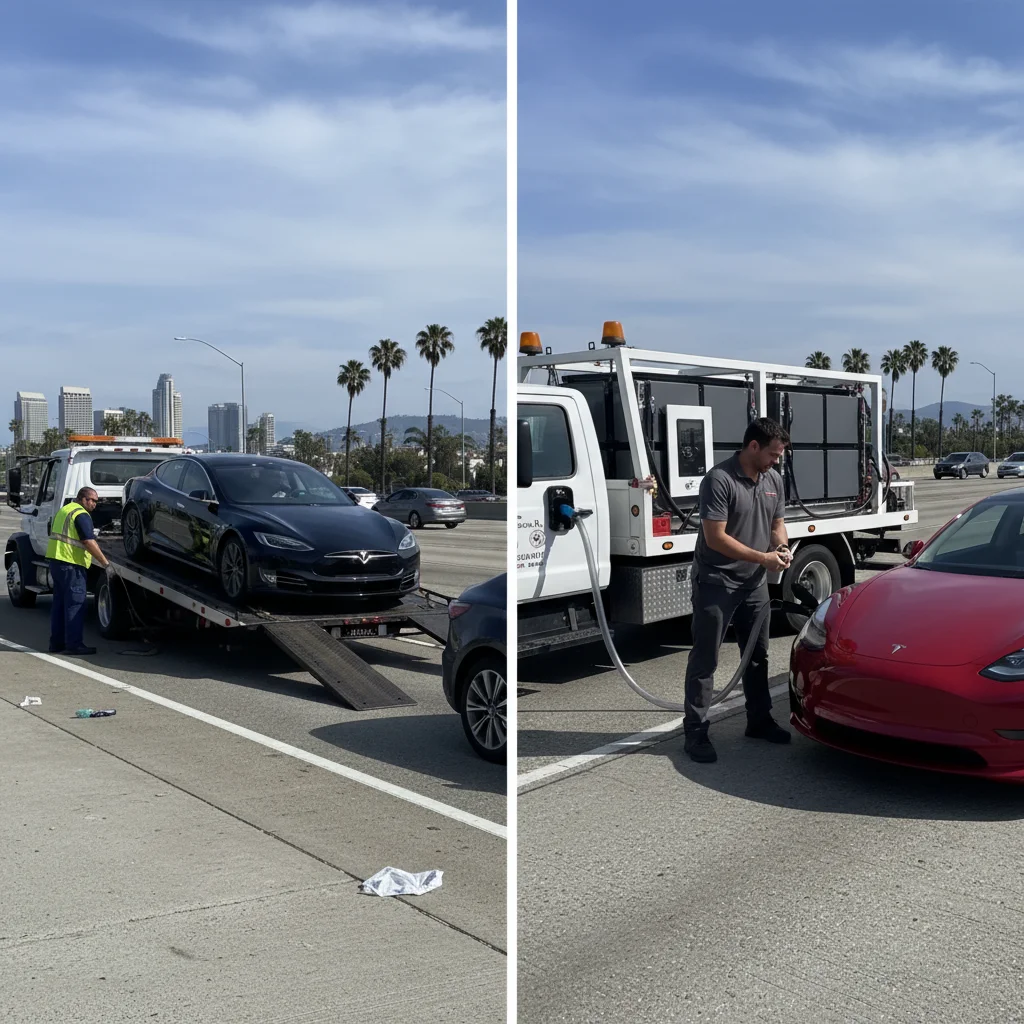
The two failures aren’t the same
The empty-pack failure means the traction pack hit zero. The 12V still works. The screen wakes. The handles unlock. The car just won’t roll. This is the version mobile EV charging was built for. The operator brings a 240-volt Level 2 source and adds 10 to 20 miles. The driver leaves under their own power.
The dead-12V failure means the small battery that powers the screen, lights, and contactors quit. The traction pack still has whatever range it had before the car parked. The screen is dark. The handles stay locked. This is also a mobile operator job, but for a different reason. The operator jumps or replaces the 12V at the stall.
The third failure is a crash or a bent wheel. Mobile charging can’t fix that. A flatbed to a shop is the right answer. A charge port that’s been physically damaged needs a tow, not a plug. The operator confirms before they start whether they can charge the car at the pin.
When mobile EV charging is the right call
The car is at zero but otherwise drivable. The traction pack is empty, the 12V works, and the car sits where the driver can stay with it. The driver needs 10 to 20 miles to reach a real charger or to get home. That’s the gap mobile EV charging fills.
This fits most LA County stalls on a curb, in a lot, or on a shoulder. The car doesn’t need to move. The operator brings the charger.
The driver is in a situation where a tow adds miles the driver doesn’t want. A tow from West Hollywood to a charger in Culver City is short. A tow from the Sepulveda Pass to a charger in Sherman Oaks crosses the hill and adds time. The mobile operator plugs in at the shoulder and the driver crosses the hill under their own power.
When a tow is the right call
The car has physical damage. A crash, a curb strike, or a bent wheel. On-site charging can’t fix that. A flatbed to a certified shop is the right answer.
The car has a charge port fault. The cable won’t lock, the port won’t accept power, or the car shows a high-voltage warning. The operator can’t charge a car with a charge port fault. The tow moves the car to a shop that can diagnose.
The car is in a location where a charging truck can’t reach. A narrow alley, a structure with no clearance, or a parking spot the operator’s van can’t pull up to. The dispatch is a tow. The driver can call a different mobile operator if one is closer, but a tow is the safe fallback.
What FSP does on the freeway
On a Los Angeles County freeway, Metro Freeway Service Patrol is one free option. Dial 511 and say Motorist Aid. FSP’s published list is a gallon of gas, a radiator refill, and a tire change. It also tows a disabled car to a safe CHP-chosen spot, free.
FSP tows. FSP doesn’t bring a Level 2 charger. If you’re on the 405, the 101, the 10, the 110, the 5, or the 60, FSP will tow you to a safe spot. After the tow, you can call a mobile operator at the new pin if you still need a charge.
What AAA does
AAA covers tows, lockouts, and tire changes. They handle 12V jumps too, depending on your plan. They do not always bring a mobile EV charger. A tow to a public charger is the answer AAA gives when the dispatch is a tow truck.
A mobile EV operator brings the charger to the car. The car doesn’t move. AAA or a mobile charge: what actually gets an empty EV moving covers the side-by-side in more detail.
The grade problem
A tow from a freeway shoulder to a charger on the other side of a hill moves the car up and over. The driver doesn’t get to drive the car over the hill. A mobile charge at the shoulder lets the driver finish the climb under their own power. This is the single biggest reason mobile charging beats a tow on the Sepulveda Pass, the Cahuenga Pass, and the climb up to Diamond Bar or Glendora.
A 10 to 20 mile boost is enough to clear a 1,000-foot climb in most EVs. The dash range at the shoulder reads zero. After 15 to 30 minutes of charging, it reads 10 to 20. The driver goes the rest of the way under their own power.
What the operator quotes
We’re a referral line for Los Angeles County. We match stranded EV drivers with independent local operators. The pros we connect you with are licensed and insured. We hold no license for the work. We own no trucks and employ no technicians. We set no prices and publish no arrival time.
The operator quotes you before they start. They bill you directly. No dollar figure belongs here. They quote you on the phone and confirm access before they roll. The operator decides on the call whether charging or a tow fits the pin. If they can’t charge the car, they tell you.
The combined answer
If the car is at zero and otherwise drivable, mobile EV charging is the right call. If the car has physical damage or a charge port fault, a tow is the right call. If the operator can’t reach the car at the pin, a tow is the right call. If the car is on a freeway shoulder, FSP can tow to a safe spot and a mobile operator can charge after.
The number to call is (213) 410-1991. We’ll match you with a local operator. They quote before any cable goes in.