Range hits zero on an LA freeway, and the usual roadside playbook does not fit an EV. A jump, a gallon of fuel, or a short tow to a garage still leaves you short of a working charger. EV charging roadside assistance is the job of putting enough energy in the pack on the shoulder so the car can roll off under its own power.
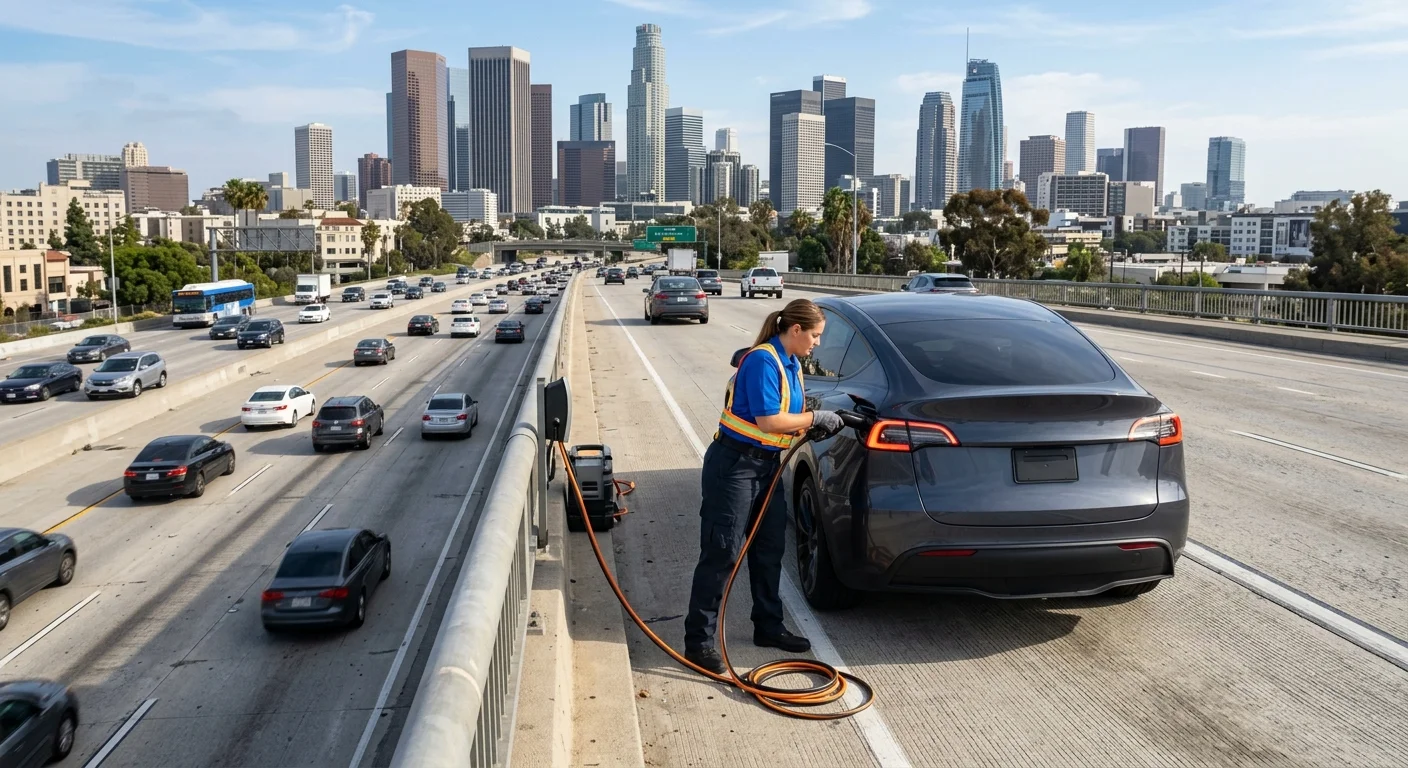
Out of charge on the 405, 10, 5, and 110
These four freeways carry most of the county’s EV traffic, and they strand you in different ways.
The 405 through the Sepulveda Pass is a long climb between the Westside and the San Fernando Valley. Range falls faster on that grade than it did on flat Sunset or Ventura. If you stall there, you are not in a parking lot. You are on a high-speed shoulder with few exits and a lot of truck traffic. The pass-specific steps live in out of charge on the 405 through the Sepulveda Pass. This page is the broader roadside-assistance search those drivers type from the fog line.
The 10 through the San Gabriel Valley is stop-and-go more than it is a mountain. Heat soak, air conditioning, and creeping traffic all chew range. El Monte, West Covina, and Alhambra sit on that corridor. A stall there is often between packed on-ramps, not at a charger plaza you can see from the car.
The 5 north toward Santa Clarita and Castaic is the county’s long northbound grade. Once you leave the dense basin, public charging is harder to confirm from a shoulder. Do not trust a remembered stall. Open the charging app you already use and check live status. If the app cannot confirm a working stall, treat that as unconfirmed and plan a mobile stop.
The 110 Harbor Freeway into downtown is short on shoulder and heavy on trucks. Metro ExpressLanes run on I-110 and I-10. Those lanes need a FasTrak transponder tied to a funded account. A dead EV in an ExpressLane is a worse problem than a dead EV on a regular shoulder. If the car still has any motion, get right, out of the priced lanes, before it stops.
California Vehicle Code 21718 prohibits stopping on a freeway, with an exception for a disabled vehicle when help has been summoned. That exception is why you call before you sit. You are not parked. You are disabled, and help is on the way.
Charge Pro LA is a referral service. We connect you with licensed, independent local operators who do the physical work. We do not own trucks, we do not run a fleet, and we do not charge the car ourselves. The operator you are matched with quotes you, bills you, and does the rescue.
For a dead pack on any of these routes, start with out-of-charge EV recovery. That is the service built for a car that cannot roll to a plug.
Why a tow to a charger is often the slow path
A tow feels like the default because that is what gas-era roadside plans were written to do.
GEICO’s published Emergency Road Service list covers towing to the nearest qualified repair facility (mileage limits apply), battery jump starts, tire changes when you have a working spare, lockout services, winching near a publicly maintained roadway, and fuel delivery. That page does not name electric vehicles or mobile EV charging. In most states, GEICO says towing is covered up to 15 miles to the nearest qualified repair facility. A public charger is not always a “qualified repair facility.” Confirm your own policy in writing. We could not confirm from a primary page what AAA, USAA, Allstate, State Farm, or any manufacturer roadside program will send on a given call. Check the membership app or the card in your wallet before you assume a charge is included.
Metro Freeway Service Patrol is free on designated LA County freeway beats. Dial 511 and say Motorist Aid. Hours are Monday through Friday 6am to 7pm, and weekends 10am to 6:30pm. Published help is a flat tire, a jump-start, a radiator refill, up to a gallon of fuel, and a tow to a designated safe location off the freeway. Mobile EV charging is not on that list. FSP can get you off the travel lane. It will not fill a traction pack.
A tow still has to find a working stall, wait for a hook, load an EV the right way, and sit in the same traffic you just left. Then you wait for a charger that may be occupied, offline, or the wrong connector. We compared that fork in on-site EV charging or a tow in LA County.
California Vehicle Code 22651 lists when a peace officer may remove a vehicle, including freeway obstruction. CVC 22651(f) is blunt: if a vehicle is stopped on a freeway right-of-way with full access control for more than four hours, and the driver cannot move it under its own power, it can be towed. Sitting and waiting for a distant stall to free up is how you burn that clock.
The slow path is not the truck. The slow path is the extra steps after the truck: the charger hunt, the wait, the second move. Roadside assistance EV charging cuts that chain by putting energy in the car where it sits.
What a mobile Level 2 stop actually adds
A typical rescue charge is 10 to 20 miles of range in 15 to 30 minutes of Level 2 charging. That is charging time, not arrival time. Nobody here can promise when a truck shows up.
The U.S. DOE Alternative Fuels Data Center notes that AC Level 2 equipment can range from 2.9 to 19.2 kW. What you get on the shoulder depends on the operator’s gear and your car’s onboard charger. The point is not a full pack. The point is enough miles to leave the freeway, reach home, or reach a public stall you have already confirmed in an app.
Mobile EV charging is the roadside version of that stop. The charger comes to the car. You do not limp the car to the charger.
How much roadside EV charging costs is between you and the operator. Charge Pro LA sets no prices, fees, or discounts. Ask for the quote before work starts. If you want the quoting process in LA County terms, read how mobile EV charging is quoted in LA County. We will not invent a kWh rate or a callout fee here.
A portable trunk charger is not the same as a rescue truck. If you already carry a Level 2 unit and you are in a legal, powered parking spot, that is a different job. On a freeway shoulder you do not have a 240-volt outlet. You need an operator with onboard power.
The U.S. Department of Energy’s electric vehicle pages are a clean primer on how Level 1, Level 2, and DC charging differ. Use that for the physics. Use a local operator for the shoulder.
Roadside assistance for EV drivers is still new to a lot of insurers. Do not assume a fuel-delivery benefit converts into a charge. Ask the operator what they will deliver: miles of range, minutes of Level 2, connector type. Write it down.
Shoulder safety before an operator arrives
Get as far right as the car will still roll. Hazards on. If you can, put the car in Park and stay inside with the seat belt on unless the car is in a live lane or on fire.
Call for help so you fall under the CVC 21718 disabled-vehicle exception. Then stay off the travel lanes.
CVC 21809 is the move-over law. Other drivers must slow or change lanes for stopped emergency, tow, or Caltrans vehicles displaying flashing lights. That protection starts when that vehicle is on scene, not while you are sitting alone in a dark EV. You still do not walk the fog line to flag someone down. Let the call, and later the lights, do that work.
If you are on a designated FSP beat during published hours, 511 Motorist Aid can still help with a move to a safer turnout. That is a safety move, not a charge.
Do not stand behind the car. Do not pop the hood to look like a gas breakdown. Traction packs are not jump-started with jumper cables the way a 12-volt accessory battery sometimes is. If the screens are dark, that may be a 12-volt issue rather than an empty pack. Tell the operator both symptoms. They will sort which rescue you need.
Private property is a different statute. CVC 22658 covers private-lot tows, including a sign not less than 17 inches by 22 inches with lettering not less than one inch high, and a half-charge rule if you return after the car is coupled but before it leaves. A freeway shoulder is not a shopping-center stall. Do not treat them the same.
Keep passengers, kids, and dogs in the vehicle if it is safe. Basin heat and pass wind both punish people standing on chip seal. If you must exit, exit right, away from traffic.
Take a photo of mile markers, an exit sign, and the direction of travel. Operators in this county need “northbound 405 at Mulholland” more than they need “I’m on the 405.”
Matching NACS, CCS, and Tesla connectors on site
A mobile stop fails when the plug in the truck does not match the port on the car.
Say the make, model, and year. Say whether the port is NACS, CCS, or a Tesla-branded inlet. Adapters live in trunks and get left at home. Do not assume the operator carries every adapter. Confirm before they roll.
Tesla-specific station maps and official range figures could not be confirmed from Tesla’s site for this page. Check the Tesla app, or the charging app you actually use, for live stall status. If the app is down or a site looks offline, treat that as unconfirmed. Do not drive on a remembered always-open Supercharger.
CCS cars (Hyundai, Kia, Ford, Chevy, VW, and many others) need a CCS1 plug unless you already have a NACS adapter fitted. Some newer models shipped with NACS. The operator cannot guess from the badge.
J1772 is the common Level 2 inlet on many non-Tesla EVs. A Level 2 rescue often lands on J1772 or NACS, not a DC-fast gun. That matches the 10-to-20-mile goal. You are not trying to refill 80 percent on the fog line.
If the charge port will not open, say so on the call. A stuck door is a different job than an empty pack. Forcing it on a live shoulder is how ports get broken.
Once the operator is on site, they set cones, confirm the car is in the right state to accept charge, and plug in. You contract with that operator, not with Charge Pro LA. The pros we connect you with are licensed and insured. Their work is the work.
If the pack is empty and the 12-volt is also dead, say both. A car that will not unlock or will not wake may need a 12-volt step before any Level 2 session starts.
The California Energy Commission tracks the state’s charging build-out at energy.ca.gov. Those pages will not tell you which stall is open at 9 p.m. on the 10. Your app will, if it is working. If it is not, plan for a mobile stop instead of a gamble.
Searching “roadside assistance EV charging near me” from the shoulder is the right instinct. Pick a local match who can name your freeway and your connector, not a national script that only offers a tow.
When to call us
Call when the pack is empty, the car is on an LA County freeway or surface street, and you need energy in the car rather than a ride to a maybe-working stall. That is out-of-charge recovery and mobile EV charging together. Call us at (213) 410-1991 and we’ll connect you with a local EV rescue operator.