An EV that reaches zero on Interstate 605 needs a freeway rescue plan, not a search for the closest plug. Move as far right as the car can safely travel, turn on the hazards, summon help, and report your direction and nearest exit. Then decide whether the car needs energy at a safe staging point or a tow.
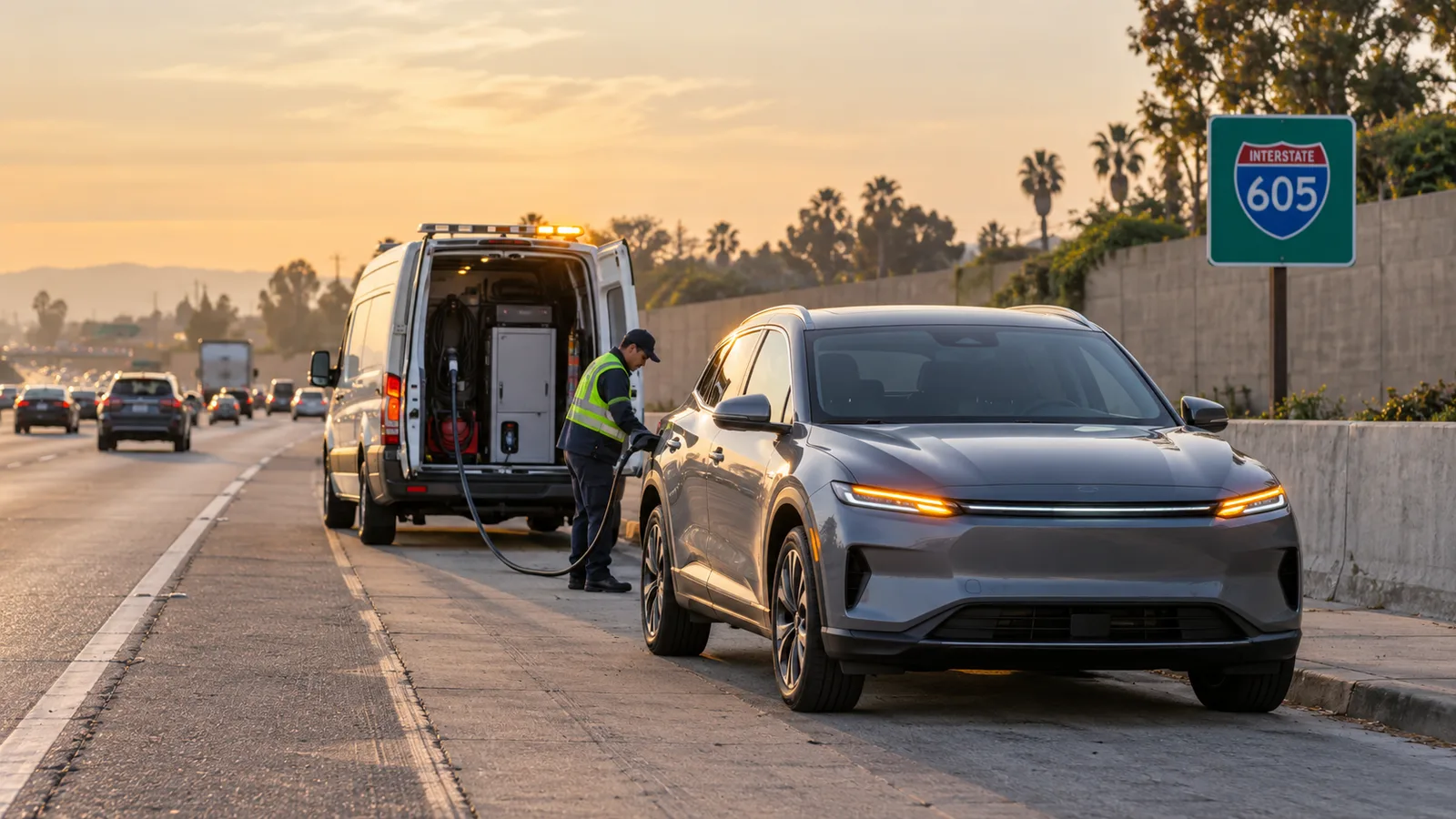
First steps when the pack reaches zero
California law generally prohibits stopping on a freeway. Vehicle Code 21718 includes an exception for a disabled vehicle after help has been summoned. That makes the first call important.
If the car can still move, take the next safe exit. Do not spend the final usable energy circling for a charger. If it cannot move, get as far out of the travel lane as possible. Keep seat belts on when staying in the vehicle is the safer option. Follow instructions from law enforcement or roadside personnel at the scene.
Tell the dispatcher:
- Northbound or southbound I-605
- The last exit passed and the next visible exit
- Whether the vehicle is fully on the shoulder
- Whether the display is awake
- Whether the traction battery reached zero while driving
- The make, model, and charge-port type
Also report whether the displays are awake and whether the traction-battery reading reached zero while driving. Those observations help the operator choose the right equipment without asking you to diagnose the vehicle on the shoulder.
Why the 605 location matters
California Streets and Highways Code 619 designates Route 605 as the San Gabriel River Freeway. The route runs from Route 1 near Seal Beach to Route 405, then continues north to Route 210 near Duarte.
That long north-south corridor crosses several different rescue conditions. Near Lakewood, an operator may need to reach a shoulder close to the 91 or move the car to a surface street. Farther north, the same freeway reaches the San Gabriel Valley. Saying only “the 605” leaves too much unknown.
Use a ramp, cross street, or freeway sign as the pin. Lakewood Boulevard and the 91 interchange are more useful than a city name alone. Share a phone location pin only after confirming it matches the side of the freeway where the car stopped.
Call 511 for the freeway problem
Metro Freeway Service Patrol is free on designated Los Angeles County freeway beats. Dial 511 and say “Motorist Aid.” The patrol can be the right first call when a disabled vehicle needs protection or movement from a dangerous shoulder.
Metro’s published assistance list does not include mobile EV charging. It names services such as a jump-start, tire help, and towing a disabled vehicle to a designated safe location. A low-voltage jump can wake an EV whose 12V system is down. It does not refill an empty traction pack.
If Freeway Service Patrol moves the car off the freeway, confirm the drop point. A safe surface-street location is not necessarily a charger. You may still need out-of-charge recovery after the tow.
Mobile charge or tow?
A mobile charge adds energy where the vehicle can be reached safely. A tow moves the vehicle somewhere else. They solve different tasks.
A typical mobile rescue charge adds 10 to 20 miles of range during 15 to 30 minutes of Level 2 charging. That is charging time, not an arrival estimate. It may be enough to reach a working public charger after the car is safely off the freeway.
A tow may be the right choice when:
- The car is partly in a travel lane
- The shoulder is too narrow for charging equipment
- Law enforcement directs that the vehicle be moved
- The car will not accept a charge
- Collision damage or another fault makes driving unsafe
Do not assume an insurance tow will take the car to the charger you choose. Confirm the covered destination and mileage with the insurer before authorizing the tow.
What the operator needs before coming out
Give the vehicle’s exact model and model year when you know them. Connector requirements vary. A Tesla with a native NACS inlet does not present the same connection as every CCS-equipped vehicle.
Also report whether the charge-port door opens and whether the car can shift into neutral or transport mode. Do not experiment with towing procedures on the shoulder. The owner’s manual controls how that specific vehicle may be moved.
Charge Pro LA is a referral service. We connect drivers with independent local operators. The operator performs the work, sets the quote, and bills the driver directly. Charge Pro LA does not own a truck, employ a crew, set a price, or promise an arrival time.
For a broader decision between charging, a low-voltage jump, and towing, read EV died: should you charge, jump, or tow?. For help across the county, use EV roadside assistance.
Before the next 605 trip
Check the route in your charging app before leaving with a small buffer. A listed station can still be occupied or unavailable. Keep a second charging option in mind on longer freeway trips.
Save the vehicle maker’s roadside instructions offline. Transport mode and charge-port release procedures differ by model. Those instructions are easier to find before the dashboard goes dark.
If your EV is out of charge on the 605, call (213) 410-1991. Give the direction, nearest exit, shoulder condition, and vehicle model. We will connect you with an independent operator who can quote the appropriate next step.