The public stall on your garage level will not start a session. Range on the dash is already at zero on the 405 through the Sepulveda Pass. Drivers who want an EV mobile charging service want a licensed local operator at the car with portable Level 2 gear, enough miles to roll to a working charger, and a quote before anyone plugs in.
What drivers mean by a mobile charging service
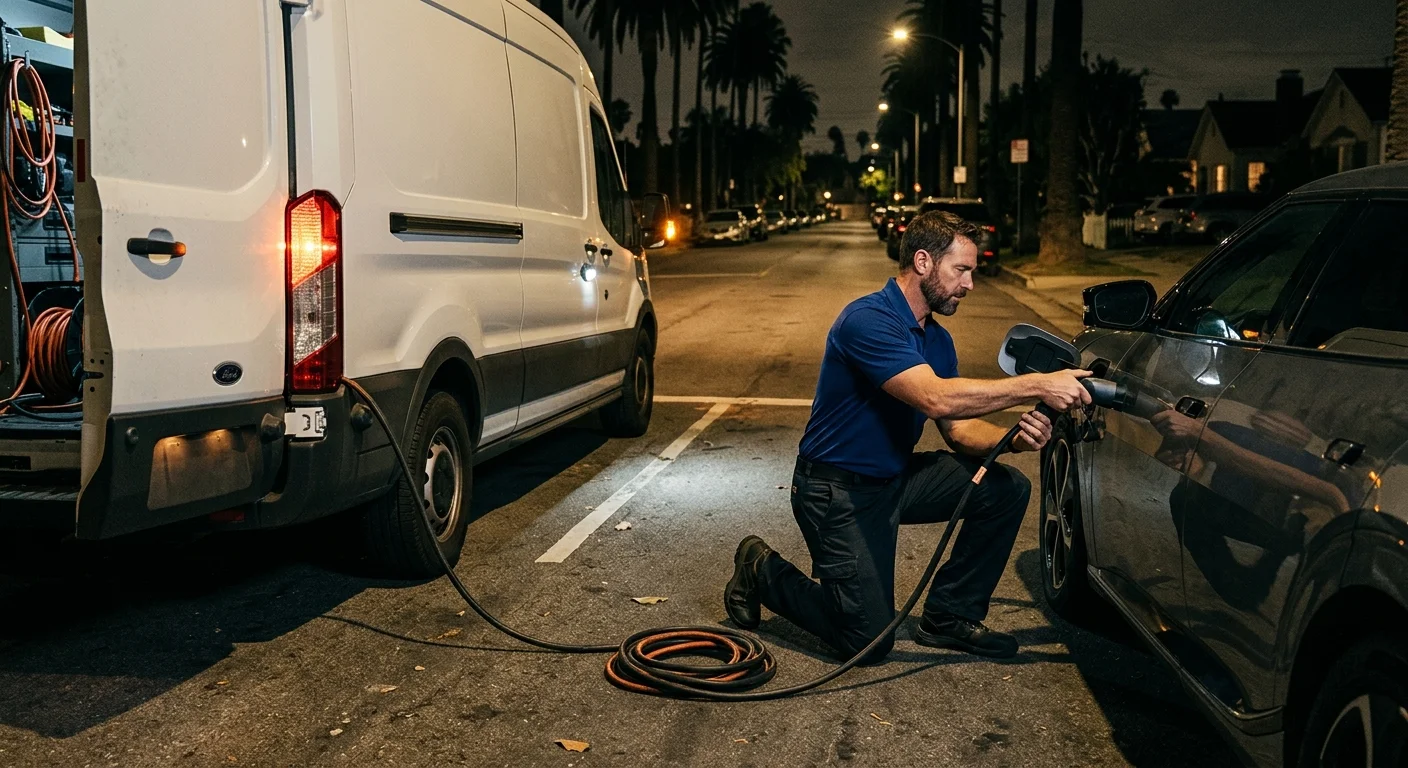
When someone in Los Angeles County asks for an EV mobile charging service, they mean power delivered to the parked car. A van or small truck rolls to the pin. A licensed independent operator plugs portable Level 2 gear into the inlet. The session adds enough range to leave.
That call comes from a short list of local scenes. A Bunker Hill or South Park garage where the pedestal on your level is dark. A Santa Monica Civic or Manhattan Beach lot after a beach day, every stall showing an error. A West Hollywood curb where overnight charging never finished. A San Fernando driveway after the home unit tripped. A PCH turnout in Malibu after the coastal hills used the last miles. A shoulder on the Sepulveda Pass, grade still climbing toward the Valley.
The operator who takes the stop is independent. Charge Pro LA refers the job. We own no van, cables, or inverter. The matched pro already works this county. They confirm the port, stage the vehicle, and run the session at your bumper.
The hardware is usually a van or small truck with onboard storage and an AC Level 2 dispenser. For the equipment picture, read what an EV charging truck actually is. The service page for the product itself is mobile EV charging.
A typical rescue charge adds 10 to 20 miles of range in 15 to 30 minutes of Level 2 charging. That clock is session time at the car. The U.S. Department of Energy Alternative Fuels Data Center states that AC Level 2 equipment can range from 2.9 to 19.2 kW. What you get on a given stop depends on the operator’s gear and what your car will accept. Ask on the call.
If you are scanning by neighborhood, use mobile EV charging near me in Los Angeles County. This page is the commercial service: what it is, how a stop is quoted, and who does the work.
Metro Freeway Service Patrol will not run that session. LA Metro’s published help is flat tires, jump-starts, radiator refills, up to a gallon of fuel, and a tow to a designated safe spot off the freeway. Hours are Monday through Friday 6am to 7pm, and weekends 10am to 6:30pm. Dial 511 and say Motorist Aid if you are on a designated beat. Plan a charge once you are off the lane.
A Level 2 boost versus a tow to a public stall
The choice on site is a boost or a flatbed.
A Level 2 boost fits when the traction pack is empty and the car still wakes. The operator plugs in. You wait through 15 to 30 minutes of charging. You leave with 10 to 20 miles, usually enough to reach a working public stall or a home plug.
A tow fits when the car will not accept charge, the 12-volt system will not close the high-voltage contactors, or you cannot stay where you are. California Vehicle Code 21718 prohibits stopping on a freeway, with an exception for a disabled vehicle when help has been summoned. California Vehicle Code 22651(f) lets a peace officer remove a vehicle left more than four hours on a freeway right-of-way when the driver cannot move it under its own power. On the 405 through the Sepulveda Pass, that four-hour mark is a live risk. Get to a shoulder if you can. Hazards on. Stay belted unless a peace officer says otherwise.
CVC 21809 is the move-over law. Other drivers must slow or change lanes for stopped emergency, tow, or Caltrans vehicles displaying flashing lights.
Downtown Los Angeles parks in stacked structures. Bunker Hill, the Financial District, South Park, and Little Tokyo hide dead cars on garage levels with low clearance and valet desks. A boost in the stall beside you can beat a flatbed down a spiral ramp during the evening crush on the 110. A tow still wins if you are blocking a fire lane, or the operator cannot reach the port.
Beach lots fail in a different pattern. Santa Monica, Manhattan Beach, Redondo Beach, and the Malibu civic stretch along PCH fill with visitors who planned on a public pedestal. The City of Malibu describes that PCH section as 21 miles. When those pedestals are down, the lot is a row of cars with nowhere to plug. A mobile stop at the space gets you out. A tow from a packed weekend lot still dumps you at another stall that may also be down.
If the pack is empty and you need recovery rather than a short boost, that work is out-of-charge EV recovery. Same referral model. The matched operator decides on site whether a Level 2 session or a tow is the honest next step.
Insurance roadside is a separate question. GEICO’s Emergency Road Service page lists towing to the nearest qualified repair facility (mileage limits apply), battery jump starts, tire changes when you have a working spare, lockouts, winching near a publicly maintained roadway, and fuel delivery. In most states GEICO says towing is covered up to 15 miles to the nearest qualified repair facility. That page does not name electric vehicles or mobile EV charging. Confirm your own policy before you assume a charge is covered.
Connectors on site: NACS, CCS, and Tesla
The stop fails if the cable does not match the port. Name the connector on the first call.
NACS is the North American Charging Standard plug. Tesla cars in this market use it. A growing set of newer non-Tesla models use it as well. CCS Combo 1 is still the DC port on a large share of Hyundai, Kia, Ford, GM, Volkswagen, and BMW EVs in the county. The J1772 inlet is the AC socket on most non-Tesla cars. CHAdeMO still appears on some older Nissan Leafs.
A mobile Level 2 session usually lands on J1772 or NACS on the AC side. Tesla cars take AC through the NACS port. Many CCS cars take AC through the J1772 half of the inlet. Adapters exist. The operator should say which adapter they will bring. A random adapter in the frunk is a poor plan for a Sepulveda Pass shoulder or a B2 stall downtown.
Give the dispatcher the make, model, year, and a photo of the open charge door. Westside structures hide the port against a pillar. Downtown garages hide it against a wall. Beach lots hide it behind a tire stop. The operator needs to know which side the port sits on before they stage the van.
Charge Pro LA stocks no cables. The matched operator does. If they cannot serve your inlet, they should say so before they roll.
The U.S. Department of Energy keeps a plain overview of electric vehicles and charging. The California Energy Commission tracks ZEV and charging policy at energy.ca.gov. Those pages explain the hardware. They do not dispatch an operator.
How operators quote a stop, without invented fees
Charge Pro LA sets no price. The operator quotes you and bills you. That is the network rule.
A real quote is built from a few inputs. Location first: a Burbank driveway is one stop, a B2 stall under Bunker Hill is another, a PCH turnout in Malibu is a third. Connector and adapter next. Then how many kWh you need to reach the next working charger you can actually use. Access after that: garage height, valet, a fire lane, an HOA gate on a Calabasas cul-de-sac. Traffic across the Sepulveda Pass and the 10 changes how long the operator spends on the road. Nobody on this site will invent an arrival window for that.
We publish no per-kWh rates, dispatch fees, or starting prices. Those figures change by operator and by stop.
The walkthrough of those inputs is how mobile EV charging is quoted in LA County. Read it before you argue with a number on the phone.
Ask every time: what kW they will deliver, how many kWh they plan to add, whether that is enough to reach a named charger, and what the quote includes. Get it in a text if they will send one. California Penal Code 632 makes this an all-party consent state for recording confidential communications. Record the call only when everyone on it agrees.
You pay the operator. Charge Pro LA does not bill you for the energy.
Who Charge Pro LA connects you with
Charge Pro LA is a referral service for Los Angeles County. We match drivers with licensed, independent local EV charging professionals. We perform no work. We employ no technicians. We own no trucks. We hold no trade license. We give no warranty. You contract with the professional. You pay that professional directly.
The service area is Los Angeles County: 48 cities and communities in 9 regions. That runs from Lancaster and Palmdale through Santa Clarita and the San Fernando Valley, across the Westside and downtown, down the South Bay, and out through the San Gabriel Valley to Pomona and Diamond Bar. A dead stall in a Torrance lot is a different stop from a Castaic off-ramp. Local operators know those seams.
The pros we connect you with are licensed and insured. Their work is theirs. If a session needs a warranty conversation, that conversation is with the operator who billed you.
Call with the pin, the car, the port, and the range you still show. If the cluster is dark, say that too. We connect you with a local EV rescue operator who can take the stop.
When to call us
Call when the car will not make the next working charger, the public stall in your garage or beach lot is dead, or you are on a shoulder and need a Level 2 boost. Call us at (213) 410-1991 and we’ll connect you with a local EV rescue operator.