The 60 crawls through Monterey Park and the range number can hit zero before Atlantic. Garvey looks busy enough that a charger should be right there, but an empty pack does not coast like a gas tank on fumes. Put the hazards on, stay out of the travel lane if you still have any motion, and treat this as a disabled EV, not a parking errand.
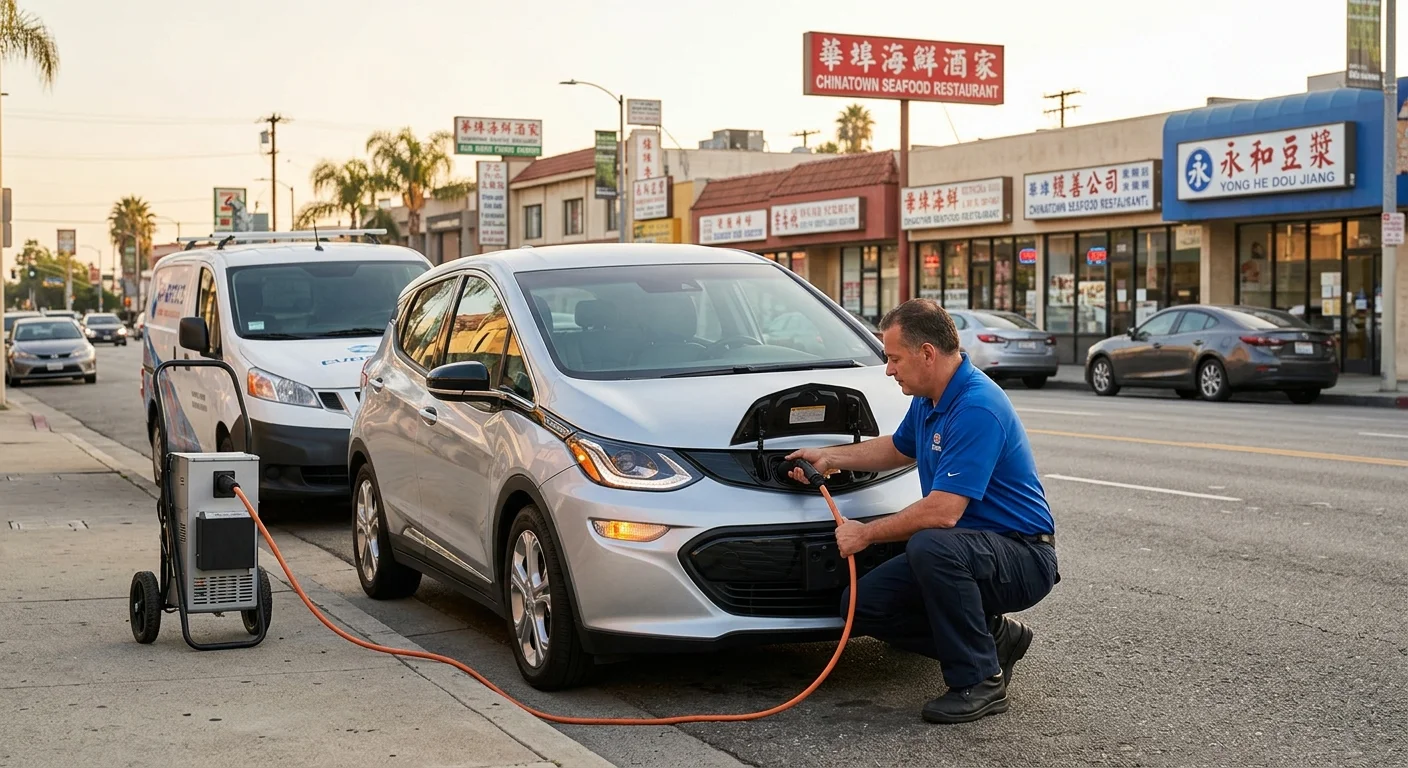
Empty pack on the 60, Garvey, or Atlantic
Monterey Park sits in the west San Gabriel Valley on the SR-60 corridor, with Garvey Avenue running east-west through the commercial strip and Atlantic Boulevard cutting north-south. Those three lines are where most empty-pack calls start. The 60 is a freeway. Garvey and Atlantic are city streets with driveways, lots, and curb cuts. What you do first depends on which one you are on.
If you are on the 60, California Vehicle Code 21718 bars stopping on a freeway except for a disabled vehicle after you have summoned help. Hazards on. Stay in the vehicle if it is safe. Do not walk the shoulder looking for a plug. Metro Freeway Service Patrol runs on designated Los Angeles County freeway beats. Dial 511 and say Motorist Aid. FSP’s published help is a tire change, a jump, a radiator refill, up to a gallon of fuel, or a tow to a designated safe spot off the freeway. That list does not include mobile EV charging. CVC 21809 is the move-over law for stopped emergency, tow, or Caltrans vehicles with flashing lights. If the car sits more than four hours on a full-access freeway, CVC 22651(f) lets a peace officer remove it.
On Garvey or Atlantic the picture is different. If you still have a trickle of motion, get out of the through lane into a driveway, a lot, or a legal curb. Hazards still matter. You are in a dense, older street grid, not a wide desert shoulder. Delivery vans, buses, and left-turn pockets fill Atlantic at rush hour. Garvey’s storefronts sit close to the curb. A dead EV in the number-one lane is a traffic problem before it is a charging problem.
West of here, Garvey feeds toward Alhambra. South of the city, the I-10 is the other east-west trap in this part of the valley. A stall on the 10 is a different road with different ramps, which is why we keep a separate guide for a stranded EV on the 10 in the San Gabriel Valley. In Monterey Park the 60, Garvey, and Atlantic are the ones in front of you. Emergency EV roadside assistance in this city means matching you with a licensed local operator who can come to that pin, not a national script that treats every zip the same.
Tesla and CCS connectors are the mix operators see in this part of the county. Say the make, the port, and whether the car is on the freeway or a surface street when you call. That is the difference between a useful dispatch and a truck that cannot plug in.
Apartments with no home plug in the San Gabriel Valley
A lot of Monterey Park driving does not start from a garage with a wall unit. Census ACS 2019-2023 puts the city at 59,639 people, with 78.3% of housing built before 1980. That stock is two-story stucco, courtyards, carports, and street parking. Assigned EV stalls are rare. Many drivers trickle from a 120-volt window outlet, or they do not plug in at home at all.
Southern California Edison delivers power in most of Los Angeles County outside municipal-utility cities, and Monterey Park is in that SCE footprint. SCE publishes Charge Ready Home, a rebate toward a Level 2 home charger, but that path is for a unit you control. Renters on Garvey, Atlantic, or the side streets off those arterials often cannot add a 240-volt circuit. The morning then starts with whatever the car held last night. A short hop to a market, a school drop, or a run toward the 60 can empty a pack that never had much to give.
Cabin climate is the drain people underestimate. Recurrent Auto’s winter work across dozens of models found EVs keep about 78% of range at 32°F on average, with cabin heating the main driver, and about 70% even at 20°F. Monterey Park is not a mountain town, but A/C on a hot San Gabriel Valley afternoon, stop-and-go on Garvey, and hill grades toward the Repetto side of town still chew range. You feel it most when home charging was never in the picture.
This is also why a neighbor’s building is a weak backup. Older panels, shared laundry circuits, and unassigned carports are a poor place to hunt for a spare outlet after dark. If the car is already at zero in that driveway, you need energy brought to the bumper. Long term, a Level 2 install where the building and the utility allow it is the fix. Tonight, mobile EV charging is the tool that does not depend on a landlord, a HOA, or an open public stall two cities over.
Alhambra sits immediately west, and that city already has its own roadside write-up. Monterey Park’s apartment mix, the 60, and Garvey’s commercial curb are not Alhambra’s. If you live here and work toward the west, read EV roadside assistance in Alhambra for that side of Garvey. Stay on this page when the pin is Monterey Park.
12V brick versus a true zero pack
Two failures look like a dead EV from the sidewalk. Only one of them is an empty drive battery. Mixing them up wastes a tow and a charge.
A true zero pack is a range problem. The display shows no miles, or the car will not propel because the high-voltage battery is empty. Lights and screens may still work for a while. The charge port is the path back. A typical rescue charge from a Level 2 mobile unit is 10 to 20 miles of range in 15 to 30 minutes of charging. That window is charging time, not travel time. It is enough to reach a stall you choose, or to get home to the apartment outlet you actually have. The U.S. Department of Energy notes that AC Level 2 equipment can range from 2.9 to 19.2 kW, so the miles you gain depend on the gear the operator brings and what your car will accept.
A 12V brick is a different car. The 12-volt battery runs computers, contactors, locks, and the “ready” state. When it is down, the car can look fully dead even with tens of miles still in the pack. Doors may not release the way you expect. The charge port may not wake. Jumping or replacing that 12-volt battery is the work, not a roadside fill of the big pack. Do not throw jumper cables at high-voltage terminals. Say what the screen showed before it went dark. Mention any 12V or “electrical system” warning from the last few days.
Tesla and CCS cars both show this split. The port on the car does not tell you which failure you have. The symptoms do. If the car still reports miles and simply will not go ready, tell the operator that. If it reports zero and rolled to a stop on Atlantic, that is a pack. Roadside assistance for EV drivers fails when the first truck is a gas-can call or a generic jump that never looks at the port.
You can still tow an EV when it breaks down. A flatbed to a charger or a shop is legal and common. FSP, as noted, will tow a disabled vehicle off a designated freeway beat to a safe location. That does not refill the pack. If the only problem is energy, a mobile charge on site usually beats a tow across the valley and a wait in a foreign lot. If the 12V is the failure, towing a silent car without the right procedure can make a simple brick worse. Describe both possibilities when you call, and let the matched operator decide on site.
Public stalls nearby, and what to do when they are full
Do not treat an empty pack as a scavenger hunt with no Plan B. Open the charging app you already use and look for an open stall you can actually reach. We do not publish a nearest-charger list for Monterey Park. Station counts and mile figures go stale, and inventing them does not help you. If you still have a few miles, a working stall is the cheapest path. If you are already at zero on Garvey, the app is only useful for a destination after a rescue charge.
Full stalls are the usual second failure. A single open bay on a map is often occupied, offline, or blocked by a gas car. Sitting behind a charging vehicle with hazards on is not a plan, and it is a problem for the business whose curb you are using. Move only if you can do it without rolling into traffic. Otherwise stay put and call.
Tesla and CCS both show up in this zip of the county. A Tesla-only stall does not help a CCS-only car. A CCS stall does not help every Tesla unless the adapter and the network actually allow it. Read the plug on your car, not the logo on the shopping center. If the stall starts a session and then dies, that is a station fault, not proof that your pack is healthy. Try one other stall if you can roll to it. After that, stop burning the last mile.
Insurance roadside is a weak substitute for a mobile charge. GEICO Emergency Road Service, as one example of a published plan, is optional coverage. Its listed help is a tow to the nearest qualified repair facility (in most states, up to 15 miles), a jump, a tire change with a working spare, lockout help, winching near a publicly maintained roadway, and fuel delivery. That page does not name electric vehicles or mobile EV charging. Other carriers were not confirmed here. Read your own card. Do not assume a fuel-delivery benefit turns into a kilowatt-hour delivery.
The California Energy Commission tracks the state’s charging buildout, and more stalls will keep landing in the San Gabriel Valley. That does not charge the car in front of you when every plug on the block is taken. Roadside assistance EV charging near me, in this city, means a licensed operator bringing Level 2 energy to the bumper so you can leave under the car’s own power.
Calling a local operator through Charge Pro LA
Charge Pro LA is a referral service. We match you with a licensed, independent local EV rescue operator. We do not own the truck, we do not hold a trade license, and we do not set the price. The operator quotes you, you accept or you don’t, and you pay that operator directly. There is no brand fee schedule, no “free estimate” promise, and no arrival window we can publish. Anyone who quotes you a number of minutes before a truck is even matched is guessing.
Have this ready when you call. You are in Monterey Park. You are on the 60, on Garvey, on Atlantic, or in an apartment driveway. The car is a Tesla or a CCS vehicle, named by make. The failure is a zero pack, a 12V brick, or you are not sure. Hazards are on. If you are on the freeway, say whether 511 already has a Motorist Aid call in. If a public stall is full two blocks away, say that too, so the operator is not routing you to a bay you already lost.
How much roadside EV charging costs is a question the operator answers, not this page. Market talk that does not name a source is how bad numbers get into print. Confirm the quote before the session starts. A typical on-site Level 2 rescue aims for 10 to 20 miles in 15 to 30 minutes of charge time. That is enough to get off Garvey, off the 60, or over to a stall you pick. It is not a full pack.
What drains the battery most on this side of the valley is climate control, then short, cold, or hot trips with no home plug. Older apartment stock makes that worse. If this is the second empty-pack week in a row, the roadside call is the symptom. The cause is overnight energy you do not have. Fix that with a real home circuit where you can, and keep a local operator in the phone for the nights you cannot.
If you searched ev roadside assistance near me while sitting in Monterey Park, you are in the service area. We serve Los Angeles County, including this city. The pros we connect you with are licensed and insured. They bring the connector your car uses. You stay with the vehicle, keep the scene safe, and let that operator do the plug-in work.
When to call us
Call when the pack is at zero on the 60, Garvey, or Atlantic, when the apartment outlet never fed the car, or when every public stall you can reach is full or dead. A 12V brick that will not wake the car counts too. Call us at (213) 410-1991 and we’ll connect you with a local EV rescue operator.