GEICO’s Emergency Road Service page lists what the policy sends, and charging an EV is not on it. Here’s what the published wording says, and what an LA County driver can do about a stranded EV when the pack is empty.
What does GEICO’s Emergency Road Service page list?
GEICO’s own Emergency Road Service page lists exactly these covered services: towing to the nearest qualified repair facility (mileage limits apply), battery jump starts, tire changes when you have a working spare, lockout services (up to $100 for covered causes), winching if the vehicle is stuck near a publicly maintained roadway (distance limits apply), and fuel delivery to reach a gas station or destination (fuel cost not included). That is the published menu. Read it as written.
Emergency Road Service is optional coverage on a GEICO policy. It is added to the policy. It is not automatic. Confirm it is on your declarations before you treat that list as yours.
The covered-services list does not name electric vehicles, EV charging, or an EV-specific jump start anywhere. A jump start and fuel delivery are the services named. Charging is not on the list. Say that the car is an EV with little or no range when you call, so the dispatcher is working from the same facts you are.
This article is built on GEICO’s published wording, read on 2026-09-23. Nothing about what Tesla, Rivian, Lucid, Polestar, AAA, Allstate, State Farm, Progressive, Farmers or Liberty Mutual roadside covers is stated here. Those sources were not read and verified. We could not read USAA’s roadside page on 2026-09-23, so nothing about a USAA plan is stated as fact either. Read your own policy and your own maker programme.
What does the 15-mile tow limit mean for an EV?
GEICO’s page says: in most states, towing is covered up to 15 miles to the nearest qualified repair facility where repairs can be made. The destination in that sentence is a repair facility. It is not a public charger, a parking garage, or your driveway.
When the nearest qualified repair facility is not a charger, the covered tow may end at a shop. A charger is a different destination. Ask GEICO, before the truck hooks up, whether the place you want counts as that facility, and whether miles past 15 are covered.
A 15-mile tow can move the car off the pin. It does not put range in the pack. Those are different jobs. Choose the outcome you need before you authorise the truck.
Why is a tow different from a charge?
A tow loads the car and takes it somewhere. A mobile charge stays at the pin and puts range back so you can drive. GEICO’s published list names towing and battery jump starts. It does not name charging. Treat those as separate outcomes, dispatched and billed as separate jobs.
A typical mobile rescue charge is 10 to 20 miles of range in 15 to 30 minutes of Level 2 charging. That is charging time. It is never an arrival time.
If the car will not take a charge, a tow may still be the right call. Authorise the outcome that matches the car in front of you. The jump-start line on GEICO’s page is a jump start.
What can a Los Angeles County driver do instead, or as well?
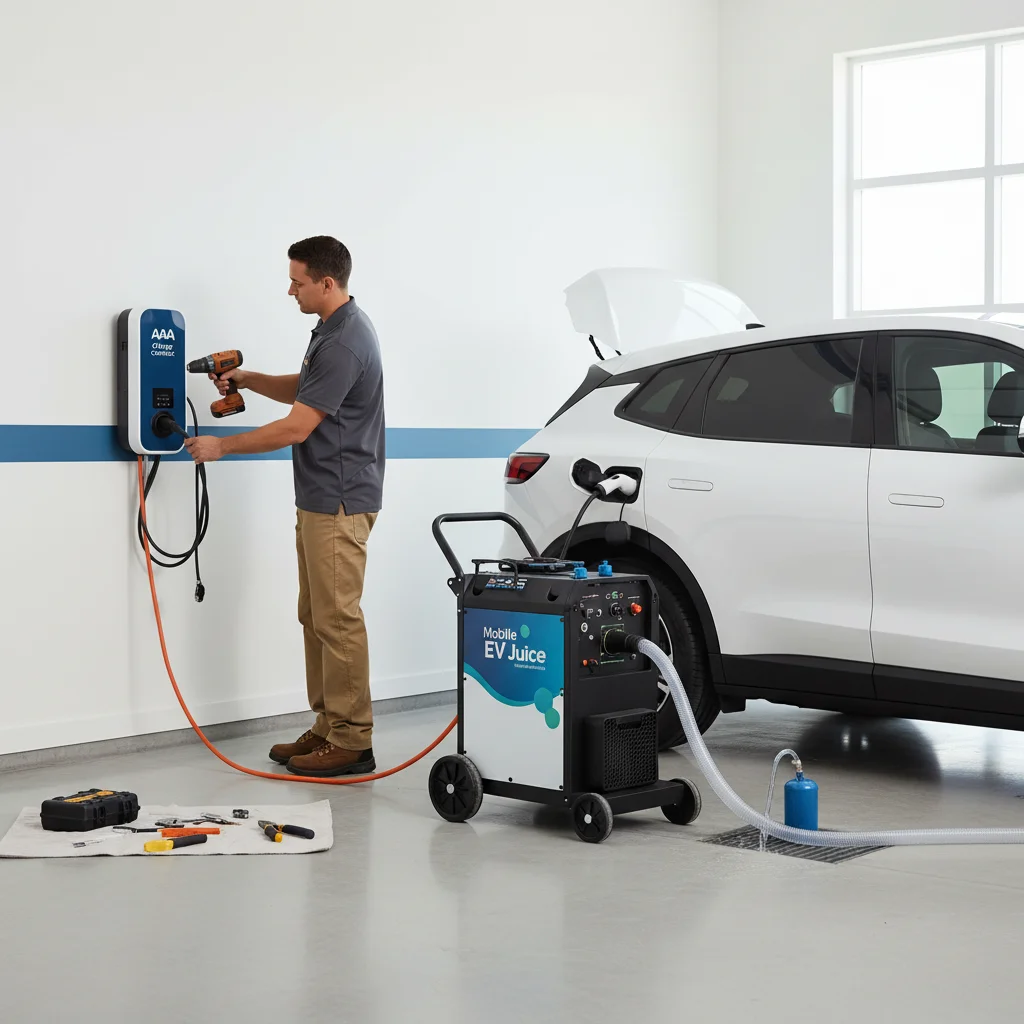
You can call GEICO and still arrange a mobile charge at the pin. Charge Pro LA covers 48 cities and communities across 9 regions of Los Angeles County. Charge Pro LA is a referral service only. It performs no work, owns no equipment, holds no trade licence, sets no prices and gives no warranties. You contract and pay the independent operator directly. A typical mobile rescue charge is 10 to 20 miles of range in 15 to 30 minutes of Level 2 charging. The request path is on the EV roadside assistance page.
If you are on a designated LA County freeway beat, Metro Freeway Service Patrol is free. Dial 511 and say Motorist Aid. The published motorist-assistance list names gas, radiator refill and tire change. It does not include mobile EV charging. FSP can still be the right first call for a tire or a move to a safer spot. It is not a published EV charge.
California Vehicle Code 21718 prohibits stopping on a freeway, with an exception for a disabled vehicle when help has been summoned. Make the call. You can run GEICO and a mobile-charge referral in the same window. Tell each dispatcher what you already authorised.
What should you have ready when you call?
Have the policy number, the year, make and model, and a clear line that this is an EV with little or no range. Have the pin: freeway name, direction, nearest exit, or a street address plus a cross street. If you are on a designated freeway beat, say so, because Freeway Service Patrol may already be the free unit on that stretch.
Name the outcome you want. Towing to the nearest qualified repair facility is the wording on GEICO’s page. A tow to a charger is a different destination. A mobile charge at the pin is not on the published list. The dispatcher can only work from the policy and the list in front of them.
If you also carry USAA or a maker programme, read those documents yourself. We could not read USAA’s roadside page on 2026-09-23, so this article does not describe what a USAA plan covers. A companion note lives at USAA roadside and a dead EV battery. For how local mobile rescue sits next to programmes we did not read, see Tesla, AAA, or local mobile rescue compared. Those pages are not a substitute for the papers in your glovebox.
What should you ask GEICO before you authorise anything?
Ask whether Emergency Road Service is on this policy. It is optional coverage. It has to be added. If it is not on the policy, you are arranging a tow or a charge as a retail job.
Ask whether the listed tow is the 15-mile tow to the nearest qualified repair facility, and whether the place you want counts as that facility. Ask who pays the extra miles if the nearest shop that can take the car is farther than 15 miles.
Ask whether they will send a battery jump start to an EV, and what they will do if the pack is empty rather than the 12-volt being dead. The published list does not name EV charging. Get a yes or a no on charging before you agree to a dispatch.
If you are on a freeway, tell them help has already been summoned if you also called 511. That is the CVC 21718 exception. Then authorise one outcome, or two on purpose, with each dispatcher clear on the job.
Common questions
Does GEICO roadside cover charging an EV?
GEICO’s covered-services list does not name electric vehicles, EV charging, or an EV-specific jump start. Ask GEICO before you authorise a dispatch.
How far will GEICO tow in most states?
GEICO’s page says that in most states, towing is covered up to 15 miles to the nearest qualified repair facility where repairs can be made.
Is Emergency Road Service automatic on a GEICO policy?
Emergency Road Service is optional coverage on a GEICO policy. It is added to the policy, not automatic.
Can Freeway Service Patrol charge an EV on an LA freeway?
Metro Freeway Service Patrol is free on designated LA County freeway beats; dial 511 and say Motorist Aid. The published motorist-assistance list does not include mobile EV charging. It names gas, radiator refill and tire change.
The number to call is (213) 410-1991. We match you with a local operator, and they quote you before any cable goes in.