USAA covers tows and tire changes for any car, including EVs. EV charging at the pin is the gap. Here’s how LA County drivers handle a dead EV through USAA and beyond when they need electrons, not a flatbed.
What USAA covers
USAA’s roadside assistance covers tire changes, jump starts, lockouts, and tows. The dispatch routes through a third-party contractor network. The contractor decides what to bring.
USAA’s program is meant for any car, including EVs. A flat tire is a flat tire. A dead 12V battery is a dead 12V battery. A tow is a tow.
USAA’s program doesn’t always cover mobile EV charging at the pin. A driver who runs out of charge gets a tow to a charger. The tow is covered under most USAA plans.
What about EV-specific help
USAA’s roadside treats EVs the same as gas cars for most failures. A dead 12V gets a jump. A flat tire gets a tire change or a tow. An empty traction pack gets a tow to a charger.
A driver with an EV that has a unique failure mode may need specialized help. The USAA contractor may not have the right tools. The driver should describe the failure clearly to the dispatcher.
The gap for EV drivers
A driver who runs out of charge on the shoulder of the 405 needs electrons at the pin. A tow to a charger takes 30 to 60 minutes. The driver waits on a hook.
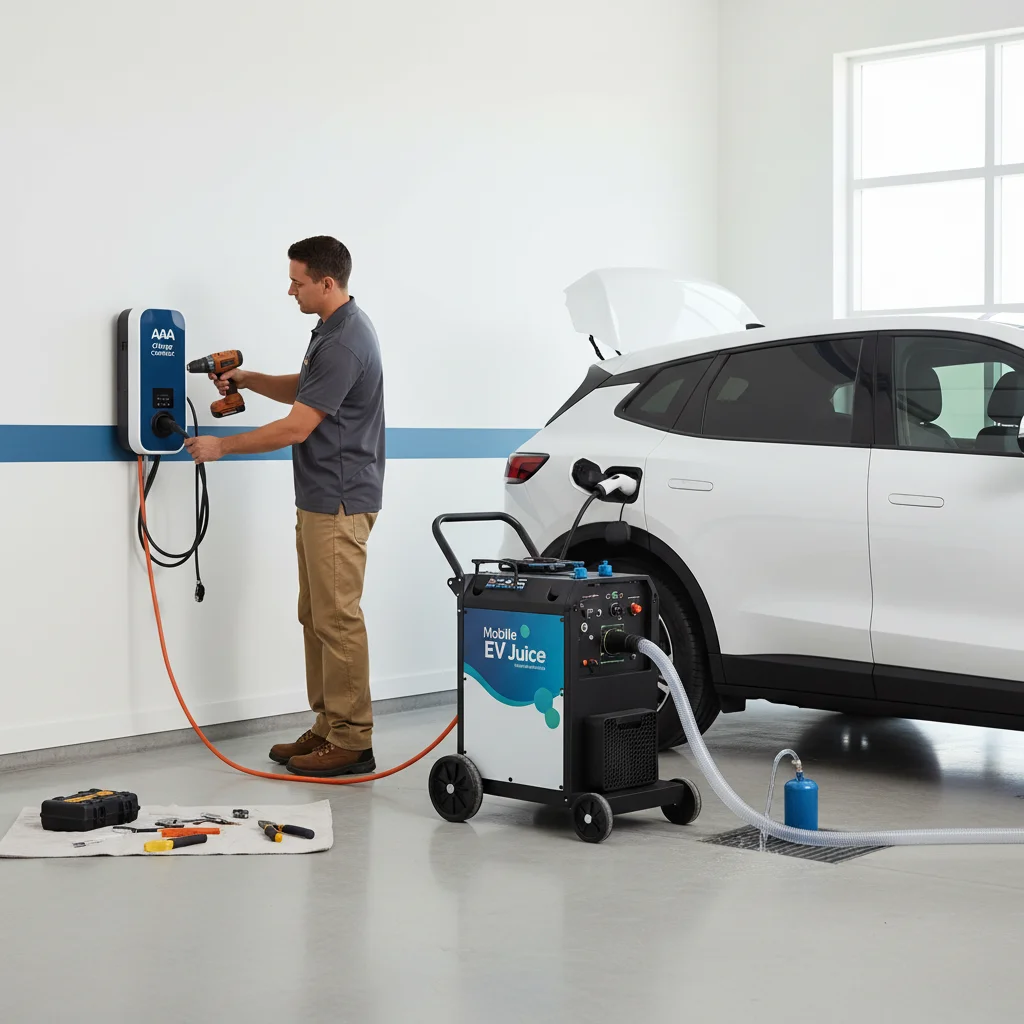
A mobile charge at the pin is faster. The driver gets 10 to 20 miles in 15 to 30 minutes. The driver can finish the trip or get to a charger without a tow.
We’re a referral line for Los Angeles County. We match stranded EV drivers with independent local operators. The pros we connect you with are licensed and insured. We hold no license for the work. We own no trucks and employ no technicians. We set no prices and publish no arrival time.
The operator quotes you before they start. They bill you directly. No dollar figure belongs here. They quote you on the phone and confirm access before they roll.
How EV drivers use USAA and mobile rescue together
A driver with USAA can call USAA first for the tow. If the contractor brings a flatbed, the driver can decline and call us for a mobile charge. The tow can be declined before it hooks up.
A driver who needs a 12V jump can call USAA first. If the contractor brings a jump pack, the dispatch is covered. If the contractor brings a flatbed, the driver can decline and call us.
The USAA program and a local mobile rescue aren’t mutually exclusive. The driver picks the dispatch that fits the failure.
Tesla, AAA, or a local mobile rescue: how the three actually differ compares the three columns in more detail.
What about Allstate and other insurers
Allstate, GEICO, State Farm, and other insurers offer roadside programs that work similarly to USAA. Each program has its own coverage details and its own dispatch network.
A driver should check what the policy covers before the failure. The driver should know the difference between the basic coverage and any add-on coverage.
Geico roadside for an EV: what they send when you are empty covers the Geico version in more detail.
What about manufacturer programs
A driver of any EV brand should also know what the manufacturer program covers. Tesla’s basic program covers tows as a courtesy. Rivian’s program covers tows in service zones. Lucid’s program covers tows through a third-party dispatch.
A driver with multiple options can pick the dispatch that fits the failure. A tow fits a crash. A mobile charge fits an empty pack. A 12V jump fits a dead 12V.
How to avoid the situation
Plan charging into your day. A driver who starts each trip with 80 percent charge and tops up at a fast charger between trips is rarely stranded.
A driver who runs the pack down to 10 percent before charging is gambling on the next stall being available. The gamble sometimes fails.
The Tesla app shows real-time Supercharger availability. The Electrify America app shows the same for CCS. Drivers who plan around the network are rarely stranded.
The combined answer
USAA covers tows and tire changes for any car. EV charging at the pin is the gap. A driver who needs electrons calls a local mobile rescue. The driver gets back on the road faster than waiting for a tow.
The number to call is (213) 410-1991. We’ll match you with a local operator. They quote before any cable goes in.