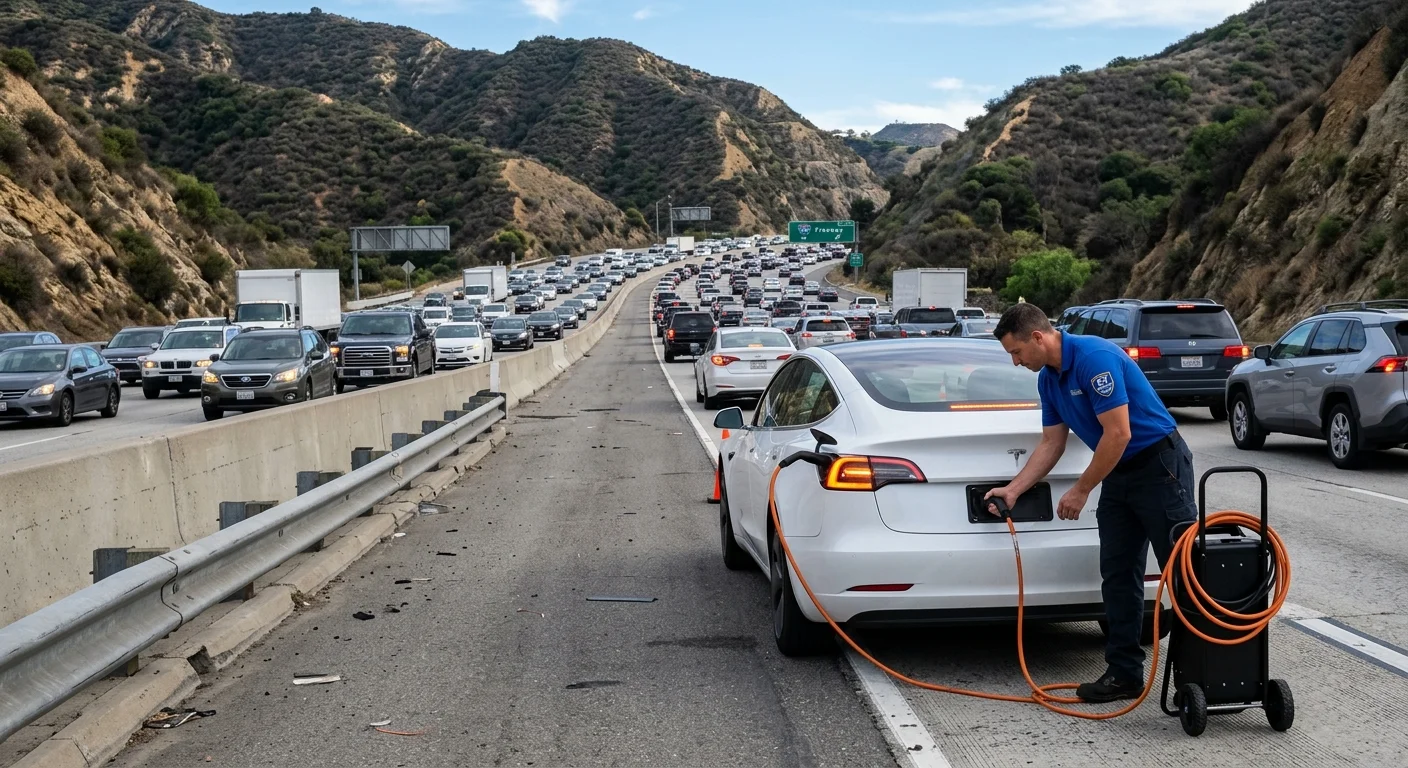
You’re on the right shoulder of the 405 in the Sepulveda Pass, hazards flashing, and the Tesla app is still working a request. Tesla will not give you a county-wide number for how long Tesla roadside assistance takes, and neither will we. The honest clock is the live estimate on your ticket, plus the Los Angeles roads, CHP holds, and garage gates between you and the unit.
Why Tesla will not quote a fixed arrival
A roadside wait is not a menu time. It is a live dispatch into whatever traffic exists at that hour. Tesla does not publish a single arrival figure that covers every Los Angeles County call. Tesla’s own public pages could not be confirmed for this article, because tesla.com was not readable in our research. No official Tesla average, cap, or advertised window is available to quote. If another site tells you Tesla arrives in a set window, treat that as unverified.
That gap tells you where to look. Open the Tesla app and stay on the request. The live estimate on that ticket is the only Tesla clock you can actually watch. If the field is blank, spinning, or jumping by large steps, Tesla has not locked a nearby unit, or the unit is still in traffic. Refreshing a blog post will not change that field.
People also ask how long Tesla covers roadside assistance. That is a warranty question, not a wait question. Tesla’s published coverage term could not be confirmed here. Read the Tesla app and the warranty packet that came with the car. Do not borrow years or mile caps from an insurance recap.
Reliability is the same problem in different clothes. A quiet stretch in Lancaster is not the 405 at 5 p.m. Tesla roadside assistance near me still has to drive the same basin you stalled in. Palmdale and Santa Clarita sit over the Grapevine grades. Malibu’s Pacific Coast Highway runs 21 miles of coastline through the city, with few places to stage a truck. Downtown and the Westside stack ramps. The San Gabriel Valley packs the 10 and the 60. None of those jobs share one timer.
If you call Tesla roadside assistance instead of tapping the app, you still will not get a fixed promise. A phone agent can only work the same pool and the same freeways. Keep the app open even if you called. The map on the ticket is where movement shows up.
LA traffic, CHP shoulders, and garage access
Los Angeles County is not one commute. The Sepulveda Pass on the 405 is a long grade between the San Fernando Valley and the Westside. A unit coming from Van Nuys toward Santa Monica is not close when the pass is stopped. The 110 through downtown runs into tunnels with almost no room to work. Metro ExpressLanes on I-10 and I-110 need a FasTrak transponder on a funded account. That does not help a dead Tesla already on the shoulder.
California Vehicle Code 21718 bans stopping on a freeway, with an exception for a disabled vehicle once help has been summoned. That is why the Tesla request matters even before anyone arrives. You have summoned help. Keep hazards on. Stay out of the live lanes. California Vehicle Code 21809 is the move-over law for stopped emergency, tow, or Caltrans vehicles with flashing lights. Other drivers are supposed to move over or slow down around the unit that finally reaches you.
If the car sits too long, removal becomes a legal clock, not a Tesla clock. California Vehicle Code 22651(f) lets a peace officer remove a vehicle stopped more than four hours on the right-of-way of a full-access freeway, when the driver cannot move it under its own power. Four hours is not an arrival promise. It is the outer edge of how long a dead car can occupy that shoulder before a tow can be ordered.
CHP can also freeze a live lane after a stall. That freeze protects you. It also stops the rescue unit in the same queue. A nearby pin on the app can sit still for a long stretch while the pass or the 110 is held.
Metro Freeway Service Patrol is free on designated LA County freeway beats. Dial 511 and say Motorist Aid. FSP runs Monday through Friday from 6 a.m. to 7 p.m., and weekends from 10 a.m. to 6:30 p.m. Published help is a flat, a jump, a radiator refill, up to a gallon of fuel, or a tow to a designated safe spot off the freeway. The published list does not include mobile EV charging. FSP can get you off a live lane. It will not put miles back in a Tesla pack.
Garage jobs run on a different delay. SoFi in Inglewood, Universal, and downtown structures add security, height bars, and one-way ramps. A truck that could reach a curb on Figueroa may wait at a gate. Tell Tesla dispatch the garage name, level, and nearest stair or elevator. A pin on a map is not a parking stall.
What the Tesla app actually shows you
The Tesla app is the request, the map, and the only live estimate Tesla gives you. Tesla does not publish a static wait table you can check before you stall. Watch the ticket you just opened.
Treat the estimate as a snapshot. It can lengthen when traffic stacks. It can drop if a closer unit takes the job. It can vanish and return. None of those moves is a promise. Screenshot the screen when a figure first appears, and again if it jumps. That record helps if you later compare notes with Tesla or with a local operator.
Stay with the car if you can do it safely. Keep hazards on. Do not stand behind the bumper in a live lane. If you are on a freeway shoulder, wait behind the barrier when there is one. If you are in a structure, stand where the driver can see you without blocking a ramp.
The app also will not tell you, in plain words, who actually shows up. That is a separate question from how long the wait feels. A Tesla-branded truck, a contracted tow, or a mobile tech are different clocks. A tow has to hook, clear CHP, and then drive. A charge-in-place job still has to reach you first, then spend time on the cable.
If the estimate keeps slipping and you are on a freeway, remember the four-hour removal rule above. If you are in a garage that closes, the clock is the closing time, not Tesla’s field. Start a backup before the structure locks you in.
Do not close the ticket to reset it unless Tesla asks you to. Opening a second Tesla request can confuse dispatch. If you add a local operator, keep the Tesla ticket alive until someone is physically there and you know who is doing the work.
Charge in place versus waiting on a tow
Waiting on Tesla roadside and waiting on a tow are not the same job. If the high-voltage pack is empty, a tow is a ride to a charger or a shop. That clock is arrival, plus hook, plus freeway time, plus the line at the destination. Tesla’s published tow-mile caps and service-center routing could not be confirmed from Tesla’s pages here. Check the ticket and ask the driver where the car is going before it is hooked.
If the car only needs enough energy to reach a charger, mobile EV charging changes the second half of the clock. Charge Pro LA connects you with a licensed local operator who can charge on site. The brand does not send its own truck and does not quote an arrival window. Once a Level 2 cable is on the car, a typical rescue charge adds about 10 to 20 miles of range in 15 to 30 minutes. That 15 to 30 minutes is charging time, not the drive to you.
Level 2 gear can range from 2.9 to 19.2 kW, per the U.S. Department of Energy’s Alternative Fuels Data Center. A weaker output stretches the cable time. A stronger output shortens it. Either way, you skip the hook and the trip across the basin. The U.S. Department of Energy explains why that onboard energy is what actually moves the car.
A flat tire is a third clock. Tesla’s published tire steps could not be confirmed here. A mobile unit that can change a tire, when that unit exists and can reach you, avoids a hook. A tow for a flat still sits in the same Sepulveda or 110 queue. Do not assume Tesla roadside is a tire van.
A 12-volt sleep can look like an empty pack. If the screens are dark and the doors are fussy, say that in the Tesla ticket. A jump or a 12-volt swap, when the operator can do it, is a shorter on-site job than filling a pack. It is still not a promised minute count.
If you already know the pack is empty, read what to do when a Tesla is out of charge on the road while you wait. Hazards, location, and a second plan matter more than refreshing the estimate.
How to choose a backup without a minute guarantee
You need a backup that does not pretend to beat traffic with a slogan. Charge Pro LA is a referral service. It matches you with licensed, independent local operators for Tesla roadside rescue. The operator quotes and bills you. The brand sets no price and promises no ETA. That is the point. You are buying a second live dispatch, not a stopwatch.
Call Tesla first if you want that ticket on record. Keep the app open. Then decide whether the job is a charge, a 12-volt wake, a tire, or a tow. If the pack is empty and FSP cannot charge it, a local mobile charger is the backup that actually adds range. If you are in a live lane, FSP or CHP may still be the way off the freeway, even if they only tow you to a designated safe spot.
Insurance roadside is not a secret Tesla timer. GEICO Emergency Road Service, when that optional coverage is on the policy, publishes towing to the nearest qualified repair facility (mileage limits apply), jumps, tire changes with a working spare, lockout help, winching near a publicly maintained roadway, and fuel delivery. That page does not name electric vehicles or mobile EV charging. A gas-plan truck can still leave a Tesla pack empty.
Do not wait for a perfect number. Watch the Tesla estimate. Watch the four-hour freeway rule. Watch garage closing time. If any of those clocks is going the wrong way, start the local operator while Tesla is still assigned. Tell both sides you have two requests so they do not collide on the shoulder.
The California Energy Commission tracks zero-emission vehicles and charging across the state. That policy map will not shorten this wait. The live Tesla ticket and a local operator who can charge in place will.
When to call us
If the Tesla estimate keeps moving, the pack is empty, and you need range where you sit, that is a mobile EV rescue. Call us at (213) 410-1991 and we’ll connect you with a local EV rescue operator. The operator you are matched with does the charging. You contract and pay that operator directly.