A Tesla driver in LA County who taps the roadside button in the Tesla app doesn’t get a Tesla-owned truck. They get a third-party contractor. Most contractors in LA County carry a flatbed. Here’s what that means for a Tesla driver who needs electrons and how to fill the gap.
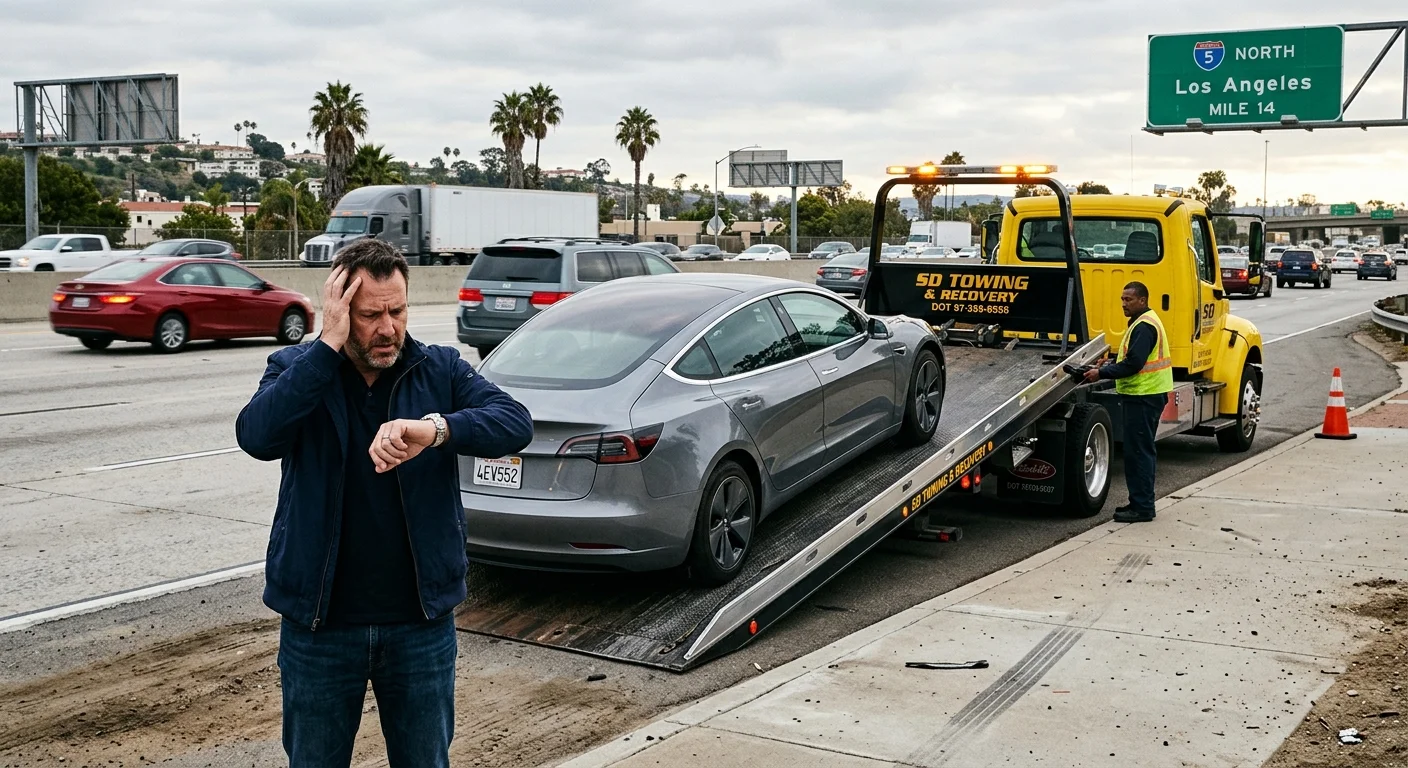
Why a third-party shows up
Tesla doesn’t operate its own roadside fleet. The basic program is included with every new Tesla for four years, but the dispatch goes through a third-party contractor network. The contractors are tow companies and service companies that have agreements with Tesla.
The third-party arrangement lets Tesla offer roadside coverage without operating a fleet. The tradeoff is that the contractors carry whatever equipment they carry. Most carry a flatbed. Some carry a mobile charger. The dispatch is uneven.
What the contractors typically carry
Most contractors in LA County carry a flatbed and a basic tool kit. The flatbed tows the Tesla to a Service Center or a charger. The tool kit handles small fixes.
Some contractors carry a mobile charger. The mobile charger plugs into the Tesla’s NACS port and adds 10 to 20 miles. The Tesla gets back on the road under its own power.
A few contractors carry a 12V jump pack. The jump pack wakes the Tesla’s computer if the 12V is dead.
Tesla 12V is dead: how to tell, then how to jump it covers the 12V version in more detail.
The contractor decision
The contractor decides on the call what to bring. The decision is based on the failure description, the location, and the equipment the contractor has on the truck.
A driver who describes an empty pack may get a flatbed to a charger. A driver who describes a dead 12V may get a jump pack. A driver who describes a crash gets a flatbed to a Service Center.
The decision is in the contractor’s hands. The driver doesn’t get to choose what arrives.
What the gap looks like
A Tesla driver on the shoulder of the 405 climbing the Sepulveda Pass needs 10 to 20 miles to clear the grade. The basic program may send a flatbed to a charger. The flatbed tows the car to a charger the driver could have driven to in 20 miles. The driver waits on a hook.
The gap is the mobile charge at the pin. The basic program doesn’t always fill it.
A local mobile rescue fills the gap. The local operator brings a charger to the car. The driver gets 10 to 20 miles at the shoulder.
We’re a referral line for Los Angeles County. We match stranded EV drivers with independent local operators. The pros we connect you with are licensed and insured. We hold no license for the work. We own no trucks and employ no technicians. We set no prices and publish no arrival time.
The operator quotes you before they start. They bill you directly. No dollar figure belongs here. They quote you on the phone and confirm access before they roll.
What about the contractor’s equipment
The contractor’s equipment varies. Some contractors carry Tesla-specific tools. Others carry general tow equipment.
A contractor with Tesla-specific tools can do more on site. The contractor can reset certain warning lights, run some diagnostics, and perform certain repairs. A contractor with general tow equipment can only tow.
Tesla’s preferred contractors in LA County carry Tesla-specific tools. The dispatch routes to preferred contractors when possible.
What the driver should do
A driver who needs electrons at the pin should describe the failure accurately. “Out of charge at a curb, need a mobile charge” is the right description. “Car won’t move” is too vague.
The driver should ask the dispatcher if the contractor carries a mobile charger. If the contractor does, the dispatch is faster than a tow. If the contractor doesn’t, the driver can decline and call a local mobile rescue.
Tesla, AAA, or a local mobile rescue: how the three actually differ compares the three columns in more detail.
What about Tesla’s own service vans
Tesla operates its own service vans in some markets. The vans carry diagnostic equipment and can do some on-site fixes. LA County has uneven coverage for Tesla’s own service vans.
A Tesla driver in a Tesla service zone gets a service van for certain failures. A Tesla driver outside the zone gets a third-party contractor.
The combined answer
Tesla’s basic program routes through third-party contractors. Most contractors carry a flatbed. The dispatch is uneven. A local mobile rescue fills the gap when the basic program sends a tow instead of a charger.
The number to call for a Tesla roadside request is the Tesla app or Tesla’s published phone number. The number to call for a local mobile rescue is (213) 410-1991. We’ll match you with a local operator. They quote before any cable goes in.