Hyundai’s 2025 Ioniq 5 quick-reference material names 63 kWh and 84 kWh batteries, depending on the model. That pack size answers the full-fill question, while a partial charge requires only a portion of that amount.
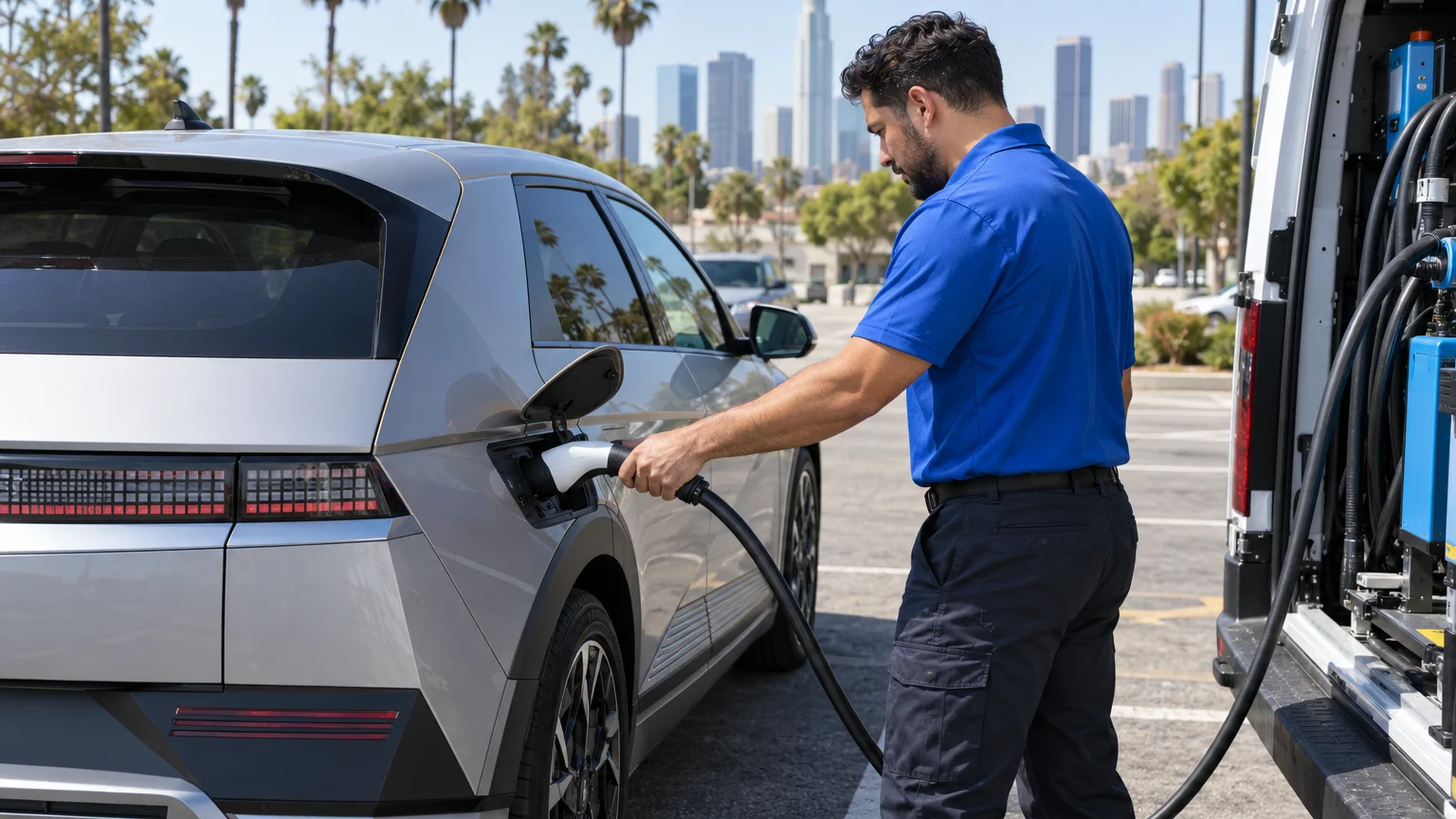
What Hyundai publishes for Ioniq 5 pack size
Hyundai’s current 2025 Ioniq 5 quick-reference material names two battery sizes: 63 kWh and 84 kWh. Your trim determines which battery you have.
That gives the clearest answer to “how many kWh to charge Ioniq 5?” A complete battery-sized fill is 63 kWh or 84 kWh. Most charging sessions start above empty, so they require less.
Check the vehicle information for your exact model before calculating. Don’t select a battery size based only on the exterior or estimated range. Hyundai publishes different range figures across the current lineup, including models that share the larger battery.
Our detailed Ioniq 5 battery size and range guide explains those model differences. Hyundai’s published 2025 EPA estimates range from 245 miles for the standard-range model to 318 miles for certain rear-wheel-drive versions. Hyundai also warns that actual range varies.
Battery capacity and energy purchased aren’t interchangeable figures. The approved Hyundai source confirms the battery sizes, but it doesn’t provide a verified wall-to-battery figure for a complete session. That means we can’t confirm exactly what a station’s meter will show after filling an empty pack.
For a dependable model-specific answer, check the battery information supplied with your Ioniq 5. The owner’s manual and Hyundai account records should match the vehicle you’re driving. If those sources don’t settle it, confirm the pack with Hyundai before planning a charge.
kWh left versus percent on the dash
The dash shows a percentage, while a charger reports energy in kWh. You can convert between them for a simple planning estimate.
Use this calculation:
Battery size × percentage being added = estimated kWh added to the pack
Convert the percentage into a decimal first. A move from 20% to 80% adds 60 percentage points, or 0.60 of the stated battery capacity.
For a 63 kWh battery, the simple estimates are:
- 10% to 80%: 44.1 kWh
- 20% to 80%: 37.8 kWh
- 50% to 80%: 18.9 kWh
For an 84 kWh battery, the same targets become:
- 10% to 80%: 58.8 kWh
- 20% to 80%: 50.4 kWh
- 50% to 80%: 25.2 kWh
These figures are arithmetic estimates based on Hyundai’s published pack sizes. They aren’t confirmed usable-capacity figures, station-meter promises, or billing amounts. The approved Hyundai material doesn’t confirm that every displayed percentage point maps exactly to the same measured energy at the charger.
That distinction matters when comparing your calculation with a receipt. It also prevents a planning estimate from becoming a false promise about the final meter reading.
The same method works for smaller targets. Subtract the current percentage from the desired percentage. Multiply that share by 63 or 84, based on your model. If you only need enough energy to reach a safe charging location, don’t assume you need a complete fill.
Level 2 roadside boost versus a DC stall
kWh measures an amount of energy. kW measures how quickly charging equipment can deliver energy. Mixing those units causes much of the confusion around Ioniq 5 charging.
The U.S. Department of Energy says AC Level 2 equipment can range from 2.9 to 19.2 kW. That wide range means “Level 2” alone doesn’t tell you how many kWh you’ll receive during a session.
A mobile Level 2 boost serves a different purpose from filling the battery at a DC stall. The goal may be enough energy to leave a parking lot or reach a compatible charger. A typical rescue charge can provide 10 to 20 miles of range during 15 to 30 minutes of Level 2 charging. Those figures describe charging time, not an operator’s travel or arrival time.
Our mobile EV charging service connects stranded drivers with licensed, independent local operators. The operator confirms the equipment, connector, energy target, and quote directly with the driver. Charge Pro LA doesn’t perform the charging or set the price.
A public DC stall may make more sense when the car can reach one safely. For charging duration rather than energy quantity, see our guide to Ioniq 5 Level 2 and DC charging time.
Hyundai’s current NACS quick-reference guide says the 2025 Ioniq 5 has a maximum charge rate of 125 kW at a Tesla Supercharger at this time. Tesla says Supercharging access depends on the vehicle, post type, and approved adapter arrangement. Confirm compatibility before relying on any specific stall.
Heat and grades on LA commutes change the fill
A fixed kWh calculation doesn’t promise a fixed Los Angeles trip. Hyundai says actual range varies, so the dash estimate shouldn’t be treated as guaranteed mileage.
That matters across Los Angeles County. A driver leaving the San Fernando Valley may face heat-soaked pavement and a climb through the Sepulveda Pass. Another driver may be crossing the San Gabriel Valley toward the 605. The route after charging matters as much as the percentage target.
We don’t have an approved Hyundai figure showing exactly how Valley heat changes an Ioniq 5 fill. We also can’t publish a precise kWh adjustment for the grades on the 405. Those figures couldn’t be confirmed in the approved source material.
Use a route-based target instead of assuming every trip needs 80% or 100%. Consider where the next compatible charger is, whether the car can reach it, and what reserve you want when you arrive. Don’t rely on an unverified “nearest charger” distance.
The Ioniq 5’s published EPA consumption also varies by configuration. FuelEconomy.gov lists 29 kWh per 100 miles for the 2025 standard-range version, 30 kWh per 100 miles for the rear-wheel-drive version, and 32 kWh per 100 miles for an all-wheel-drive version with 19-inch wheels. Those are standardized EPA figures, not a promise for a specific LA route.
Charging to 100% is a separate battery-care question. The approved claims ledger doesn’t confirm a model-specific rule about daily full charging. Check the current Hyundai owner’s manual for the charging guidance tied to your model.
When a local operator should deliver the kWh
A local operator may fit when the Ioniq 5 can’t safely reach a compatible charger but remains accessible for charging. The useful target is often enough energy to reach the next planned stop, not the battery’s full capacity.
Before requesting non-Tesla EV rescue, note the displayed percentage, exact location, model year, connector, and destination. Tell the operator whether the car is in a driveway, parking structure, surface lot, or roadside position. Access conditions can affect whether charging at that spot is practical.
If the Ioniq 5 is stopped on a freeway, safety and vehicle position come first. California Vehicle Code 21718 generally prohibits stopping on a freeway, with an exception for a disabled vehicle when help has been summoned. Metro Freeway Service Patrol is free on designated Los Angeles County freeway beats. Its published assistance list doesn’t include mobile EV charging.
Don’t assume every no-start event needs traction-battery energy. An Ioniq 5 can also have a low-voltage issue, charge-port problem, or charging-session failure. If the dash is dark or the car won’t enter a ready state, describe those symptoms before asking for kWh. That helps the matched operator decide whether charging, low-voltage help, or a tow is the suitable response.
The operator quotes and bills you directly. Confirm the proposed energy target, equipment compatibility, and price before authorizing service. Charge Pro LA refers drivers to local professionals and doesn’t perform the work.
When to call us
Call when your Ioniq 5 lacks enough charge to reach a compatible station and its location allows safe access. We’ll connect you with a licensed, independent operator who can assess whether mobile charging or another recovery option fits.
Call us at (213) 410-1991 and we’ll connect you with a local EV rescue operator.