The Supercharger you planned on is full, offline, or farther than the range left in the pack. In Los Angeles County, that often means a Tesla sitting dead in a Santa Monica beach lot, a downtown garage, or on the Sepulveda Pass. A mobile Tesla charger service is a local operator who brings Level 2 NACS charging to that spot so you can roll to a working stall.
What drivers mean by a Tesla charger service
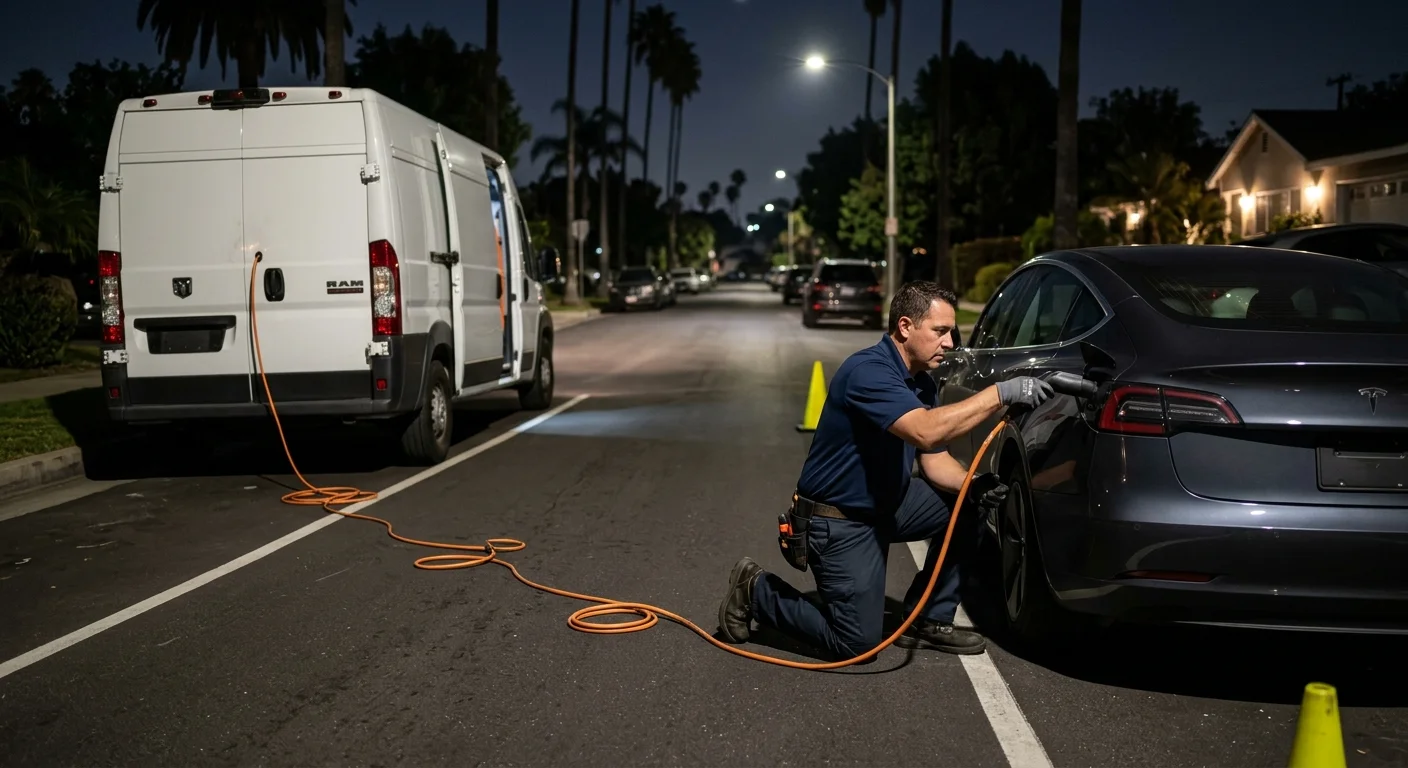
Most people who type this query want a van, not a cable. They want someone to show up where the car already sits, plug into the Tesla charge port, and add enough range to leave. That is a roadside Tesla charging service. It is not the portable EVSE Tesla sells for a wall outlet at home or at a hotel.
The home unit is the Tesla Mobile Connector. It lives in a bag. It needs a working receptacle. If you are already at 0% in a Redondo Beach lot, that bag does not help unless you can push the car to a live outlet and stay there for hours. The search is for mobile Tesla charging that comes to the parking space.
Drivers also mix this up with the Supercharger network itself. That network is a destination. A mobile stop is what you call when the destination is full, down, or out of reach. Westside beach lots are a common version of this. Posted stalls look open in the app and sit dark when you get there. Downtown structures around Bunker Hill and the Music Center do the same thing: a charger on the wayfinding sign, a dead unit on the wall.
The 405 through the Sepulveda Pass is another local version. The climb from the San Fernando Valley toward the Getty and Westwood eats range on a low pack. If you misjudged the grade, you are not looking for a new wall connector. You are looking for an operator who can reach a legal, safe stop on or just off that corridor. For the freeway version of that stall, see out of charge on the 405 at Sepulveda Pass.
A Tesla charging service, in the way county drivers mean it, is the operator who brings NACS to the car. Charge Pro LA does not own that van. We connect you with licensed, independent local operators who do.
Tesla’s own truck versus a local Level 2 operator
Many owners open the Tesla app first. That is reasonable. Tesla roadside is the factory channel. What Tesla currently dispatches on a given call could not be confirmed from a readable Tesla page for this site, so check the app and the in-car request for the offer on your account. Do not assume a charging truck is what arrives. It may be a tow, a tire stop, or a 12V jump. Confirm before you wait in a lane.
A local Level 2 operator is a different product. The operator we connect you with brings onboard charging equipment to your location. The U.S. Department of Energy’s Alternative Fuels Data Center lists AC Level 2 equipment from 2.9 to 19.2 kW. That is the power class of a typical mobile rescue, not a Supercharger stall. A typical rescue charge adds about 10 to 20 miles of range in 15 to 30 minutes of charging time. That is plug-in time. It is not an arrival window, and Charge Pro LA does not promise one.
Use that 10 to 20 miles as a planning number, not a full recharge. The point of Tesla roadside rescue on a low pack is usually to reach the next working public stall, not to fill the battery in a garage aisle.
If the car is dark and will not wake, the high-voltage pack may not be the first problem. A dead 12V can leave a Tesla unresponsive even with range showing in the last screenshot you took. Tell the operator whether the screens are on, whether the charge port opens, and whether the car will accept a plug. A NACS cable on a van does not wake a car that will not close its contactors.
Tesla’s factory channel and a local Level 2 stop can both be part of the same afternoon. Call Tesla if your policy is the first move. Call a local operator if you need NACS at the bumper and the factory path is a tow you do not want. You contract with the operator who shows up, not with Charge Pro LA.
The U.S. Department of Energy keeps a plain overview of how EV charging levels differ. Level 2 is the roadside class described here. DC fast charging is what Superchargers and other highway stalls do. A mobile Level 2 stop is slower than a Supercharger and faster than a 120-volt outlet.
NACS on site when Superchargers are full or down
NACS is the port on the car. The operator’s cable has to match it. Ask for a NACS handle when you describe the Tesla. Do not assume a J1772 gun and a loose adapter in the frunk. If you already carry an adapter, say so. If you do not, say that too. The quote depends on the connector the van actually brings.
Superchargers fill up on Westside weekends, on event nights downtown, and whenever a site goes offline. When that happens, sitting in the queue does not add miles. A mobile stop at the space you already occupy can. For the stall-side version of that decision, read Tesla Supercharger full or down.
Beach lots are a special LA County mess. Santa Monica, Manhattan Beach, and Redondo Beach mix public chargers with ordinary stalls. A unit that charged last month can sit dark this afternoon. Malibu’s Pacific Coast Highway stretch through the city is a 21-mile section of coastline. If you are on that ribbon with a low pack, the next working stall may be behind you, and a turnaround on PCH is not always clean.
Downtown garages add access rules. Some structures will not let an unmarked van in without a ticket or a conversation with the attendant. Tell the operator the garage name, the level, and whether a visitor can pull to your bumper. A quote that assumes a curb on Figueroa is wrong if you are on P4 with a gate.
Airport parking is its own map. LAX terminal structures P1 through P7 offer Level 2 and DC fast charging. Economy Parking has 514 active EV chargers. Those numbers help if you are already in those lots. They do not help if you are in a private structure in El Segundo or on a hotel curb off Century. The operator needs the lot you are in, not the lot you wished you had booked.
Freeway stops have a legal frame. California Vehicle Code 21718 prohibits stopping on a freeway, with an exception for a disabled vehicle when help has been summoned. If you are on the 405, 10, 110, or 5, put the hazards on, stay out of live lanes if you can, and call for help. Metro Freeway Service Patrol is free on designated LA County freeway beats. Dial 511 and say Motorist Aid. FSP’s published list names gas, radiator refill, tire change, a jump, and a tow off the freeway. It does not name mobile EV charging. FSP hours are Monday through Friday 6am to 7pm and weekends 10am to 6:30pm. CVC 21809 is the move-over law for stopped emergency, tow, or Caltrans vehicles with flashing lights. Give that vehicle room when it is working near you.
Metro ExpressLanes on I-10 and I-110 need a FasTrak transponder tied to a funded account. If you stall in that corridor, say so on the call. The operator still has to reach you legally.
How operators quote a stop, without invented fees
Charge Pro LA sets no price. The operator you are matched with quotes the stop and bills you directly. We do not publish a per-kWh rate, a dispatch fee, or a waiver. Anyone quoting a number for “the brand” is inventing it.
What the operator needs from you is specific. Location first: city, street, garage level, or freeway and direction. Connector second: NACS on a Tesla, and whether you have an adapter in the car. Energy third: current indicated miles or percent, and how far you must go to a stall you trust. Whether the car is awake. Whether you can stay with it. Those inputs are how a real quote is built. The walkthrough is in how mobile EV charging is quoted in LA County.
People also search how much a Tesla mobile charger costs, and how much it charges per hour. Those are two different objects. The home Mobile Connector’s retail price could not be confirmed from a readable Tesla page, so check Tesla’s own shop for the current kit. Its charge rate depends on the outlet and the car’s onboard charger, not on a roadside van. A roadside Tesla charging service is billed by the operator for that trip. Ask them what is in the number: energy added, time on site, access into a garage, and any after-hours handling they use. If they will not name those pieces, keep shopping.
Insurance is not a substitute for that quote. GEICO Emergency Road Service is optional coverage. Its published covered list is towing to the nearest qualified repair facility (mileage limits apply), battery jump starts, tire changes when you have a working spare, lockout services (up to $100 for covered causes), winching if the vehicle is stuck near a publicly maintained roadway (distance limits apply), and fuel delivery (fuel cost not included). In most states, that tow is covered up to 15 miles to the nearest qualified repair facility. The GEICO page does not name electric vehicles or mobile EV charging. What AAA sends on a given call could not be independently confirmed here. Read your own card, or see AAA or mobile EV charging for the decision, not a coverage promise.
LADWP serves the City of Los Angeles. Southern California Edison serves most of the county outside municipal-utility cities. Clean Power Alliance is the community choice aggregator for many cities, with SCE still delivering the power. None of those utilities dispatch a NACS van to a beach lot. They set home rates and rebate programs. They do not replace a mobile stop.
Who Charge Pro LA connects you with
Charge Pro LA is a referral service for Los Angeles County. We match stranded drivers with licensed, independent local EV charging professionals. We perform no work. We employ no technicians. We own no trucks. We hold no trade license. We set no prices. We give no warranties. You contract with the operator. You pay the operator.
The service area is Los Angeles County: 48 cities and communities in 9 regions. That includes the Westside, the San Fernando Valley, the San Gabriel Valley, the South Bay, and the Antelope Valley. Those places do not drive the same. A Model Y that ran out on a flat street in South Gate is a different stop from one that faded on the 14 near Acton or on PCH in Malibu. Tell the operator which one you are.
The product we refer for this query is mobile EV charging. For a Tesla that will not wake, the operator may need a 12V path before any NACS session starts. For a Tesla that simply ran the pack down, Level 2 at the bumper is the usual ask. Either way, the person on site is the independent pro, not Charge Pro LA.
Bring the facts on the call. Make, model, year if you know it. Indicated miles or percent. NACS port, and whether it opens. Exact location. Whether you are on a freeway, in a gated garage, or in a public lot. Whether anyone is with the car. That is enough for an operator to decide if they can take the stop.
When to call us
Call when the Tesla cannot reach a working stall and you need a local operator to bring Level 2 NACS charging to the car. That includes a dead beach lot, a downtown garage with a dark wall unit, and a low pack on the Sepulveda Pass. Call us at (213) 410-1991 and we’ll connect you with a local EV rescue operator.