A Tesla driver in Los Angeles County who runs out of charge has two real answers. Tesla’s own dispatch through the app, or a local mobile rescue. They aren’t equivalent. Here’s how to choose between them, and when a local mobile rescue fills the gap that Tesla’s program doesn’t.
What Tesla’s dispatch actually sends
Tesla roadside is requested through the Tesla app. The call routes to a third-party contractor. The contractor decides what to bring based on the failure and the location.
The contractor may bring a tow truck with a flatbed. The contractor may bring a van with a mobile charger. The contractor may bring a service truck with diagnostic equipment. The decision is on the call.
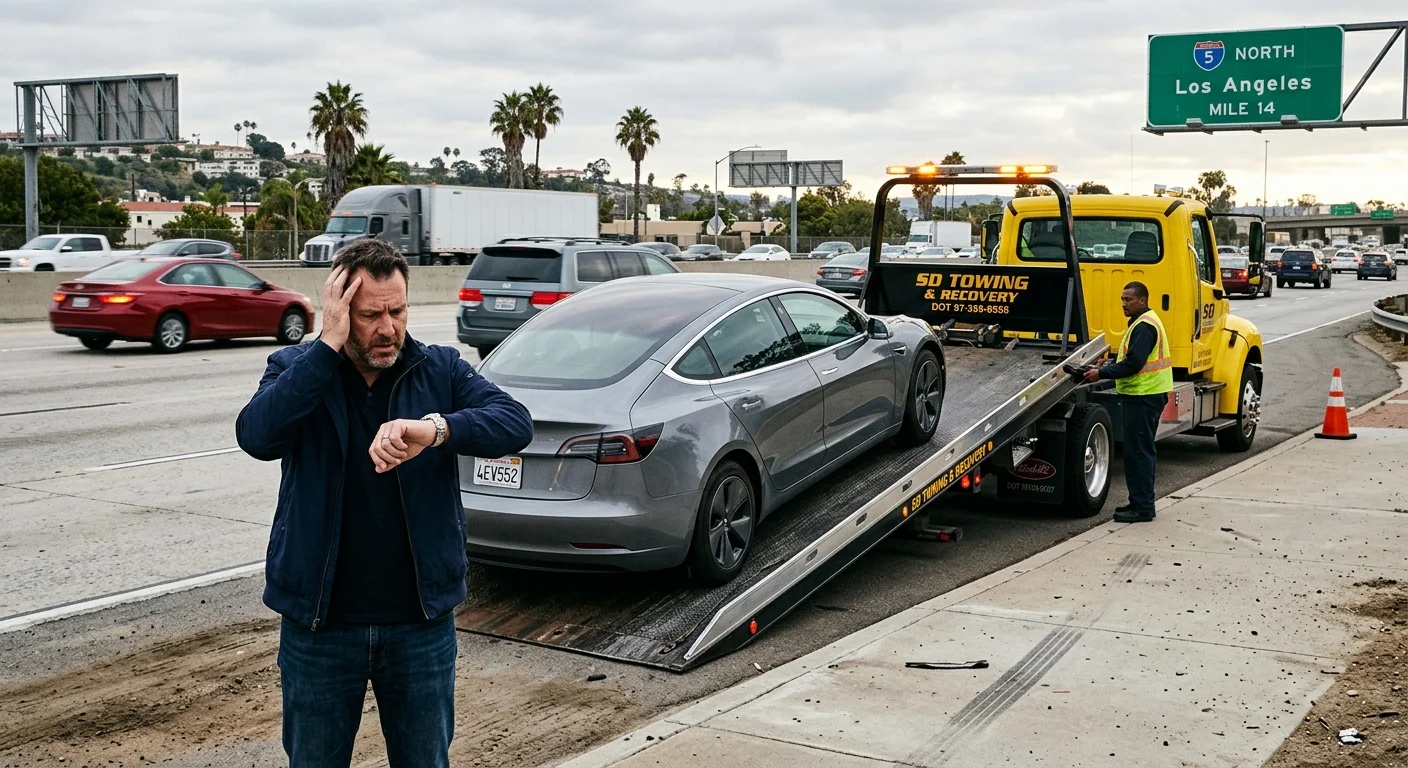
Most contractors in LA County carry a flatbed. The flatbed takes the Tesla to a Tesla Service Center or to a public charger. The driver waits on a hook.
Tesla roadside who actually shows up covers the contractor gap in more detail.
What a local mobile rescue brings
We’re a referral line for Los Angeles County. We match stranded Tesla drivers with independent local operators. The pros we connect you with are licensed and insured. We hold no license for the work. We own no trucks and employ no technicians. We set no prices and publish no arrival time.
The operator quotes you before they start. They bill you directly. No dollar figure belongs here. They quote you on the phone and confirm access before they roll.
What they bring is a 240-volt Level 2 source to the car. Teslas take a native NACS plug. A typical session adds 10 to 20 miles of range. Charging time is usually 15 to 30 minutes, and that clock starts when the plug is in. It isn’t a clock for when the truck shows up.
That boost is enough to reach a Supercharger on Sunset, a workplace stall, or the next charger on your route.
The choice between them
A Tesla driver who needs electrons at the pin has two paths. The Tesla path is the app. The local path is a phone call to us. Both paths lead to a charge.
The Tesla path is covered under the basic roadside program included with the car. The driver pays nothing out of pocket for the dispatch. The contractor bills Tesla. The downside is the dispatch may bring a tow truck instead of a charger.
The local path is a referral match. The operator bills the driver directly. No dollar figure belongs here. The operator quotes on the phone. The upside is the operator brings a charger.
When Tesla’s dispatch is the right call
A crash or a bent wheel needs a flatbed. Tesla’s program tows to a Tesla Service Center. The driver gets the right shop for the car.
A charge port fault needs a dealer. Tesla’s program tows to a Service Center.
A Tesla with a high-voltage fault needs a dealer. Same answer.
A driver inside a Tesla service zone who needs a tow gets a fast dispatch. The contractor has Tesla parts and Tesla diagnostic equipment. The tow goes to the right shop.
When a local mobile rescue is the right call
An empty pack or a dead 12V at a curb or in a lot. The car doesn’t need to move. The driver needs electrons at the pin. Tesla’s program may send a tow to a charger. The driver waits on a hook. The local operator plugs in at the stall.
A Tesla in a Hollywood garage that won’t wake after a week. The driver needs a 12V jump at the stall, not a tow to a Tesla Service Center. The local operator brings a jump pack and handles it on site.
A Tesla on the shoulder of the 405 climbing the Sepulveda Pass. The driver needs 10 to 20 miles to clear the grade. The local operator plugs in at the shoulder.
Combining the two
A Tesla driver can call Tesla’s app first and request a mobile charge. If the contractor brings a charger, the call is covered. If the contractor brings a flatbed, the driver can decline and call us. The tow can be declined before it hooks up.
The Tesla program and a local mobile rescue aren’t mutually exclusive. The driver picks the dispatch that fits the failure. A mobile charge fits empty-pack and dead-12V calls. A tow fits crash, charge port, and high-voltage fault calls.
Tesla, AAA, or a local mobile rescue: how the three actually differ compares the three columns in more detail.
What mobile EV charging can’t fix
A crash or a bent wheel still needs a shop. So does a charge port that won’t accept power. On-site charging can’t fix that. A Tesla with a high-voltage fault is a flatbed to a Tesla Service Center. The operator quotes and confirms before they start.
A dead 12V is different. The operator jumps or replaces the battery on site. That’s the more common call in many LA County garages.
The combined answer
Tesla’s dispatch is the first call for most Tesla drivers in LA County. The dispatch is fast and the program is included with the car. The gap is the mobile charge at the pin. A local mobile rescue fills that gap.
The number to call for a local mobile rescue is (213) 410-1991. We’ll match you with a local operator. They quote before any cable goes in.