Your EV is sitting at zero on a Koreatown curb, or on the shoulder of the 405 through Sepulveda Pass. Club roadside help may send a flatbed to a public stall. What you actually want is charge brought to the car so you can drive it out.
What this search means when you are already stopped
You’re already stopped. That is the whole point of this search. You are not shopping for a home charger. You are in a car that will not move, and you want power brought to the curb.
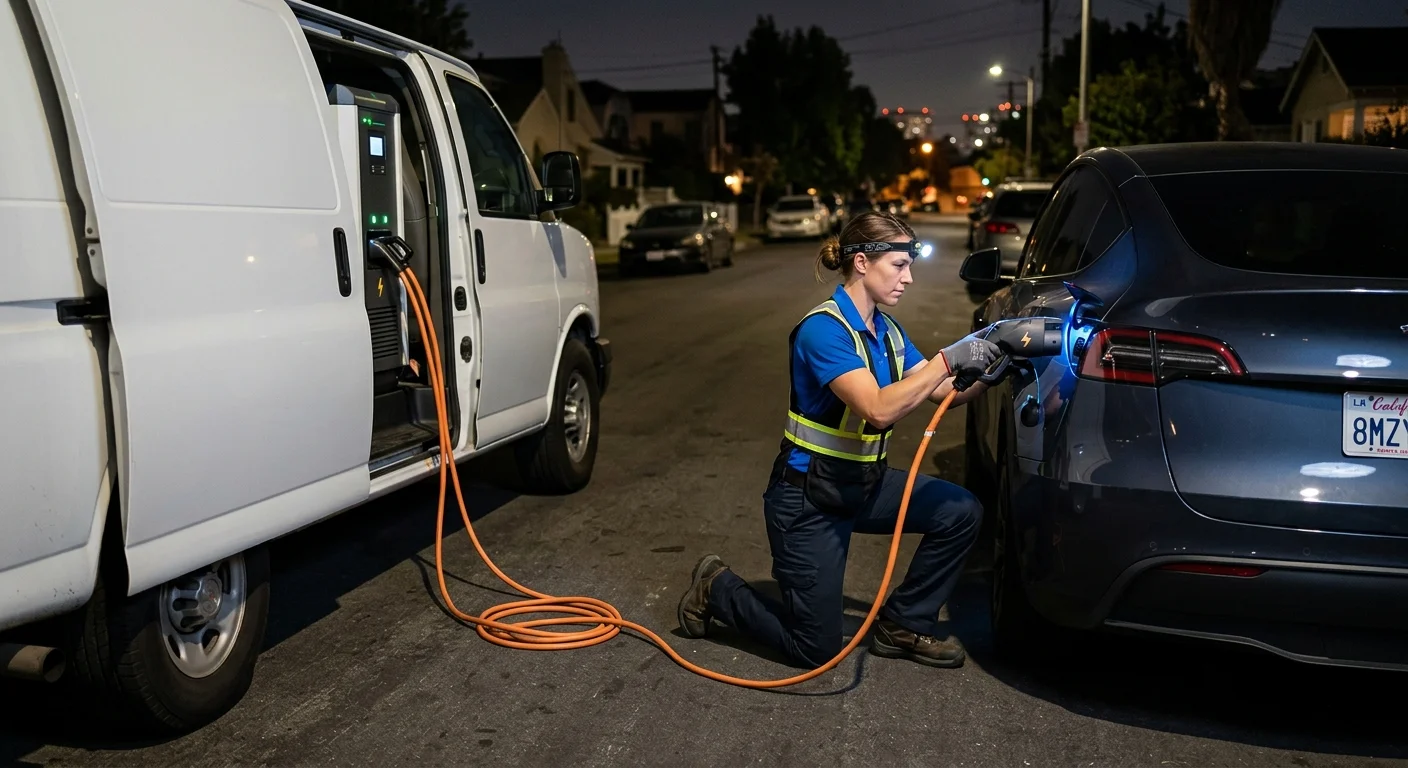
Classic roadside assistance still covers flats, lockouts, and a dead 12-volt battery. An empty high-voltage pack is a different job. Mobile EV charging is the roadside version of that job: an independent operator arrives with charging gear, matches your connector, and adds enough range to leave.
Metro’s Freeway Service Patrol will help on designated Los Angeles County freeway beats if you dial 511 and ask for Motorist Aid. That patrol’s published list names gas, a radiator refill, and a tire change. It does not name mobile EV charging. If you are on the 405, the 5, or the 10, FSP can still make the scene safer. It will not refill your pack.
California Vehicle Code 21718 generally bars stopping on a freeway. There is an exception for a disabled vehicle once help has been summoned. Stay with the car if it is safe. Put on hazards. Do not walk into a live lane. CVC 21809 is the move-over law for stopped emergency, tow, or Caltrans vehicles showing flashing lights. CVC 22651 lets a peace officer remove a vehicle that is blocking a freeway or sitting unattended. Summoning help is not optional if you are in traffic.
Off the freeway, the same search still fits. A dead public stall in a Santa Monica beach lot. A Manhattan Beach structure where the session never started. A Redondo lot at the water. A quiet block in East Los Angeles or Huntington Park after the last percent vanished in stop-and-go. In those spots, ev charging roadside assistance means a van or truck at your bumper, not a hunt for the next working pedestal.
National club plans vary by city and by year. Some advertise a charging truck. Some send a tow. Confirm what your membership covers before you assume a charge is coming. For how club help usually plays out in this county, read AAA EV roadside assistance in Los Angeles. Independent operators here do this work as a paid rescue, quoted to you, not as a club perk.
A Level 2 boost versus a tow to a public stall
A typical rescue charge is 10 to 20 miles of range in 15 to 30 minutes of Level 2 charging. That is charging time once the cable is in, not how long it takes anyone to arrive. For many LA County stalls, that window is enough to reach a working public charger, a home plug, or a driveway in the next neighborhood.
A tow to a public stall sounds simple until you are the one waiting. Beach lots along Santa Monica, Manhattan Beach, and Redondo Beach fill on weekends. Pedestals fail. A cable looks connected and never starts a session. You can sit on a flatbed, then sit again in a queue, then find the stall is down. That is why people search for roadside assistance ev charging instead of “nearest charger” after they have already stopped.
A boost is not always the right call. If the 12-volt battery is dead, the high-voltage pack may still have range and the car still will not wake. If a wheel is off, a charge will not roll you home. If you are in a live freeway lane and a peace officer is already clearing the scene, a tow may be the only legal way out. Many owners’ manuals call for a flatbed when an EV has to be moved. Check yours. Do not assume a wheel-lift is safe.
When mobile EV charging beats a tow is the comparison in full. The short version for this county: if the car is otherwise healthy, the port opens, and you only need enough miles to reach a charger you already know works, on-site charging is the cleaner path. If you need out-of-charge EV recovery because the pack is at zero and you cannot creep to a stall, that is still a charge-first job when the operator can reach you safely.
Metro ExpressLanes on I-10 and I-110 need a FasTrak transponder tied to a funded account. If you stopped in those lanes, treat it as a disabled-vehicle scene under CVC 21718. Get help summoned. Do not try to “just make it” through a toll lane on a dying pack.
The U.S. Department of Energy’s electric vehicle pages explain charging levels in general. Roadside work in this county is almost always a short Level 2 session, not a full pack fill. You are buying an exit, not an overnight charge.
LA heat, grades, and a pack at zero
Los Angeles County is not one commute. A dead pack on the Westside is not the same problem as a dead pack climbing out of the San Fernando Valley, and neither matches a stall on the Grapevine approach.
Sepulveda Pass on the 405 is a long grade between the Westside and the Valley. Cabin air conditioning on a hot afternoon burns range you thought you still had. You drop from “I’ll make it to Ventura Boulevard” to a shoulder or an offramp with no charger in sight. If that is where you stopped, read out of charge on the 405 at Sepulveda Pass for the local sequence: hazards, help summoned, then a charge or a flatbed. Do not coast backward in a live lane to “save” a percent.
North of Santa Clarita, I-5 toward Castaic is the Grapevine approach. Grades there punish a pack that was already thin when you left the Valley. A Level 2 boost of 10 to 20 miles may get you to a charger in town. It may not be enough to finish the climb if you were already at zero on the grade. Tell the operator the road, the direction, and that you are on a hill. That changes how much energy they plan to deliver. For that corridor, EV rescue on the Grapevine near Castaic is the local walkthrough.
Beach lots are a third pattern. You parked at the water in Santa Monica, Manhattan Beach, or Redondo Beach. The public stall was occupied, broken, or never started. You came back to a car that sat on climate control, then died in the structure. Mobile charging for ev drivers in those lots is often the difference between waiting for a tow in a jammed garage and driving out under your own power.
A pack at true zero is not a 12-volt jump. Jumping the 12-volt can wake screens and door handles. It does not put miles in the traction battery. If the dash already showed empty, you need energy at the charge port. If the car is dark and silent, say that when you call, because the operator may be looking at two jobs, not one.
Cold-weather range loss is real in other climates. Recurrent Auto has reported that, across 30-plus models, EVs retain about 78% of range at 32°F on average, with cabin heating the main driver. That is not the usual LA County failure. Here the pattern is heat, grades, and a public stall that did not work. Plan around those, not a Minnesota winter.
How local operators quote a roadside charge
Charge Pro LA does not set a price. The independent operator you are connected with quotes you, and you pay that operator. There is no brand fee schedule, no published per-kWh rate, and no “free estimate” promise on this site. If someone quotes you a number, it is theirs.
What they need in order to quote is boring and specific. Location: city, street, structure level, freeway mile marker, or a pin. Connector: NACS, CCS, or J1772, plus any adapter you actually have in the car. How empty the pack is, and how many miles you need to reach a charger you trust. Whether the car will unlock and the port will open. Whether you are in a live lane, a garage with height limits, or a beach lot with a gate.
Those inputs change the job. A quiet side street in South Gate is not the 405 shoulder. A Tesla port is not a CCS port. Ten miles to a home plug in Culver City is not twenty miles out of a structure in Santa Monica. Operators bill for the work they expect to do, not for a slogan. Confirm the quote before the cable goes in.
For the full quoting walkthrough in this county, read how mobile EV charging is quoted in LA County. Do not use a blog, a club commercial, or a Houston or Seattle price list as your number. Those figures are not verified for Los Angeles County, and this brand will not invent one.
If you only need a short Level 2 session, say so. If you need enough energy to climb Sepulveda or to leave the I-5 grade, say that too. Underselling the miles you need is how people get a second stall an hour later. Overselling them is how you pay for energy you will not use. The operator meters what they deliver. You still have to describe the road.
The California Energy Commission publishes statewide charging and ZEV context. It does not publish a roadside rescue rate. Neither does this site. Ask the operator. Get the number in writing or in a text you can keep. Then decide.
Who Charge Pro LA connects you with, and who does the work
Charge Pro LA is a referral service for Los Angeles County. It matches stranded drivers with licensed, independent local EV charging professionals. It does not own a charging truck. It does not employ crews. It does not hold a trade license, set prices, or warrant the work. You contract with the operator. You pay the operator. The operator does the physical job.
That split matters when you search “mobile ev charging roadside assistance” and land on a page full of “we arrive in 30 minutes” language. This brand will not promise an arrival window. It will not say “same-day” or “24/7.” Availability depends on the operator who can take the job. If no one can reach you safely, you will hear that. A tow may still be the honest answer.
The person who shows up is the one with the gear. If you want a plain-English picture of that vehicle, read what is an EV charging truck. Portable Level 2 kits exist for roadside use. Some operators run vans. Some run trucks. The right question is whether the unit they are sending matches your connector and can deliver the 10 to 20 miles you need, not whether the paint says “fleet.”
Coverage is the county: the Westside, the Valley, the San Gabriel Valley, the South Bay, the Antelope Valley, and the 48 cities and communities this site lists. A stall in Lancaster is not a stall in Santa Monica. Tell the operator which one you are in.
If the high-voltage pack is empty, ask for a charge. If the car is a brick because the 12-volt died, say that before anyone drives out. Mixing those two jobs wastes a trip. Charge Pro LA’s job is the match. The operator’s job is the cable, the meter, and the miles.
When to call us
Call when the car is already stopped, the pack is empty or too low to reach a charger you trust, and you want a local operator to bring Level 2 charging to the curb instead of waiting on a tow. That includes a Sepulveda Pass shoulder, the Grapevine approach near Castaic, a dead beach-lot stall, or a side street anywhere in Los Angeles County. Call us at (213) 410-1991 and we’ll connect you with a local EV rescue operator.