Your non-Tesla EV won’t leave a Glendale parking structure. Before requesting help, identify what the car displayed and exactly where it’s parked. Those details help an operator decide whether mobile charging or towing fits the situation.
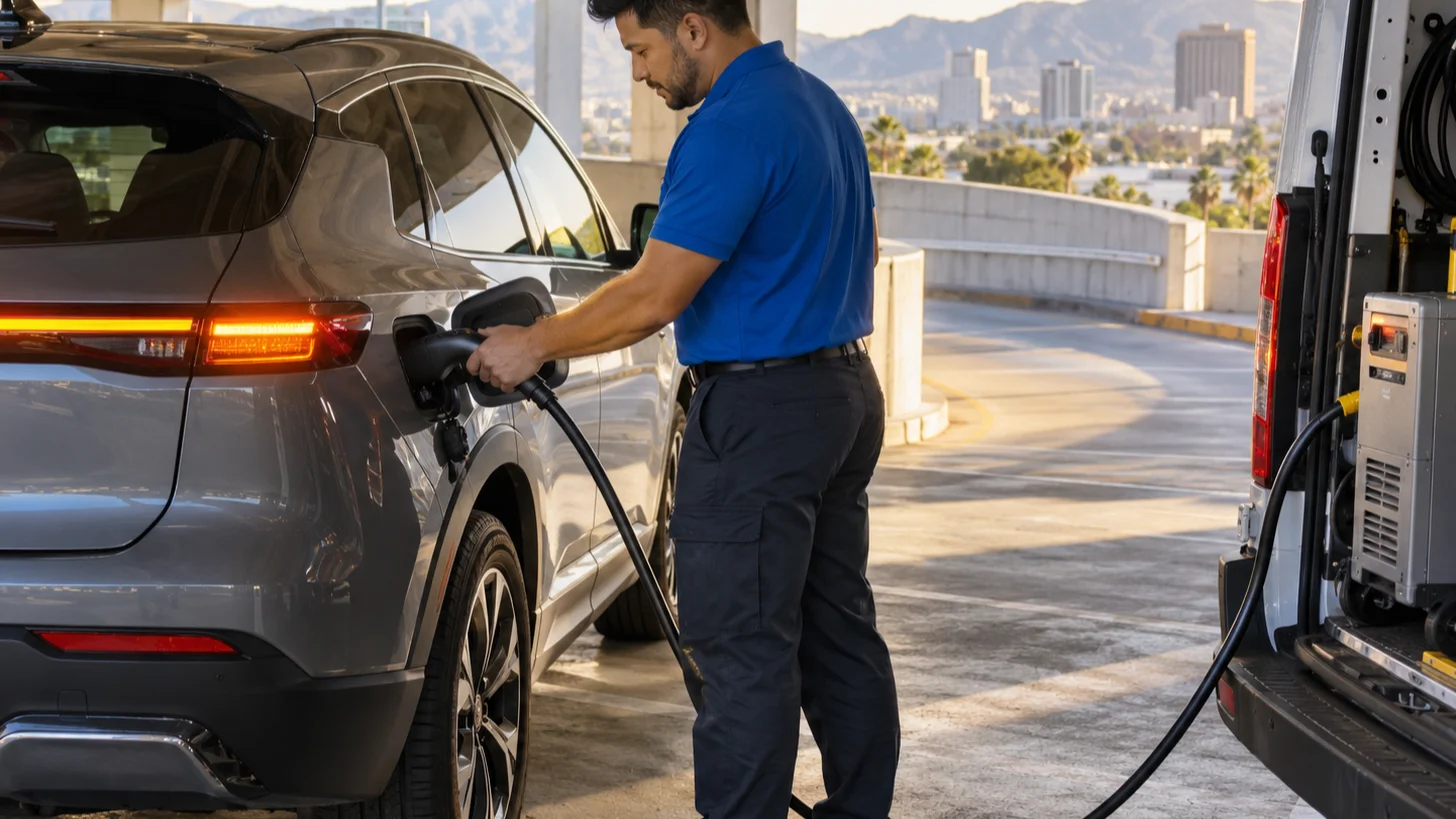
A dead EV inside a Glendale parking structure
A dead EV inside a garage presents a different request than a roadside stall. Start with the garage entrance, floor, section, and nearest visible marker. If the structure has several entrances, name the one you used. Tell the operator whether the vehicle is near Brand Boulevard or another recognizable Glendale street.
Include your vehicle’s year, make, and model. Explain whether it’s parked normally or blocking part of a lane. Mention whether the doors open, the displays illuminate, and the car can shift. Don’t label the problem if you aren’t certain. Describe what happened and repeat any message shown by the vehicle.
Garage permission also matters. No verified rule confirms that every Glendale parking structure permits roadside charging, battery work, or towing. Ask the garage owner, manager, or posted contact before assuming an operator can enter. Confirm any entry process, vehicle-height restriction, payment requirement, and work restriction directly with that property.
Charge Pro LA is a referral service. We connect drivers with licensed, independent local operators. The operator quotes and bills you directly, and Charge Pro LA doesn’t set the price or promise an arrival time.
Our Non-Tesla EV Rescue service is the focused option for this situation. The broader guide to EV roadside assistance in Glendale covers other citywide breakdowns, including problems outside parking structures.
Keep your request factual. “The display showed zero estimated range before it shut down” is more useful than “the main battery failed.” Clear observations give the matched operator a better starting point.
Empty drive pack versus a failed 12V battery
A non-Tesla EV that won’t move doesn’t automatically have an empty drive pack. It also doesn’t automatically have a failed low-voltage battery. A dark cabin, an unlocked charge door, or a warning message should be reported as an observation, not treated as a final diagnosis.
Think back to the last clear information the vehicle gave you. Did the displayed range fall toward zero while driving? Did the car stop responding after it had been parked? Did an alert name charging, propulsion, or the low-voltage system? Take a photo of every visible message before the display changes.
Tell the operator what still works. Note whether the doors unlock, exterior lights respond, screens turn on, and the vehicle recognizes its key. Also report whether a charging cable is attached or trapped. Don’t force a connector or attempt a procedure copied from another model. The matched operator can use your vehicle details and symptoms to choose the next step.
The Emergency EV Roadside Assistance service covers the broader request when the cause isn’t clear. It lets the operator evaluate whether the call appears suitable for charging, low-voltage help, or a tow.
Ask what the proposed service addresses before authorizing it. An energy delivery doesn’t repair an unrelated fault. Likewise, a low-voltage procedure isn’t a substitute for adding usable driving range. If the operator can’t confirm the right approach from your description, share photos of the instrument panel, charge port, parking position, and garage entrance.
That short record also reduces confusion when several people are involved. A garage representative, driver, operator, and tow provider may each need the same location and vehicle details.
Connector details to give the operator
Connector information can determine whether a charging plan is even considered. Don’t rely only on the words “non-Tesla.” Give the exact make, model, model year, and any connector or adapter information you can confirm.
Take a clear photo of the open charge port. Include the full inlet rather than a close crop of one section. If you carry an adapter, photograph both ends and any label. Tell the operator whether the adapter came with the vehicle, came from its manufacturer, or has another source. Don’t describe an adapter as compatible unless you’ve confirmed that through the vehicle or adapter manufacturer.
NACS and CCS1 are distinct terms that may appear during the call. Tesla states that access to its Supercharging network depends on the vehicle and Supercharger type. Some access uses a Magic Dock, while other CCS1-equipped vehicles require an NACS DC adapter provided by Tesla or the vehicle manufacturer. That doesn’t establish whether a particular Glendale charging location, mobile unit, or adapter will work for your car.
The U.S. Department of Energy’s electric vehicle overview can help drivers understand general EV terminology. For an active garage rescue, however, the vehicle’s documentation and the operator’s confirmed equipment matter more than a general guide.
Also report what happened during the last charging attempt. Say whether the connector latched, the vehicle displayed a charging session, or an error appeared. If no attempt occurred, say that plainly.
A photo prevents avoidable guessing. It also lets the operator decide whether the available setup matches the inlet before discussing access to the structure.
Access limits around Brand Boulevard garages
A parking structure near Brand Boulevard may have gates, payment equipment, multiple entrances, and controlled areas. That doesn’t mean every structure uses the same rules. No verified source establishes a single roadside-service policy for Glendale garages.
Contact the property authority before the operator enters. Ask whether an independent roadside or towing operator may access the vehicle. Confirm which entrance they should use and whether anyone must meet them. If the property gives instructions, pass them along exactly. Don’t promise access based on a previous visit or another garage’s policy.
Measure nothing by guesswork. Read any posted clearance figure to the operator, but don’t paraphrase it. If no clearance is displayed where you can see it, say that the height limit couldn’t be confirmed. The operator can then decide whether the proposed vehicle or equipment is suitable.
Share the route from the entrance to the parked EV. Mention ramps, turns, gates, columns, and the vehicle’s position. Photos can show the available area without claiming that the property approves work there. A live location pin may identify the building, but it often won’t identify a garage floor or stall.
Glendale is also distinct from the neighboring San Fernando Valley. Drivers looking for coverage farther west can use our guide to mobile EV charging in the San Fernando Valley. For a Brand Boulevard structure, keep the request tied to the actual Glendale entrance and floor.
If the vehicle stalled after leaving the garage and reached the 134, describe it as a freeway situation instead. Metro Freeway Service Patrol operates on designated Los Angeles County freeway beats, but its published assistance list doesn’t include mobile EV charging. An operator also needs to know whether the car remains inside private property or is on a public roadway.
When charging works and when towing is necessary
Mobile charging may fit when the operator confirms that the drive pack is depleted, the vehicle can accept a charge, and the garage permits the proposed service. The approved rescue reference for this site describes a typical rescue charge as 10 to 20 miles of range during 15 to 30 minutes of Level 2 charging. That is charging time, not an arrival estimate or a promise for every vehicle.
AC Level 2 equipment can range from 2.9 to 19.2 kW of power output. Actual compatibility and the resulting range aren’t established by that equipment range alone. The vehicle, connector, charging state, operator’s setup, and property access all affect the decision.
Ask the operator what the charge is intended to accomplish. A limited rescue charge may be discussed as a way to reach a suitable destination. It shouldn’t be described as repairing a fault. Confirm the destination yourself, since this page doesn’t verify any nearest charger or mileage from a Glendale garage.
Towing becomes the clearer option when the matched operator determines that charging isn’t suitable or can’t be performed at the location. That may follow an access denial, an equipment mismatch, a vehicle that won’t accept a charge, or a condition requiring evaluation elsewhere. The operator should explain the proposed tow and quote you directly.
Before approving either path, confirm the service type, vehicle destination, garage entry process, and payment arrangement. Charge Pro LA doesn’t set rates or issue warranties. The independent operator performs the work and handles those terms with you.
If your insurer or vehicle manufacturer offers roadside benefits, ask that provider what your specific plan covers. Coverage for mobile EV charging, towing distance, garage entry, and related costs can’t be assumed without checking the current policy.
When to call us
Call when a non-Tesla EV won’t leave a Glendale garage and you need an operator to assess mobile charging or towing. Have the vehicle details, garage location, connector photo, displayed messages, and confirmed access instructions ready.
Call us at (213) 410-1991 and we’ll connect you with a local EV rescue operator.