A Lancaster driver who runs out of charge in a non-Tesla EV doesn’t get a NACS plug at the next exit. They get a CCS plug or a J1772 plug, depending on the car. That’s the connector matchup a mobile operator handles on site. Here’s the non-Tesla EV rescue path in Lancaster and how the dispatch works.
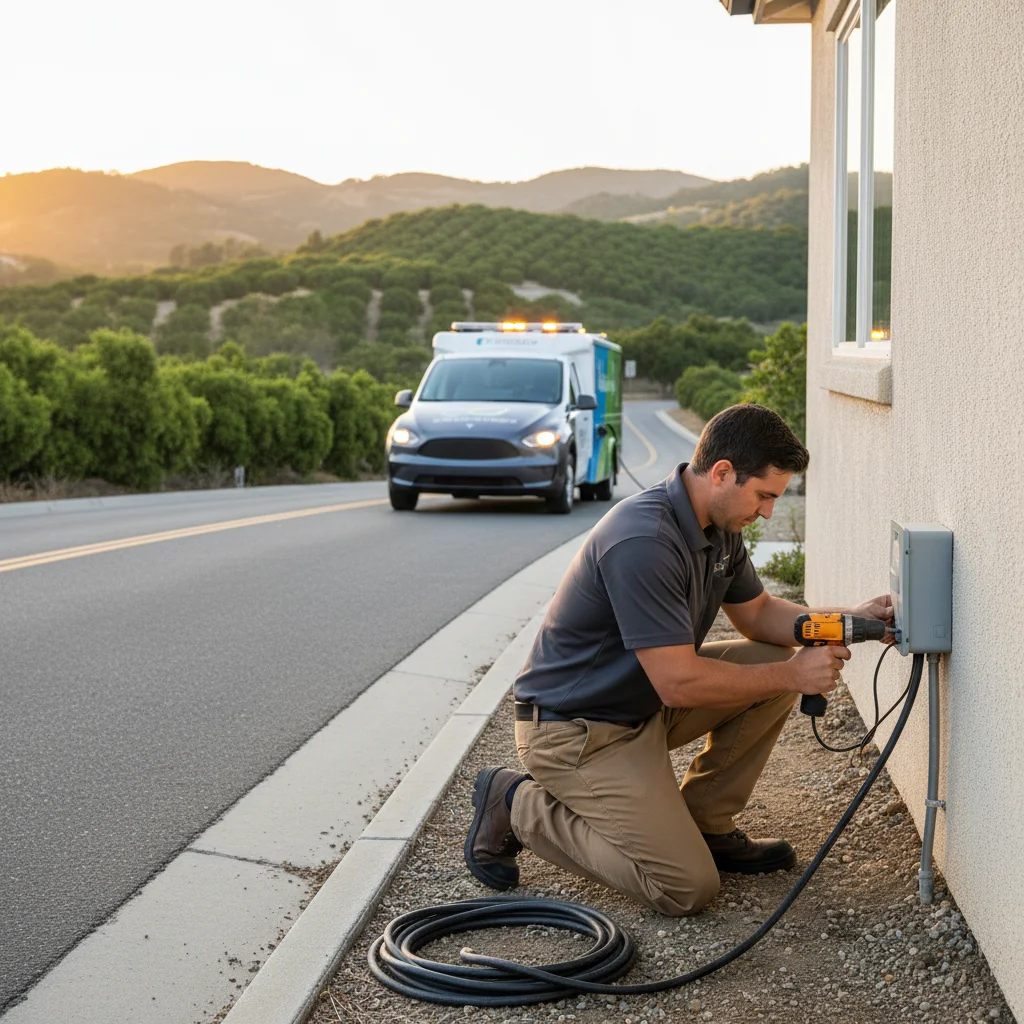
Lancaster is CCS and J1772 country
Lancaster sits in the Antelope Valley, north of the city of Los Angeles. The Antelope Valley has a high density of non-Tesla EVs. Ford F-150 Lightnings, Mustang Mach-Es, Chevy Bolts, Hyundai Ioniq 5 and 6, Kia EV6 and EV9, Rivian R1T and R1S, Polestar 2, Volkswagen ID.4 and ID.Buzz, and most other North American EVs use CCS or J1772 connectors.
Tesla drivers in the Valley carry a CCS adapter or use a Supercharger. Non-Tesla drivers need an operator with a CCS or J1772 cable on the truck.
The connector on the truck is the difference between a rescue and a tow. A mobile operator with a CCS cable and a J1772 adapter can charge almost any non-Tesla EV in the Valley.
Non-Tesla EV rescue in Los Angeles County: who helps covers the broader county dispatch.
What an operator brings for a non-Tesla
We’re a referral line for Los Angeles County. We match stranded EV drivers with independent local operators. The pros we connect you with are licensed and insured. We hold no license for the work. We own no trucks and employ no technicians. We set no prices and publish no arrival time.
The operator quotes you before they start. They bill you directly. No dollar figure belongs here. They quote you on the phone and confirm access before they roll.
What they bring is a 240-volt Level 2 source to the car. Native NACS covers Tesla. A CCS or J1772 adapter covers every other major EV brand. A typical session adds 10 to 20 miles of range. Charging time is usually 15 to 30 minutes, and that clock starts when the plug is in. It isn’t a clock for when the truck shows up.
That boost is enough to clear the climb over the Angeles Crest or reach a charger in Palmdale. Operators also jump or replace a dead 12-volt battery on site.
The connector matchup
Tell the dispatcher the make, model, and year when you call. The dispatcher confirms the connector before the operator sets off. A Rivian R1T uses CCS. A Ford Lightning uses CCS. A Hyundai Ioniq 5 uses CCS in the US market. A Chevy Bolt uses CCS. A Nissan Leaf uses J1772 for Level 2 and CHAdeMO for DC fast. A Polestar 2 uses CCS. A Volkswagen ID.4 uses CCS.
The operator’s van carries CCS and J1772 connectors for Level 2 charging. CHAdeMO is rare on a mobile truck because CHAdeMO is being phased out of new EV designs. A Leaf driver should ask on the call whether the operator carries a CHAdeMO cable.
Lancaster corridors that stall
The 14 runs north-south through Lancaster and Palmdale. The 5 (the Grapevine) runs east-west at the south end of the Valley. The 138 cuts west toward Palmdale and the foothills. Lancaster Boulevard and Sierra Highway carry the surface traffic through town.
A driver who climbs out of the LA Basin via the 14 or the 5 in summer arrives in the Antelope Valley with the pack lower than the morning dash showed. AC load at 95F and the climb over the Grapevine take real range. EV rescue on the Grapevine near Castaic covers the south side of that climb.
Surface streets add their own pattern. Lancaster Boulevard through downtown stacks cars at every signal. Sierra Highway through the commercial stretch catches local drivers who ran out between sessions.
Two different dead cars, two different calls
The empty-pack version shows up after a long climb or a hot AC day. The driver sees the dash dropping, finds a shoulder on the 14 or a side street in town, and calls for a charge. The traction pack is at zero, but the 12V still works. The operator plugs in and adds 10 to 20 miles.
The 12V version shows up after a long sit. A car that parked for a week in a Lancaster driveway wakes up dead. Heat on those driveways wears 12V batteries faster than the coast. The operator jumps the 12V at the stall or replaces it on site.
Both versions happen in this part of the Antelope Valley. The operator’s van covers Lancaster and Palmdale from the same dispatch.
Stay safe on an Antelope Valley shoulder
California Vehicle Code 21718 bars stopping on a freeway. A disabled vehicle that has summoned help is an exception. CVC 21809 is the move-over law. Other drivers must change lanes or slow when a service vehicle has lights on.
The 14 and the 5 are high-speed corridors. Pull as far right as you can and set hazards. Stay with the car if you can do so off the travel lane. If the shoulder is too narrow, get out on the uphill side and stay visible.
The Antelope Valley runs hot in summer. Carry water. Stay out of direct sun while you wait.
When a tow is still the honest answer
A crash or a bent wheel still needs a shop. So does a charge port that won’t accept power. On-site charging can’t fix that. If CHP is already there, take the safe tow.
The number to call is (213) 410-1991. We’ll match you with a local operator. They quote before any cable goes in.