A non-Tesla EV driver in Los Angeles County who runs out of charge types something different into a phone. They don’t get a Tesla service network. They get Ford, Hyundai, Kia, Rivian, Polestar, or VW. None of those programs send a mobile charger to a stall in most cases. Here’s the non-Tesla EV rescue path in LA County and how the dispatch works.
What the manufacturer programs cover
Ford’s roadside assistance covers tows and tire changes for the F-150 Lightning and Mustang Mach-E. The dispatch goes through Ford’s call center. Ford tows to the nearest Ford dealer or certified EV shop. Ford does not always send a mobile charger.
Hyundai’s roadside covers tows for the Ioniq 5 and Ioniq 6. The dispatch goes through Hyundai’s call center. Hyundai tows to a Hyundai dealer. Hyundai does not always send a mobile charger.
Kia’s program covers tows for the EV6 and EV9. Same pattern. Tow to a Kia dealer.
Rivian’s program is more developed. Rivian sends mobile chargers in some markets through their own network of service vans. Coverage in LA County is uneven. A Rivian driver outside Rivian’s service zone gets a tow.
VW, Polestar, Volvo, BMW, Mercedes, and Lucid all have manufacturer roadside programs that route through third-party dispatch. Most cover tows. Few cover mobile charging.
The gap is the same across all of these. A driver who needs electrons at the curb doesn’t always get them.
Non-Tesla EV rescue in Lancaster covers the Antelope Valley version of this dispatch.
What a referral to a local operator does
We’re a referral line for Los Angeles County. We match stranded EV drivers with independent local operators. The pros we connect you with are licensed and insured. We hold no license for the work. We own no trucks and employ no technicians. We set no prices and publish no arrival time.
The operator quotes you before they start. They bill you directly. No dollar figure belongs here. They quote you on the phone and confirm access before they roll.
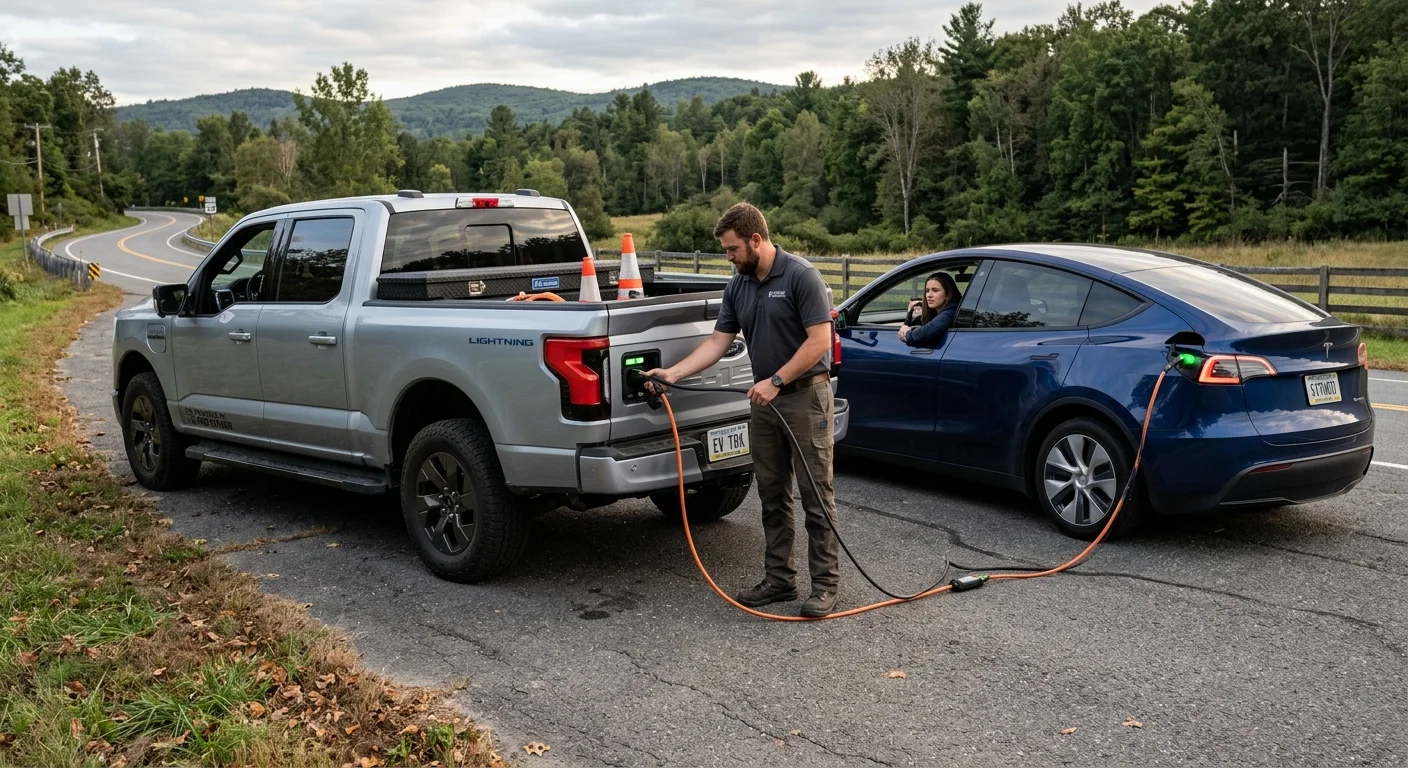
What they bring is a 240-volt Level 2 source to the car. Native NACS covers Tesla. A CCS or J1772 adapter covers every other major EV brand. A typical session adds 10 to 20 miles of range. Charging time is usually 15 to 30 minutes, and that clock starts when the plug is in. It isn’t a clock for when the truck shows up.
That boost is enough to reach a charger or get home. Operators also jump or replace a dead 12-volt battery on site.
The connector matchup
Tell the dispatcher the make, model, and year when you call. The dispatcher confirms the connector before the operator sets off.
Rivian R1T and R1S use CCS. Ford Lightning and Mustang Mach-E use CCS. Hyundai Ioniq 5 and 6 use CCS. Kia EV6 and EV9 use CCS. Chevy Bolt and Equinox EV use CCS. Polestar 2 uses CCS. Volkswagen ID.4 and ID.Buzz use CCS. BMW i4, i5, i7, and iX use CCS. Mercedes EQE and EQS use CCS. Lucid Air uses CCS. Genesis GV60 and GV70 Electrified use CCS.
Nissan Leaf uses J1772 for Level 2 and CHAdeMO for DC fast. The Leaf is the one car where a CCS-only operator may not be able to help. Confirm CHAdeMO coverage on the call.
Most other North American EVs fit those same connectors. The operator’s van carries CCS and J1772 cables for Level 2 charging.
Why LA County has a lot of these calls
Census ACS data puts 71.0 percent of City of Los Angeles housing built before 1980. East Los Angeles is older still, at 86.2 percent pre-1980 stock. Most of those buildings don’t have home chargers. Non-Tesla drivers in Koreatown, Hollywood, and East Los Angeles rely on public stalls.
The Westside and Beaches cities are dense with EVs of every brand. Santa Monica, Culver City, and West Hollywood have a mix of Teslas and non-Teslas. Public stalls fail or sit full. The math fails. The car stops at zero.
How the dispatcher picks an operator
We don’t dispatch a Charge Pro truck. We match your pin to an operator who already covers that part of LA County. The Westside gets a Westside operator. The Valley gets a Valley operator. The South Bay gets a South Bay operator. The dispatch picks by coverage, not by a rotating queue.
The operator’s arrival time depends on where they already are when you call. We don’t publish an arrival time. The operator quotes you before they roll and gives you a window on the call.
Why a referral instead of just calling the manufacturer
The manufacturer covers a tow. They may cover a mobile charge in some cases. What they don’t always cover is a mobile charge at the pin. The third-party contractor decides on the call.
A mobile operator brings the charger to the car. The car doesn’t move. The driver gets 10 to 20 miles at the curb, in the garage, or on the shoulder.
What mobile EV charging can’t fix
A crash or a bent wheel still needs a shop. So does a charge port that won’t accept power. On-site charging can’t fix that. A non-Tesla with a high-voltage fault is a flatbed to a certified dealer. The operator quotes and confirms before they start. If they can’t charge your car, they tell you on the call.
A dead 12V is different. The operator jumps or replaces the battery on site. That’s the more common call in many LA County garages. A car that sat in a structure for a week often comes back to a dead 12V, not an empty pack.
The number to call is (213) 410-1991. We’ll match you with a local operator. They quote before any cable goes in.