A driver at a Shell Recharge stall or a Tesla Supercharger who can’t get a session to start has a public-network problem. The hardware is fine. The handshake is broken. The session never starts. The driver is stuck. Here’s the mobile rescue path when both networks fail in LA County.
What Shell Recharge covers in LA County
Shell Recharge operates a network of DC fast chargers and Level 2 chargers at Shell gas stations and standalone sites across LA County. The network supports CCS and NACS connectors on most modern stalls. Drivers pay through the Shell Recharge app or through partner networks that have roaming agreements.
Shell Recharge is one of several DC fast charging options in the county. Electrify America, EVgo, ChargePoint, and Tesla Superchargers are the other major networks. Each has its own app and billing system.
A driver who plans a trip around Shell Recharge stalls finds out fast that the network has gaps. Some sites have one or two stalls. Some stalls are out of service. The billing system glitches. The session doesn’t start.
What Tesla Superchargers cover
Tesla Superchargers are the densest DC fast charging network in LA County. The network supports Tesla natively and supports CCS through the Magic Dock or through a Tesla-supplied adapter on newer cars.
A Tesla driver at a Supercharger plugs in and the session starts automatically. The billing goes through the Tesla account. A non-Tesla driver using the Magic Dock goes through the Tesla app.
A Supercharger stall can be down, full, or in a site that’s hard to reach from the freeway. A driver who arrives at a full Supercharger has to wait or find another site.
When both fail
A driver whose Shell Recharge stall says connected but won’t start a session has a handshake failure. The fix is on the driver side: reseat the cable, check the connector, try a different stall, authorize the session through the app. If none of that works, the charger has a fault.
A driver whose Tesla Supercharger stall is full has a different problem. The session can start when a stall opens. The driver waits. Some sites have a queue system that holds a spot.
A driver whose Tesla Supercharger stall is down has the same handshake failure as a Shell Recharge stall. The driver tries a different stall. If all stalls are down, the driver tries a different site.
When all of that fails, the driver is stranded. The pack is low. The next charger is miles away. That’s when a mobile rescue is the right call.
What a mobile operator brings
We’re a referral line for Los Angeles County. We match stranded EV drivers with independent local operators. The pros we connect you with are licensed and insured. We hold no license for the work. We own no trucks and employ no technicians. We set no prices and publish no arrival time.
The operator quotes you before they start. They bill you directly. No dollar figure belongs here. They quote you on the phone and confirm access before they roll.
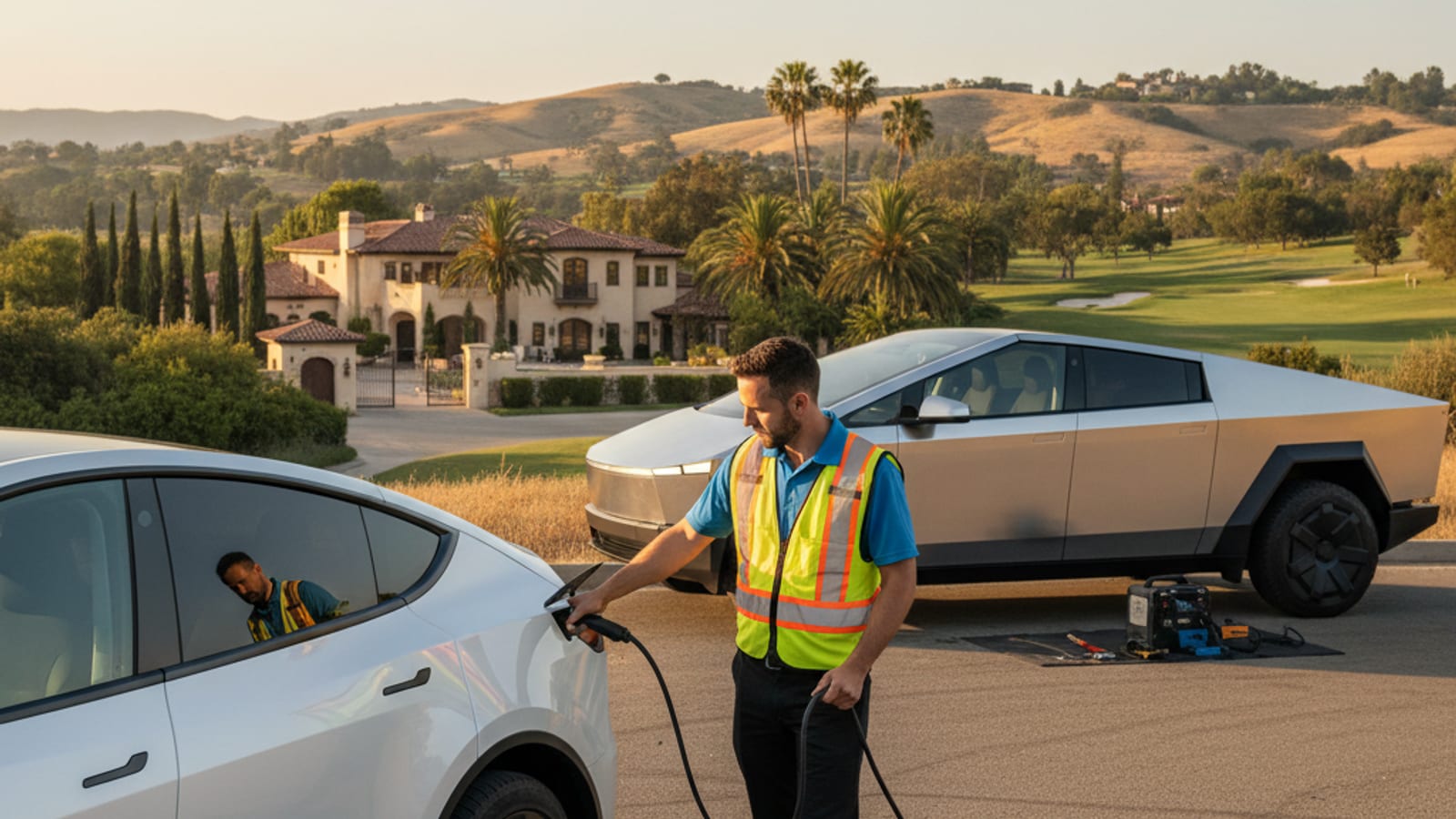
What they bring is a 240-volt Level 2 source to the car. Teslas take a native NACS plug. Other EVs use a CCS or J1772 adapter. A typical session adds 10 to 20 miles of range. Charging time is usually 15 to 30 minutes, and that clock starts when the plug is in. It isn’t a clock for when the truck shows up.
That boost is enough to reach a working charger. The operator’s equipment is independent of the public networks. If the public network is broken, the operator’s truck isn’t.
Public charger says connected but it’s not charging covers the troubleshooting path before the rescue call.
Why LA County drivers hit this
LA County has more public DC fast chargers per square mile than almost anywhere in the country. The density is high. The reliability is uneven. A driver who plans a trip around the network finds out fast that some sites are more reliable than others.
Census ACS data puts 71.0 percent of City of Los Angeles housing before 1980. Most of those buildings don’t have home chargers. Public DC fast charging is the daily plan for many drivers. When a stall fails, the math fails. The car stops.
What to do with the broken public charger
Report the broken stall through the network’s app. The network needs the report to dispatch a repair. Your report helps the next driver who pulls up.
Don’t leave the car plugged into a broken stall if you’re driving away. A car parked at a broken stall blocks the next driver from using the working stalls.
The combined answer
A public charger that says connected but doesn’t charge is usually a handshake failure. The fix is on the driver side: reseat the cable, check the connector, try a different stall, authorize the session through the app. If none of that works, the charger or the car has a fault. The next move is a mobile rescue.
A full Supercharger is a waiting problem, not a fault. The driver can wait or try a different site.
The number to call is (213) 410-1991. We’ll match you with a local operator. They quote before any cable goes in.