A Tesla Model 3 has two batteries. The 12-volt battery that powers the lights, screen, and contactors. And the traction pack that drives the wheels. They’re in different places and they fail differently. Here’s where each one sits and why it matters for roadside help in LA County.
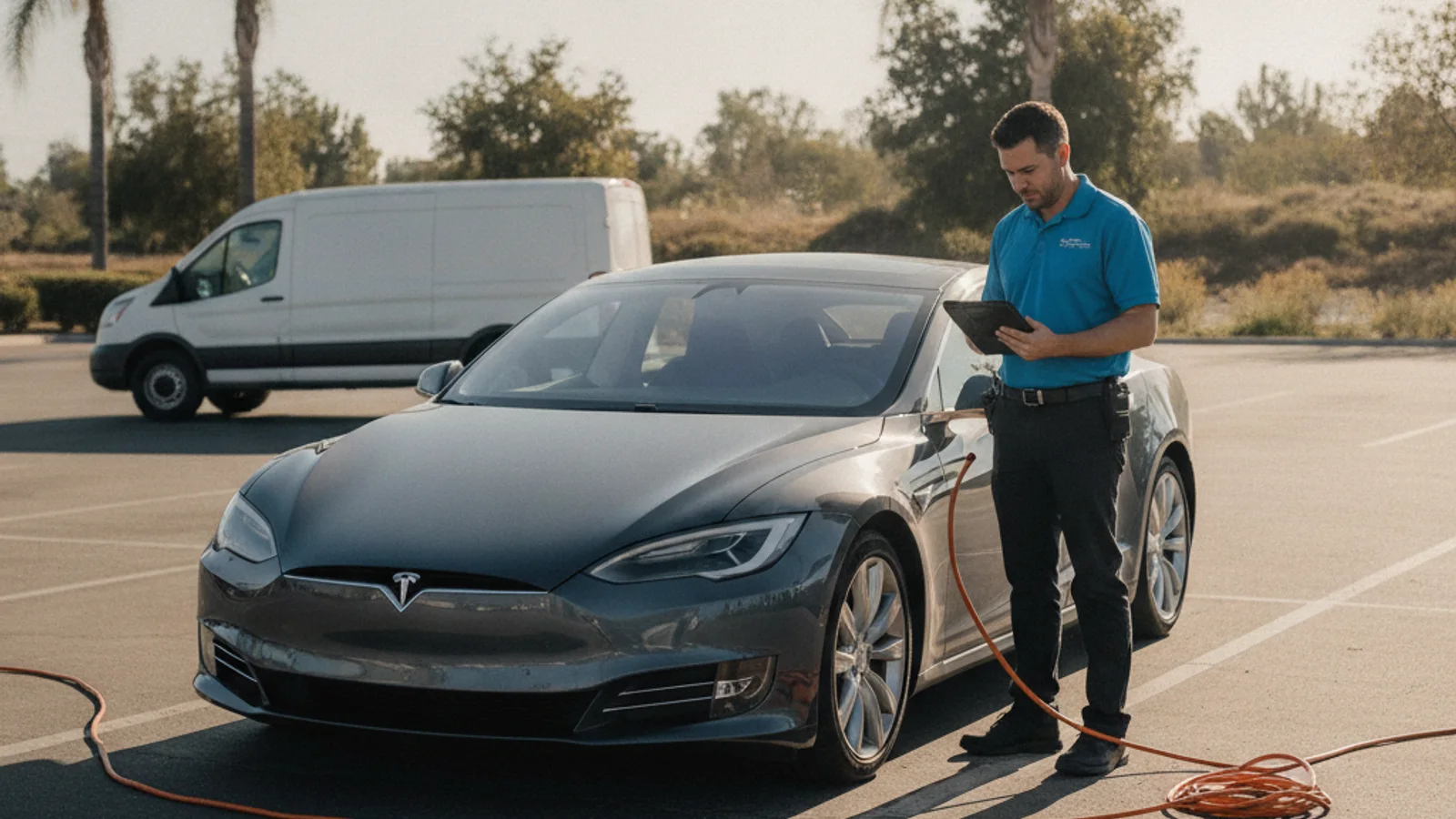
The 12V location in the Model 3
The Model 3’s 12V battery sits under the hood, near the front of the car. The positive terminal has a red cover. The negative terminal grounds to the chassis nearby.
To open the hood, the driver uses the Tesla app or the center screen. There’s no traditional hood release cable inside the cabin on the Model 3. The hood releases through the electronic latch.
Once the hood is open, the 12V is visible. A roadside operator can jump the 12V without removing any covers. They connect the positive clamp to the positive terminal and the negative clamp to a chassis ground point.
The traction pack location in the Model 3
The Model 3’s traction pack sits under the floor pan. It’s a long flat pack that runs the length of the cabin. The pack is sealed and isn’t accessible from inside the car. Service requires lowering the pack from underneath.
A driver never accesses the traction pack directly. The pack charges through the charge port on the rear driver’s side. The pack powers the motor through high-voltage cables that run from the pack to the rear motor (and the front motor on dual-motor configurations).
The traction pack is the part that holds the miles. It’s a large lithium-ion pack that holds roughly 60 kWh to 82 kWh depending on the trim. The Model 3 Standard Range uses a smaller LFP pack in some markets.
Why the two batteries fail differently
The 12V is small and ages quickly. Heat, vibration, and time all wear it out. The 12V in a Model 3 is rated for about four years in mild climates and two to three years in hot climates. LA County heat cuts that further.
The traction pack is large and lasts much longer. Tesla warranties the traction pack for 8 years or 100,000 to 150,000 miles depending on the trim. The pack rarely fails in a roadside situation. The failures that strand a Model 3 are almost always the 12V, not the traction pack.
How the two batteries interact
The DC-DC converter in the Model 3 charges the 12V from the traction pack while the car is in Ready mode or while the car is plugged in. A Model 3 that sits for a week has a 12V that drains slowly. The DC-DC converter doesn’t run during the sit. The drain comes from the alarm system, the cellular modem, and the central computer.
A Model 3 that’s driven regularly keeps the 12V topped up by the DC-DC converter. The driver never thinks about the 12V.
A Model 3 that sits for a week may return to a 12V that’s below the threshold the computer needs. The traction pack still has whatever state of charge it had when the car parked. The 12V is the problem.
Tesla 12V is dead: how to tell, then how to jump it covers the 12V failure in more detail.
What the operator accesses
A roadside operator who comes to jump the 12V accesses the front of the car. They open the hood. They connect a portable jump pack to the 12V terminals. The Tesla’s computer wakes within a few seconds.
A roadside operator who comes to charge the traction pack accesses the rear driver’s side charge port. They plug a 240V Level 2 source into the NACS connector. They add 10 to 20 miles of range.
The operator confirms what they need to access on the call. They tell you which side of the car they’ll be working at and what equipment they’ll bring.
Why the location matters for roadside help
The 12V is accessible from the front. The charge port is accessible from the rear driver’s side. A roadside operator needs to be able to reach both ends of the car. The Model 3 is short enough that the operator can usually park beside it and reach both ends.
A Model 3 in a tight parking structure may not have room for the operator’s van beside it. The operator confirms the layout on the call before they roll. If they can’t reach both ends, they bring portable equipment they can carry.
What about the Model Y
The Model Y has the same layout as the Model 3. The 12V sits under the hood at the front. The traction pack sits under the floor. The charge port sits at the rear driver’s side.
Tesla 12V battery replacement: what owners should know before a shop visit covers the 12V replacement process that applies to both models.
The combined answer
A Tesla Model 3 has two batteries. The 12V is small and accessible under the hood. The traction pack is large and sealed under the floor. The 12V is what fails in roadside situations. The traction pack rarely fails outside of a dealer visit. A mobile operator accesses the 12V from the front and the charge port from the rear.
The number to call for roadside help is (213) 410-1991. We’ll match you with a local operator. They quote before any cable goes in.