A Tesla Model Y driver in Torrance who runs out of charge on the 405 or the 110 has two real answers. Tesla’s own roadside through the app, or a local mobile rescue. They aren’t equivalent. Here’s how the dispatch works in Torrance and when a local mobile rescue fills the gap.
Why Torrance Model Y drivers hit this
Torrance sits in the South Bay between the harbor and the Westside. The 405, the 110, and the PCH run through or near the city. Aerospace campuses along El Segundo Boulevard and Hawthorne Boulevard hold cars all day. The Del Amo district pulls mall traffic. Old Torrance and Southwood drivers park on residential streets.
The marine layer keeps summer temperatures mild. Heat isn’t the main range drain in Torrance. Stop-and-go beach traffic on PCH and Hawthorne Boulevard is. The 405 crawl and the 110 harbor traffic eat extra pack.
A driver who cut it close on a Torrance commute runs short. The car stops at a curb on Hawthorne or a shoulder on the 405.
EV rescue in Torrance covers the broader Torrance pattern.
What Tesla’s dispatch actually sends
Tesla roadside is requested through the Tesla app. The call routes to a third-party contractor. The contractor decides what to bring based on the failure and the location.
Most contractors in LA County carry a flatbed. The flatbed takes the Tesla to a Tesla Service Center or to a public charger. The driver waits on a hook.
Tesla roadside who actually shows up covers the contractor gap in more detail.
What a local mobile rescue brings
We’re a referral line for Los Angeles County. We match stranded Tesla drivers with independent local operators. The pros we connect you with are licensed and insured. We hold no license for the work. We own no trucks and employ no technicians. We set no prices and publish no arrival time.
The operator quotes you before they start. They bill you directly. No dollar figure belongs here. They quote you on the phone and confirm access before they roll.
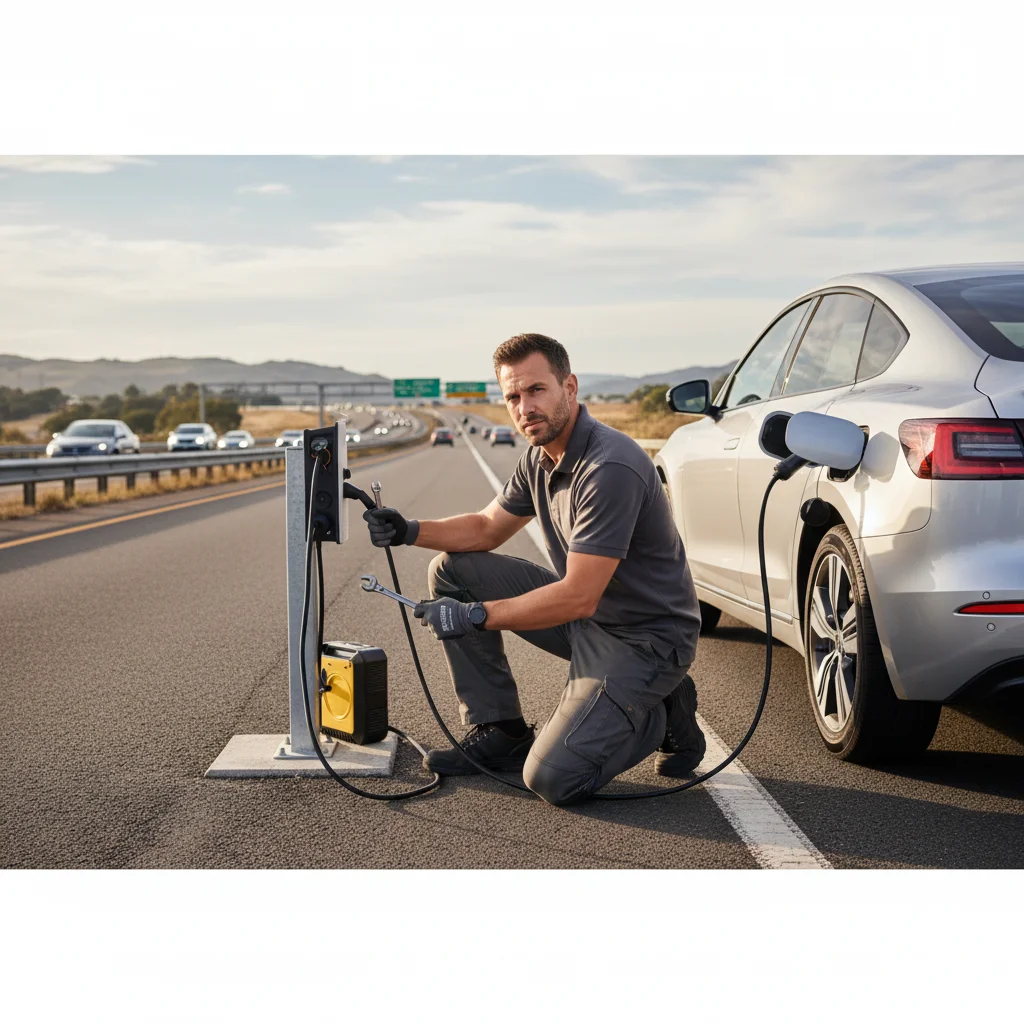
What they bring is a 240-volt Level 2 source to the car. Teslas take a native NACS plug. A typical session adds 10 to 20 miles of range. Charging time is usually 15 to 30 minutes, and that clock starts when the plug is in. It isn’t a clock for when the truck shows up.
Operators also jump or replace a dead 12-volt battery on site. That’s the more common call in many South Bay garages.
The choice between them
A Model Y driver who needs electrons at the pin has two paths. The Tesla path is the app. The local path is a phone call to us.
The Tesla path is covered under the basic roadside program included with the car. The driver pays nothing out of pocket for the dispatch. The contractor bills Tesla. The downside is the dispatch may bring a tow truck instead of a charger.
The local path is a referral match. The operator bills the driver directly. The operator quotes on the phone. The upside is the operator brings a charger.
When Tesla’s dispatch is the right call
A crash or a bent wheel needs a flatbed. Tesla’s program tows to a Tesla Service Center.
A charge port fault needs a dealer. Tesla’s program tows to a Service Center.
A Tesla with a high-voltage fault needs a dealer. Same answer.
When a local mobile rescue is the right call
An empty pack or a dead 12V at a curb or in a lot. The car doesn’t need to move. The driver needs electrons at the pin.
A Model Y in an Old Torrance garage that won’t wake after a week. The driver needs a 12V jump at the stall, not a tow to a Tesla Service Center.
A Model Y on the shoulder of the 405 in Torrance. The driver needs 10 to 20 miles to reach a charger.
Torrance corridors that stall
The 405 through Torrance catches Westside-to-South Bay traffic. The 110 runs north-south along the east side. The PCH catches beach traffic through Riviera Village and King Harbor. Hawthorne Boulevard and Crenshaw Boulevard carry the surface traffic.
A driver who climbed out of the basin via the 110 or the 405 in summer arrives with the pack lower than the morning dash showed. The crawl on those corridors eats range the dash still shows as flat.
Combining the two
A Model Y driver can call Tesla’s app first and request a mobile charge. If the contractor brings a charger, the call is covered. If the contractor brings a flatbed, the driver can decline and call us. The tow can be declined before it hooks up.
Tesla, AAA, or a local mobile rescue: how the three actually differ compares the three columns in more detail.
The combined answer
Tesla’s dispatch is the first call for most Model Y drivers in Torrance. The dispatch is fast and the program is included with the car. The gap is the mobile charge at the pin. A local mobile rescue fills that gap.
The number to call for a local mobile rescue is (213) 410-1991. We’ll match you with a local operator. They quote before any cable goes in.