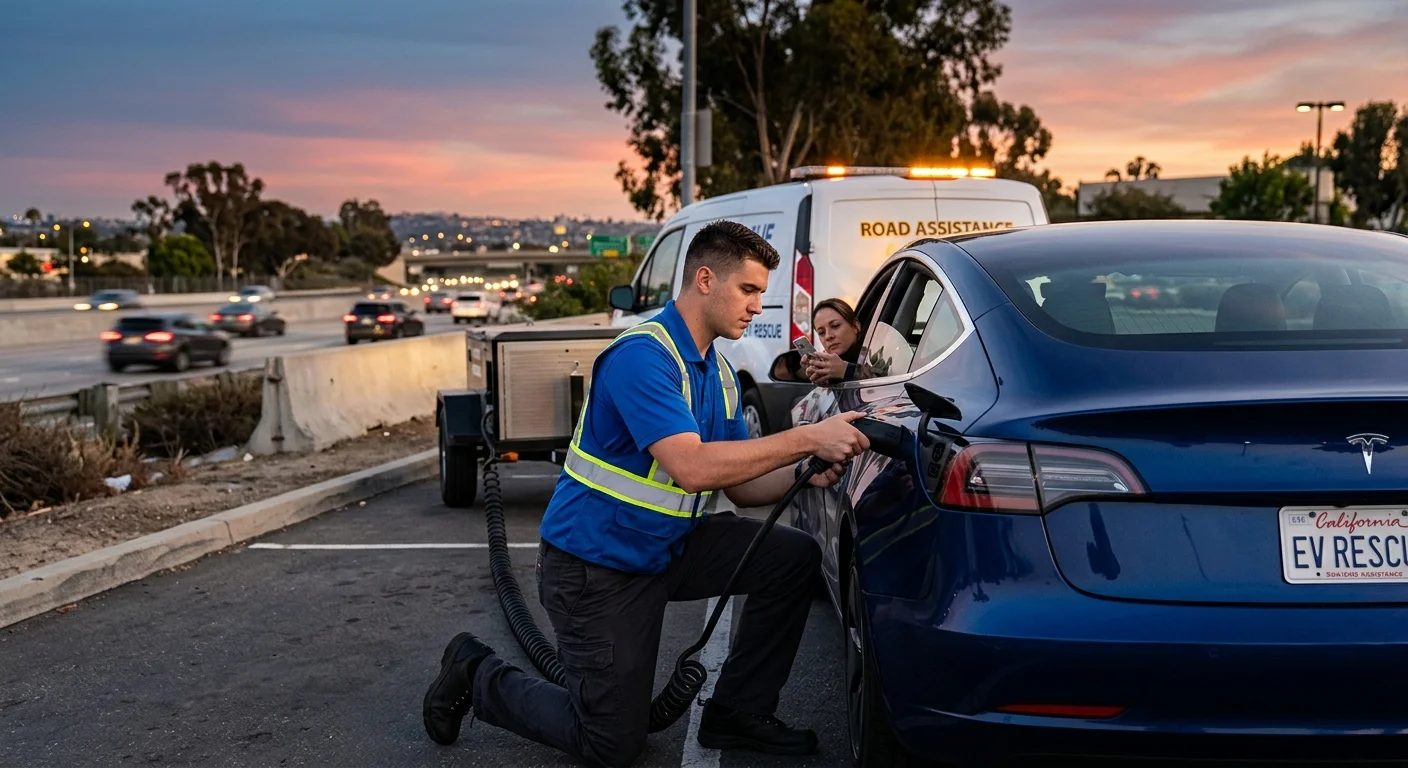
Tesla roadside assistance in Los Angeles County is a coverage question first. The Tesla app shows what Tesla will send for this VIN and this pin. It also shows whether this exact problem qualifies. A Roadside button can still appear while your stall sits outside the terms. That includes an empty pack, a dead 12-volt battery, or a flat. Independent local operators still quote you before they start. They bill you directly.
Tesla coverage is a policy, not a local rumor
Tesla writes its own roadside terms. We couldn’t confirm a current, complete coverage list from our approved sources. An old search result isn’t the policy for your car today.
Open the Tesla app tied to the stranded vehicle. Find Roadside or Support. Read every condition shown for this request. If the option isn’t there, use Tesla’s current official support materials. Skip third-party pages that may be stale.
Hours and coverage are different issues. A contact path can exist while your stall still fails the terms. Don’t treat the phrase roadside assistance as proof that this stop qualifies.
A Supercharger stall near UCLA isn’t the same stop as a shoulder on the 405. Sepulveda Pass is a different scene from a garage after a week at LAX. Terminal parking at LAX, structures P1 through P7, offers Level 2 and DC fast charging. The Economy Parking garage has more than 4,000 stalls, including 514 active EV chargers. A traveler can still return to a car that will not wake. The 12-volt battery can die in the lot even when chargers are present. That’s a different job from an empty drive pack.
Our guide to what Tesla roadside covers walks through the questions to ask. It doesn’t replace the terms Tesla displays in the app.
Name the fault without guessing the repair
Tell Tesla what you can see. Don’t invent a diagnosis on the shoulder.
Say whether the screens are on, dim, or dark. Say whether the car will shift. Read the warning out loud, word for word. Note the high-voltage percentage if the display shows one. Mention a flat, a stuck charge cable, smoke, heat, or crash damage. Say if you’re in a travel lane, on a shoulder, in a structure, or in a lot.
A Tesla that will not move isn’t one problem. The pack can be empty. The 12-volt battery can be dead. A tire can be ruined. Those need different trucks. Calling it a jump when the pack is at zero sends the wrong help. If the screens are dead after a long sit, start with our Tesla 12V versus pack article.
Payment is a separate question from dispatch. We couldn’t confirm that Tesla covers every request in every city. We also couldn’t confirm that every service is free to you. If the app says the visit isn’t included, ask who sets the bill. Ask who collects it before anyone hooks up.
Request help in the app, then save what it shows
Use the app for the stranded VIN. Follow the on-screen Roadside steps if they appear. Screenshot the terms, the confirmation, and the name of whoever Tesla lists.
Give a location a dispatcher can find. “On the 5” isn’t enough in a county this large. Include direction of travel, the nearest signed exit, the side of the road, and a landmark. In a Burbank studio garage or a downtown structure, the building name and level beat a street number. On I-10 through El Monte or on I-110, say if you’re in the Metro ExpressLanes. Those lanes need a FasTrak transponder on a funded account. If you don’t have one, Metro bills the plate under Pay-As-You-Go. That doesn’t change how rescue works. It does change how you describe the stop.
If the request vanishes or stalls, go back to Tesla’s current support channel. Don’t loop an old directory number. App or phone for Tesla roadside lists what to have ready either way. It doesn’t say which route answers first.
If the car is in a bad spot on an LA freeway
Treat a live-lane stall as an emergency, not a policy debate. Call 911 if the Tesla is blocking traffic or someone is in danger. Do what the officers tell you.
California Vehicle Code 21718 generally forbids stopping on a freeway. A disabled vehicle that has already called for help is an exception. If you can move the car without adding risk, get it out of the travel lanes. Don’t push, open high-voltage covers, or try to charge from a live lane.
Turn on hazards if they work. CVC 21809 is the move-over law. Other drivers must change lanes when safe, or slow down, for a stopped emergency vehicle, tow truck, or Caltrans vehicle with flashing lights. That rule is there to protect you. It doesn’t widen a skinny shoulder.
Metro Freeway Service Patrol is free on congested Los Angeles County freeways. It’s a joint program of Caltrans, the California Highway Patrol, and LA Metro. Dial 511 and say Motorist Aid. Coverage is typically Monday through Friday during peak commute hours. FSP’s published list includes a gallon of gas, a radiator refill, and a tire change. It also tows a disabled vehicle free to a safe spot CHP chooses. It doesn’t list mobile EV charging or an empty-pack boost. An empty Tesla can still take that free tow off the freeway. It shouldn’t expect FSP to plug in.
Stay with the car only if the shoulder is safe. That includes the long grade north of Castaic toward the Grapevine. The same goes for the 405 climb at Sepulveda Pass. If you walk away, lock it and tell the next person the exit, direction, and side.
For a focused Sepulveda Pass checklist, see out of charge on the 405 at Sepulveda Pass.
When a local operator quotes you on the spot
Tesla’s channel might not fit this stop. The app might hide the option. The terms might exclude the work. You might want a quote from someone else. An independent local operator is that other path.
Charge Pro LA is a referral line serving Los Angeles County. We connect stranded EV drivers with independent local mobile rescue operators. We don’t own trucks, employ technicians, set prices, or do the work. The operator quotes you before starting and bills you directly. The pros we connect you with are licensed and insured.
Give the operator the model and the screen message. Share the pack percentage if you have it, and a precise pin. Say whether the car is reachable in a West Hollywood garage, a Santa Monica lot, or a Long Beach structure. Access decides whether a Level 2 truck can reach the charge port.
The operators on these calls typically roll a 240-volt Level 2 source. Teslas take a native NACS plug. Other EVs use a CCS or J1772 adapter. A typical session adds about 10 to 20 miles of range in 15 to 30 minutes of charging. That’s charging time, never an arrival time. They can also jump or replace a dead 12-volt battery on site. That work covers Tesla and every major EV brand.
Ask what the quote includes: a boost, a 12-volt jump, a tow, or something else. Keep the operator’s terms and payment record. To line Tesla’s program up against club roadside and a local truck, read Tesla, AAA, or a local mobile rescue.
Tesla-specific dispatch starts at Tesla roadside rescue. Any EV brand can use EV roadside assistance.
If you need a local connection
Call when your Tesla is stranded in Los Angeles County. Ask us to find a mobile EV rescue operator. We don’t promise Tesla will cover it, and we don’t promise when someone arrives. The operator confirms the service and the quote with you.
Call (213) 410-1991 and we’ll connect you with a local EV rescue operator.