The cluster on your Hyundai Ioniq 5 just said 12V battery voltage low, and the range number still looks fine. That message is about the small auxiliary battery that wakes the computers, locks, and screens. In Los Angeles County it often shows up after a heat-soaked day in a closed garage, not after a long freeway run.
What the 12V voltage low warning is telling you
Every Ioniq 5 has two electrical worlds. The high-voltage pack moves the car. The 12-volt battery, called the auxiliary battery in Hyundai’s Ioniq 5 owner’s manual, runs the low-voltage side: latches, displays, computers, and the handshake that lets the pack come online. When that small battery sags, the car can look dead even with miles left from the last drive.
12V battery voltage low is a warning, not a full diagnosis. It means the car measured the auxiliary battery as too weak for what the computers expect. Hyundai’s Ioniq 5 owner’s manual does not publish a single voltage cutoff that applies to every model year, so we will not invent one. If you need a number, a Hyundai dealer or an independent shop with a tester can measure the battery on the car in front of them.
The warning can appear while the fob still works, the screen is lit, or the car will still go to Ready. It can also be the last thing you saw before the Ioniq 5 went silent. If the car already will not start, use the sibling walkthrough on Ioniq 5 12V checks when it will not start. This page stays on the warning itself.
Los Angeles County is hard on that small battery. Roof decks in Pasadena and Glendale bake a parked Ioniq 5. Closed podium garages in Koreatown and downtown Los Angeles trap heat overnight. A week at LAX Economy Parking, where LAWA lists 514 active EV chargers, is a long sit even if you found a plug. A long sit unplugged is harder. None of that proves the traction pack is empty. It proves the 12-volt side is the first thing to complain.
Aftermarket drains matter here too. A dash cam hard-wired to constant 12-volt power is a common reason the warning comes back. Hyundai’s owner’s manual does not list every accessory. If you added a cam, a tracker, or an always-on module, tell whoever tests the car.
The U.S. Department of Energy’s electric vehicle overview still describes a 12-volt system for ordinary loads on many EVs. The Ioniq 5 is in that camp. The traction pack is not the battery that threw this message.
Checks you can run in a parking structure
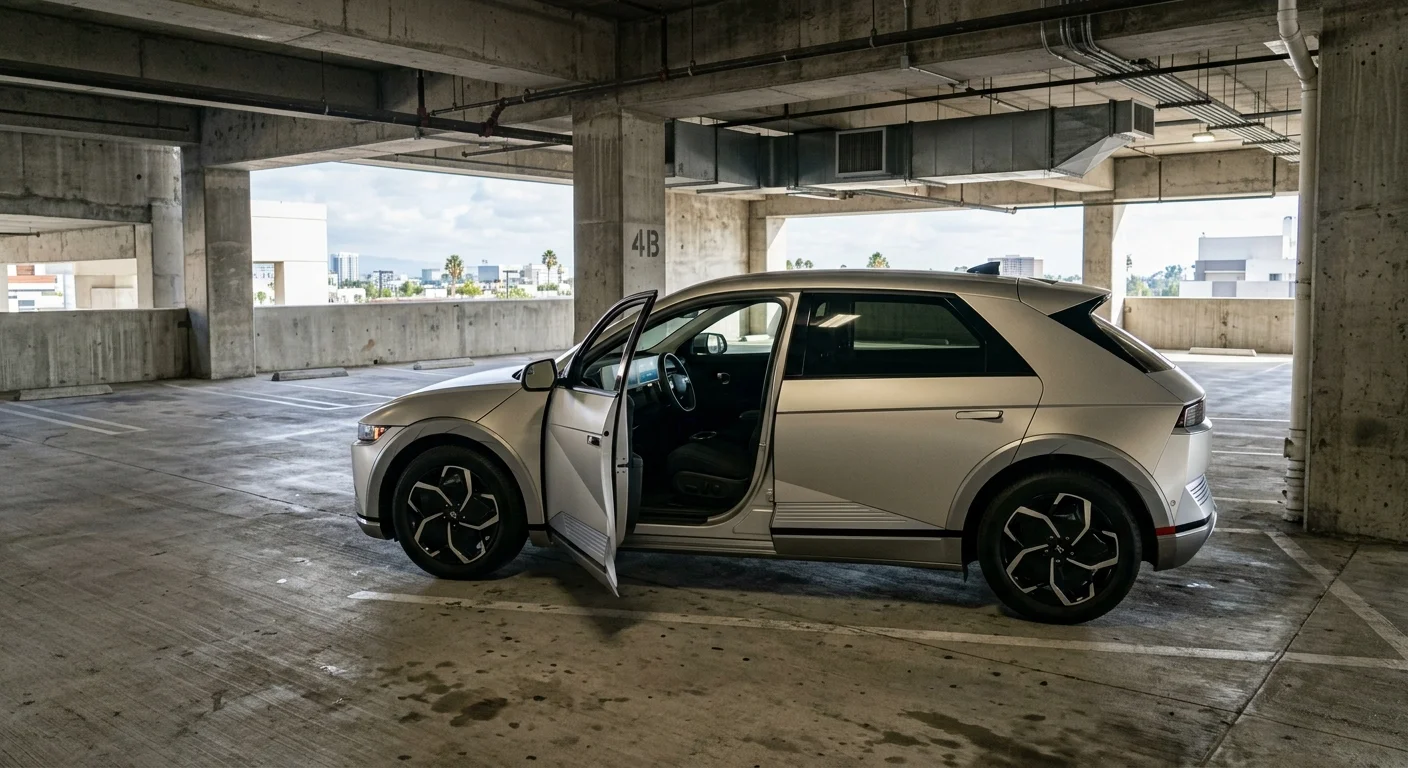
You’re probably in a garage when this hits. DTLA, Century City, Culver City, Burbank, and the stacked lots around SoFi share the same limits: poor cell service, dim light, and no room to work. The Ioniq 5 does not hide this battery under a gas-car hood. Hyundai’s Ioniq 5 owner’s manual places the 12-volt auxiliary battery in the cargo area. Open the hatch if it still unlatches. If it does not, the manual covers mechanical key access. Use the key steps in your year-specific book, not a guess from a forum.
Look, don’t wrench. Confirm the hatch, charge port door, and any cargo lamp are fully closed. A latch that looks shut and is not can keep a lamp on. Check whether a cargo cover or floor panel is sitting proud. Do not pull cables. Do not “reset” the 12-volt battery with a button sequence you found online. We could not confirm a Hyundai-published one-button 12V reset for the Ioniq 5. If your year has a battery-related item in the in-car service menus, the owner’s manual or the dealer notes for that VIN are the source.
If the car still talks to you, write down the exact wording. Photograph the screen if you can. 12V battery voltage low plus a dead fob is a different scene from the same message on a car that still goes to Ready. That note is what a Hyundai advisor and a roadside operator both need.
If you are on a freeway shoulder, stop the DIY list. California Vehicle Code 21718 bars stopping on a freeway, with an exception for a disabled vehicle when help has been summoned. California Vehicle Code 21809 is the move-over law for stopped emergency, tow, or Caltrans vehicles with flashing lights. Call for help and stay out of the lane.
Metro Freeway Service Patrol can help on designated Los Angeles County freeway beats. Dial 511 and say Motorist Aid. FSP’s published list includes jump-starting cars, flat tires, up to a gallon of fuel, radiator help, and a tow to a designated safe spot off the freeway. It does not include mobile EV charging. Hours on Metro’s page are Monday through Friday 6am to 7pm, and weekends 10am to 6:30pm. If you are in a garage, FSP is not the call.
Do not try to jump the high-voltage pack. Hyundai’s jump-start pages in the Ioniq 5 owner’s manual are about the 12-volt system only. If you are not sure which terminals your year names, wait. A mismatched clamp is worse than a quiet car. For a model-agnostic safety walkthrough, read how to jump start an electric car, then still open the Ioniq 5 book for this car.
12V brick versus a pack that is actually empty
These two failures feel the same from the driver’s seat, and they are not. A weak 12-volt brick leaves the traction pack locked out. An empty pack leaves the 12-volt system with nothing useful to recharge from once the car is awake. You need to know which one you have before anyone quotes a rescue.
Clues the 12-volt side is the problem: the last screen still showed usable range, the charge port may not answer, the handles and fob go dull, and the warning named the 12V battery. Clues the pack is actually empty: the car was already low on indicated range, you were hunting a charger, or you sat in climate control until the number fell off. For the wider picture on any EV, read what happens when an EV 12V battery dies.
People search how to recharge a 12V battery on an Ioniq 5 as if it took a separate wall charger. On this car, once the vehicle is awake, the high-voltage system can feed the 12-volt battery through the car’s own converter. Hyundai’s owner’s manual does not publish a required drive time or a plug-in duration we can quote. We will not invent 20 minutes, 30 minutes, or an overnight figure. After the car is awake, follow the manual, then have the 12-volt battery load-tested if the warning returns.
Replacement cost is another search we will not fake. How much to replace a 12V battery in an Ioniq 5 has no verified figure we can publish, and Hyundai does not post a Los Angeles County parts-and-labor number we can cite. Ask a Hyundai dealer or an independent shop for a quote on your year. A 12-volt battery is a service part. It is not the traction pack.
If the pack is the empty one, a 12-volt jump will not give you a commute. You need energy in the high-voltage battery. That is a different job from waking a brick. In this county that often means a mobile charge from a local operator, or a tow to a charger you can actually use. Typical mobile Level 2 rescue charging, as this brand describes it, is about 10 to 20 miles of range in 15 to 30 minutes of charging time. That is charging time, not arrival.
When a local operator should wake the car
Stay put if the Ioniq 5 will not unlock, will not Ready, or the warning came back after you already got it moving once. Repeating a jump without a test is how a weak battery strands you on the 405 or in a Santa Clarita driveway the next morning.
Charge Pro LA is a referral service. We do not jump the car, we do not own the truck, and we do not set the price. We connect you with a licensed, independent local operator. The pros we connect you with are licensed and insured. For a Hyundai that will not wake, that path is non-Tesla EV rescue. If you are on a shoulder or in a lot and you need emergency EV roadside assistance, that is the same idea: a local pro, not a brand-owned fleet.
An operator who knows EVs will treat this as a 12-volt wake, not a gas-car boost across the wrong posts. They should follow Hyundai’s jump-start guidance for the Ioniq 5, not a generic clip. If the hatch will not open, they work from the access the manual describes. If the car wakes, they can often add energy to the traction pack so you can reach a charger or a dealer. If it will not wake, they can talk through a tow that matches the Ioniq 5 towing chapter in the owner’s manual. Tow method is year-specific. Do not guess.
Do not wait on a freeway for a second opinion from a group chat. Summon help. CVC 22651(f) lets a peace officer remove a vehicle left more than four hours on a freeway right-of-way when the driver cannot move it under its own power. A quiet Ioniq 5 in the number-four lane of the 10 through the San Gabriel Valley is not a project car. It is a traffic problem.
GEICO Emergency Road Service, if you bought that optional coverage, lists battery jump starts and towing to the nearest qualified repair facility, with mileage limits. In most states GEICO says towing is covered up to 15 miles. That page does not name electric vehicles or mobile EV charging. Confirm with your carrier what they will actually send for an Ioniq 5.
Hyundai Service versus roadside help in this county
Roadside help is for a car that will not move where it sits. Hyundai Service is for the reason it keeps doing this.
Take it to a Hyundai dealer or a shop that works on Ioniq 5s when the warning repeats, the 12-volt battery tests weak, a sensor is in question, or you need software the car only accepts on a dealer tool. We could not confirm a Hyundai-published campaign number, wait time, or parts price for this page. Ask the service desk for what is open on your VIN. That is the honest path.
Roadside is the better first call when you are stuck in a structure with no hatch access, a dead fob, and a schedule. A dealer in Torrance or the Valley cannot reach a stall at Hollywood & Highland. A mobile operator can work in the stall, wake the 12-volt system if that is the fault, and get you to a charger or a shop under the car’s own power when that is possible.
Los Angeles County is not one climate. A car that sits in Manhattan Beach marine air fails differently from one that sits on a Lancaster driveway. Heat-soak in the San Fernando Valley and the Antelope Valley is brutal on a small 12-volt battery. Coastal Westside garages stay cooler and damper. Tell the advisor where the car lives. A 12-volt that dies every time you park at a second home in Palmdale is a sit-time problem. A 12-volt that dies after a day at the office in downtown Los Angeles may be heat, an accessory, or a battery at the end of its life. None of those are pack failures until someone measures both.
Warranty language is between you and Hyundai. Charge Pro LA does not warrant the work. The matched operator warrants their own work, if they do.
When to call us
If the Ioniq 5 is dark in a Los Angeles County garage, or the 12V battery voltage low warning came back and you cannot get to a Hyundai desk, you need a mobile EV rescue operator, not another forum thread. Call us at (213) 410-1991 and we’ll connect you with a local EV rescue operator. You contract and pay that professional directly.