An EV 12V battery powers the computer that wakes the car. When the 12V dies, the car acts bricked even though the big pack is fine. Here’s what’s actually happening when an EV 12V fails in LA County, and how a mobile operator brings it back.
What the 12V does in an EV
A 12V battery in an EV powers the same things a 12V battery in a gas car powers. The lights, the infotainment, the door locks, the power windows, the contactors. The contactors are the high-voltage switches that connect the traction pack to the motor and the charger.
The traction pack is the part that drives the wheels. It runs at 400V to 800V depending on the car. The 12V runs at 12V and powers the computer that controls everything.
The 12V doesn’t power the motor. The motor runs from the traction pack. The 12V powers the brain that tells the motor to run.
Why the car acts bricked
When the 12V drops below the threshold the computer needs, the computer can’t boot. The contactors don’t close. The motor doesn’t get power. The car doesn’t move.
The traction pack still has whatever state of charge it had when the car parked. The pack is fine. The pack can’t deliver power to the motor because the contactors are open. The contactors stay open because the computer can’t close them. The computer can’t close them because the 12V is dead.
The driver sees a dark screen, locked handles, and a car that won’t respond. The car acts bricked. The reality is the 12V needs a jump.
How an EV 12V dies
Heat ages 12V batteries. LA County summers hit 90F and above. A 12V parked in a hot driveway loses capacity faster than a 12V parked in a garage.
A week of vacation drains a 12V through the alarm system, the cellular modem, and the central computer’s standby draw. The drain is slow but continuous. A week of drain drops the 12V below the threshold.
A 12V at end of life fails without warning. The 12V holds a charge one day and is dead the next. The driver returns from a trip to a car that won’t wake.
A software bug can also drain the 12V. A module that doesn’t go to sleep pulls more current than the 12V can sustain. The 12V drains over a few days instead of a few weeks. The driver returns to a dead car.
What the mobile operator does
We’re a referral line for Los Angeles County. We match stranded EV drivers with independent local operators. The pros we connect you with are licensed and insured. We hold no license for the work. We own no trucks and employ no technicians. We set no prices and publish no arrival time.
The operator quotes you before they start. They bill you directly. No dollar figure belongs here. They quote you on the phone and confirm access before they roll.
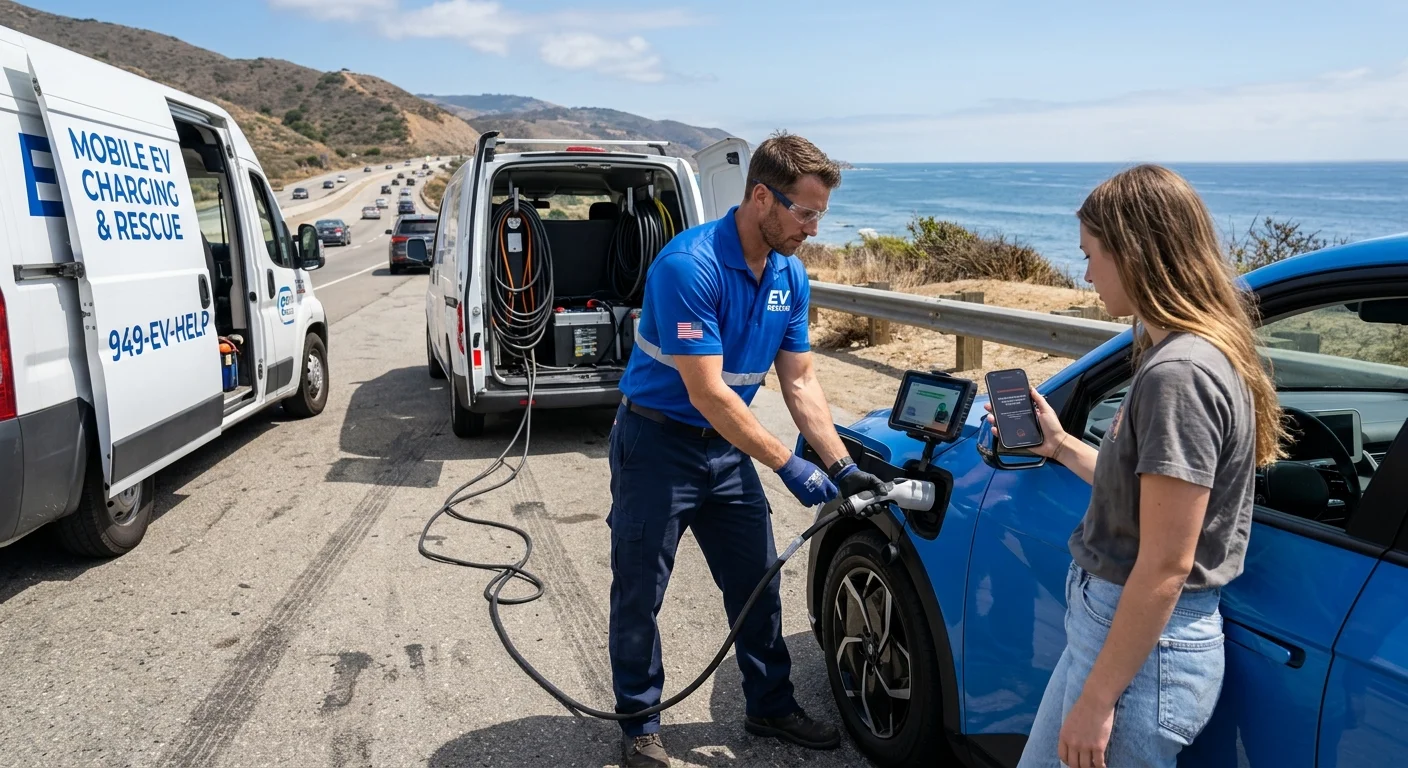
For a dead 12V, the operator brings a portable jump pack. They connect it to the 12V terminals under the hood. The computer wakes. The contactors close. The car is back to a normal Ready state.
If the 12V won’t hold a charge, the operator replaces it on site. They bring the right battery for the model. The driver leaves under their own power.
Tesla 12V is dead: how to tell, then how to jump it covers the diagnosis in more detail.
Why the traction pack can’t help
A driver might think the traction pack could power the 12V through the DC-DC converter. The DC-DC converter charges the 12V from the pack while the car is in Ready mode.
But the DC-DC converter only runs when the car is in Ready mode. The car can only enter Ready mode when the contactors close. The contactors only close when the computer boots. The computer only boots when the 12V is alive. The 12V needs an external power source to start the cycle.
A portable jump pack on the 12V terminals breaks the deadlock. The 12V wakes. The computer boots. The contactors close. The DC-DC converter takes over.
What about bidirectional charging
Some EVs have bidirectional charging capability. The bidirectional setup can power a house from the traction pack during an outage. It can also theoretically power the 12V from the traction pack during a 12V failure.
Bidirectional charging requires a specific Wall Connector and a specific car configuration. Most LA County homes don’t have bidirectional setups. A driver with a bidirectional setup has more options during a 12V failure, but most drivers don’t.
What about a Tesla Powerwall
A Tesla Powerwall doesn’t help an EV 12V. The Powerwall runs house circuits during an outage. It doesn’t output power to a car’s 12V. A driver with a Powerwall and a dead 12V still needs a mobile operator or a portable jump pack.
The combined answer
When an EV 12V dies, the car acts bricked because the computer can’t boot and the contactors can’t close. The traction pack is fine. A mobile operator brings a portable jump pack to the 12V terminals. The computer wakes. The contactors close. The car drives.
The number to call is (213) 410-1991. We’ll match you with a local operator. They quote before any cable goes in.