A Tesla that dies at 1:40 a.m. in Los Angeles County leaves you with one clock question. Drivers search “is tesla roadside assistance 24/7” because the cabin is already dark and the street is emptying. Tesla’s published hours could not be confirmed from a readable official page, so open the Tesla app and read the live roadside status Tesla is showing you tonight.
What Tesla’s own policy says about hours
Forum posts and third-party roundups like to answer this with a clean yes. Tesla’s current official roadside page could not be loaded and checked for this article. tesla.com returned a block from the network used to verify claims, so no hour window, no “24/7” line, and no Tesla covered-services list is treated as a confirmed fact here.
A made-up Tesla schedule is a liability. If you are sitting in the car, Tesla’s own app and the in-car Support menu are the live documents. Open Roadside. Read the hours and the status Tesla prints tonight. Screenshot it. Policies change by model, by warranty screen, and by region. A blog post cannot outrun Tesla’s own account.
Searchers also type “is tesla roadside assistance 24 7” with spaces. They ask whether tesla emergency roadside assistance is free. Those are Tesla billing questions, and they could not be confirmed from Tesla’s page either. Check the warranty card in the app. Then read how Tesla roadside help is described for Los Angeles County drivers. If Tesla lists a benefit as included on your VIN, that is Tesla’s offer. If Tesla lists a charge, that bill is Tesla’s too.
Hours and coverage are different jobs. A program that answers the phone at 2 a.m. may still send a tow, a tire tech, or a jump, and still skip a mobile charge. Tesla’s covered list could not be verified here. Flat tires, lockouts, and an empty pack are the usual overnight reasons people call. For a flat, start with Tesla’s ticket and ask what Tesla will actually send. For a pack that simply hit zero, you may still need a mobile charge the manufacturer ticket does not describe.
The U.S. Department of Energy’s electric vehicle pages are a clean primer on how EVs use energy. They do not set Tesla’s dispatch clock. Only Tesla does. Until Tesla’s own page is readable, treat every “Tesla is 24/7” claim you see on a forum as unconfirmed, and use the app in your hand as the authority.
Night stalls on the 405, the 10, and PCH
Overnight in this county is not one scene. A Model Y that stops on the Sepulveda Pass is a different problem from one that dies on the I-10 through the San Gabriel Valley, and both are different from a car that rolls to a stop on Pacific Coast Highway in Malibu. The City of Malibu spans 21 miles of coastline. The PCH stretch through the city is officially described as a 21-mile section. Shoulders get thin. Bluffs sit close. You want the car as far right as the pavement allows, hazards on, and people out of the travel lane.
California Vehicle Code 21718 prohibits stopping on a freeway, with an exception for a disabled vehicle when help has been summoned. That exception is why you call before you wander. CVC 21809 is the move-over law for stopped emergency, tow, or Caltrans vehicles displaying flashing lights. Other drivers are supposed to move over. Plenty will not. Stay in the car if the shoulder is narrow and traffic is still moving.
Metro Freeway Service Patrol is free on designated LA County freeway beats. Dial 511 and say Motorist Aid. FSP hours of operation are Monday through Friday, 6 a.m. to 7 p.m., and weekends, 10 a.m. to 6:30 p.m. A 2 a.m. stall sits outside that window. FSP’s published assistance list is flat tires, jump-starts, radiator refills, up to a gallon of fuel, and a tow to a designated safe location off the freeway. Mobile EV charging is not on that list. FSP can get you off a live lane. It will not put range back in a Tesla.
Leave a dead car on a freeway right-of-way long enough and the clock turns legal. CVC 22651(f) lets a peace officer remove a vehicle stopped, parked, or left standing for more than four hours on a freeway with full control of access, when the driver cannot move it under its own power. Four hours goes fast at 2 a.m. if you are waiting on a ticket with no update.
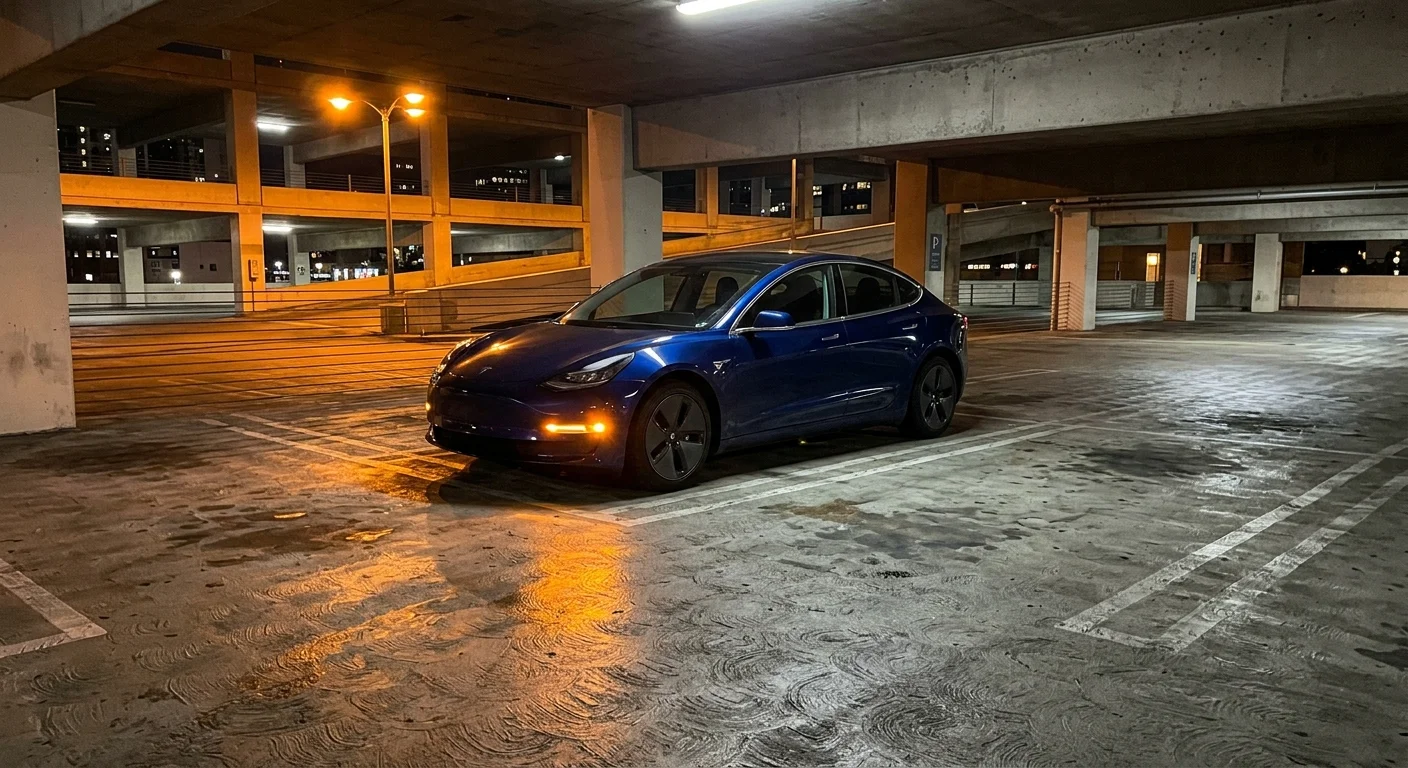
Downtown adds a second overnight trap: garage lock-ins. Structures around Bunker Hill, South Park, and the Financial District empty after last call. Gates drop. Attendants leave. A Tesla with a dead 12-volt or an empty pack can sit under orange sodium lights until morning unless someone with a charger or a flatbed can get past the gate. Burbank studio lots do the same thing after wrap. Security fences, one driveway, and a guard who has never heard of your ticket. How Tesla roadside assistance works on paper is one thing. Getting a truck onto a closed lot is another.
App request versus a phone call after midnight
After midnight, the first fork is mechanical: does the car still have a screen. Tesla roadside usually starts as an in-app request. That path needs a live display, a signed-in phone, and data. A 12-volt that has dropped out can take the screen with it. Then the app on the car is a black rectangle, and tesla emergency roadside assistance has to move to the phone in your pocket.
App versus phone is its own decision because the two paths do different jobs. The app carries location, VIN, and ticket status if the car can still talk. A voice call is what you have when the cabin is dark. Tesla’s published phone number could not be confirmed from a readable official page either, so do not copy a number from a random search result. Use the number Tesla shows inside your own app, or the Support path on Tesla’s site once it loads on your phone.
If you are on a live freeway, make the safety call first. 911 for an unsafe shoulder. 511 for Motorist Aid on a designated beat during FSP hours. Tesla’s ticket is the manufacturer path. It is not a substitute for getting people out of a travel lane.
A dead high-voltage pack and a dead 12-volt feel the same from the driver’s seat: nothing wakes. They are different jobs for whoever shows up. Who to call if a Tesla battery dies depends on which battery died. Tesla’s ticket may send a tow or a jump. A mobile Level 2 charge is a separate tool. Typical on-site rescue charging, when an operator can set up, is 10 to 20 miles of range in 15 to 30 minutes of Level 2 charging. That figure is charging time, not arrival time.
Keep the phone charged. Screenshot the Tesla ticket. Note the cross-street, the garage name, or the freeway mile. Downtown attendants and Burbank lot guards ask for a stall number. A contractor who cannot find you is a contractor who cannot start.
When Tesla’s contractor bench is thin in this county
Tesla does not roll a branded truck to every pin on the map. Manufacturer roadside is a dispatch desk plus a contractor bench. This site could not confirm Tesla’s contractor roster, overnight staffing, or service-center hours in Los Angeles County. Tesla service-center locations are unverified here. What you can see from the driver’s seat is simpler. Someone has to accept the ticket.
Los Angeles County is not one labor market. A stall on the Westside at 1 a.m. sits in a dense contractor belt. A stall in Lancaster or Palmdale on the 14 sits an hour of dark freeway away from that belt. Santa Clarita on the 5, the Grapevine grade, and the long PCH run through Malibu all stretch the same bench in different directions. You cannot see Tesla’s calendar. You can see that 2 a.m. on a Tuesday in the Antelope Valley is a thinner night than 2 a.m. in Santa Monica.
Studio lots in Burbank make the bench look thinner than it is. The operator may exist. The gate may not open. Downtown garages after events do the same: the truck is nearby, the structure is on overnight lockdown, and the ticket sits in “assigned” while nobody can reach the stall. That delay is access, not a published Tesla hour.
If Tesla’s assigned contractor is already on another call, you wait. If the ticket is a tow and you needed a charge, you wait on the wrong tool. If the app never creates a ticket because the 12-volt is dead, you wait on a path that never started. Thin nights are when a second path matters. Keep Tesla’s ticket open. Add a local operator who actually does mobile EV work, so you are not betting the whole night on one dispatch queue you cannot see.
A local operator as backup, not a time promise
Charge Pro LA is a referral service for Los Angeles County. It matches drivers with licensed, independent local EV rescue operators. It performs no roadside work, owns no trucks, and publishes no hours, no arrival window, and no “24/7” clock of its own. The operator you are connected with quotes the job, does the work, and bills you. The pros in that network are licensed and insured. Their availability is theirs to state, call by call.
Use Tesla first when the app still works. Use a local operator when the ticket stalls, when the car needs a mobile charge Tesla has not confirmed it will send, or when a downtown garage or a Burbank lot will not admit the contractor Tesla assigned. Tesla roadside rescue is the Tesla-shaped path. Emergency EV roadside assistance is the wider EV path, including a pack that simply hit zero.
A matched operator’s Level 2 gear, in the range the U.S. DOE Alternative Fuels Data Center publishes for AC Level 2, can run from 2.9 to 19.2 kW. On a real stall, the useful outcome is still that 10 to 20 miles of range in 15 to 30 minutes of charging time, enough to roll to a working charger. The California Energy Commission tracks charging build-out across the state. Station counts in this county could not be confirmed for this page, so do not plan the night around a “nearest Supercharger” guess.
Insurance roadside is a third clock, and a weaker one for an empty EV. GEICO Emergency Road Service, as an example of a published auto-club-style list, covers towing to the nearest qualified repair facility with mileage limits, jumps, tire changes with a working spare, lockouts, winching near a publicly maintained roadway, and fuel delivery. That page does not name electric vehicles or mobile EV charging. A 24-hour insurance line can still send a gas-era truck. Ask what they are actually sending before you hang up.
Hold both tickets until a person is on site. Cancel the one you do not need. Stay out of the lane. Read Tesla’s live hours in the app, because that is the only Tesla clock this page can honestly point you to.
When to call us
Call when Tesla’s ticket is stuck, the car will not take a charge, or you are locked in a downtown garage or a Burbank lot with no range left to roll. Charge Pro LA will connect you with a licensed local operator who can quote a mobile rescue on the spot. Call us at (213) 410-1991 and we’ll connect you with a local EV rescue operator.