A Jaguar I-Pace that won’t start after a long park is almost always the 12V. The traction pack can still be full while the car stays dark, locked, and silent.
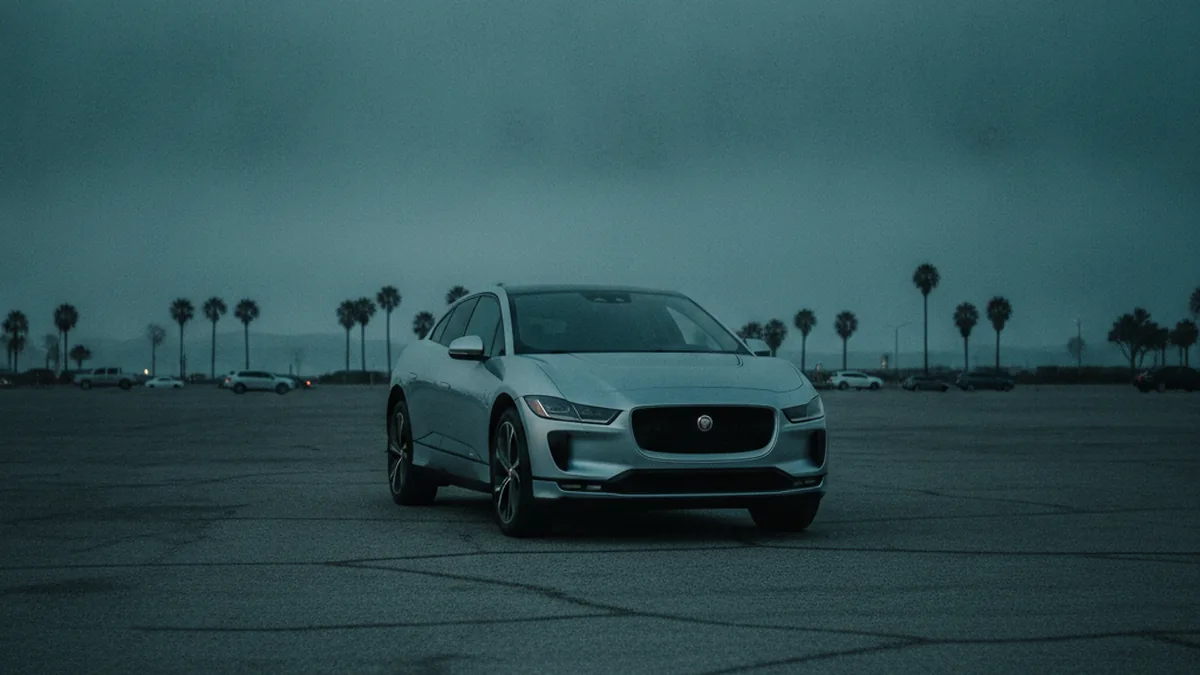
That pattern shows up after a trip through Los Angeles County. You land at LAX, get home, and leave the I-Pace in a garage for a week. Or it sits on a West Hollywood street between short drives. Then one morning nothing happens. Handles stay flush. The fob stays mute. The dash never lights. Owners blame the pack. The pack is usually fine.
What a silent I-Pace is actually telling you
The I-Pace runs two electrical systems. The high-voltage pack moves the car. A conventional 12V battery runs the computers, locks, lights, and screens. Those computers have to wake before the pack can connect. Kill the 12V and the pack stays locked out.
So a jaguar i-pace won’t start even when the last range reading looked healthy. The phone app can be stale. The car itself never booted. You’re not looking at an empty drive battery. You’re looking at a low-voltage brick.
The tells are consistent:
- Flush handles stay retracted when you walk up
- The fob won’t unlock the doors or the frunk
- Dash, touchscreens, and cabin lights stay black
- No welcome chime and no lock clunk
If the dash lights, throws a warning, then quits, that’s a different fault. It points at a high-voltage or DC-DC problem. Keep jumping and you can make it worse. Get a Jaguar scan instead. For the same 12V failure across other brands, read what happens when an EV 12V battery dies.
Why the early cars go dark after they sit
Watch the 2018, 2019, and 2020 model years first. Those cars use two 12V batteries under the frunk panel, not one. A weak unit can drag the whole low-voltage system down. Jaguar revised the setup for 2021. Pre-2021 cars are the ones that go quiet most often after a long park.
A lead-acid 12V hates heat and a low state of charge. Inland Los Angeles County is harder on that battery than the coast. The San Fernando Valley and the San Gabriel Valley park cars in closed garages that hold heat. Lancaster and Palmdale in the Antelope Valley swing from summer heat to cold nights. A battery left low starts to sulfate. That lost capacity doesn’t come back.
The coast isn’t immune. Just over 78 percent of Beverly Hills housing predates 1980. West Hollywood is 80.5 percent. Santa Monica is 75 percent. A lot of those buildings went up before home EV charging existed. The I-Pace sits on a trickle of parasitic drain. Then it won’t wake.
If your 2018 to 2020 car has never had the 12V changed, treat a slow start as a warning. A load test settles it. EV 12V battery replacement signs and steps walks through what that visit looks like.
Your electric bill doesn’t fix this. LADWP serves the City of Los Angeles. Southern California Edison delivers power across most of the rest of the county. Cities such as Beverly Hills, Santa Monica, and West Hollywood buy generation through Clean Power Alliance. SCE still runs the wires. That split doesn’t matter on the curb. A dead 12V doesn’t care which name is on the bill.
Get inside before you try a jump
A dead 12V leaves the flush handles in. You can’t pull a door the normal way. The mechanical key is inside the fob. Slide the release and pull the metal blade out of the fob body.
The lock cylinder hides behind the driver’s handle. Push the front of the handle inward, near the small button, so the back edge pivots out. Pull the handle out as far as it comes. The cylinder sits behind it. Insert the blade and turn it clockwise. The door unlocks with no power in the car.
Don’t pry the handle with a tool. You’ll break the mechanism and still be locked out. This lockout is common on EVs with powered handles. Tesla owners hit a similar wall. Tesla locked out with a dead battery covers that version.
The 12V lives in the frunk, and a dead 12V keeps it latched
The batteries sit under a removable center panel in the frunk. A dead 12V is exactly what keeps that lid shut. The interior release needs power you don’t have.
After you unlock the cabin, look in the right-side footwell. There’s a black plug. Behind it is a manual frunk-release cable. Pull that cable. The frunk should pop.
Lift the center panel. Pre-2021 cars have two batteries. Positive posts wear red caps. Confirm the post against your own model-year manual before a clamp goes on. The 2021 cars were revised, so the layout isn’t identical.
Safe jump order:
- Red clamp on the exposed positive post under the red cap
- Black clamp on bare, unpainted chassis metal, not the battery negative
- Let the donor source feed the battery for two to three minutes
- Then power the car and try to reach READY
Grounding to the body keeps any spark off the battery. Don’t guess the post. If the cables, the panel, or the posts don’t match the manual, stop. The method that applies to any EV is in how to jump start an electric car without damage.
A successful jump is a wake-up. It isn’t a new battery. If the 12V is worn out, the car will go dark again in a day or two. That repeat failure is your cue to replace it, not to keep jumping it in a driveway.
How this plays out around Los Angeles County
Long parking is the classic trigger, and airports make it easy to miss. Los Angeles International’s terminal structures P1 through P7 all offer Level 2 and DC fast charging. The Economy Parking garage has more than 4,000 stalls and 514 active EV chargers. None of that wakes a dead 12V. You can return from a week away, walk past working stalls, and still find a silent I-Pace.
Hollywood Burbank Airport, Long Beach Airport, and Van Nuys Airport see the same after-a-trip stall. Parking and charger counts at those fields weren’t confirmed for this page. The 12V pattern still holds.
Westside parking is another version of the same sit. An I-Pace on a Beverly Hills block can sit for days. So can one in a Santa Monica structure or under a West Hollywood building. Older housing stock often means no home Level 2 plug. Luxury EVs that won’t wake in Beverly Hills run into the same 12V wall.
Inland heat ages the battery faster than a marine-layer morning along Redondo Beach or Manhattan Beach. A parked I-Pace in Glendale, Burbank, or Pasadena sits in a garage that holds heat. Antelope Valley nights can swing cold. Both directions are hard on a weak 12V.
Freeway shoulders aren’t a backyard jump. If the car dies on the 405 at Sepulveda Pass, stay with it if that’s safe. The same goes for the 10 through the San Gabriel Valley, or the 110. California Vehicle Code 21718 bars stopping on a freeway. There’s an exception for a disabled vehicle once you’ve summoned help. Code 21809 is the move-over law. Approaching drivers must change to a non-adjacent lane if they can, or slow down.
Metro Freeway Service Patrol is free and roams congested LA County freeways. It can give a gallon of gas, change a tire, tape a hose, or tow you to a CHP-chosen safe spot. Dial 511 and say Motorist Aid. Its published motorist list doesn’t include mobile EV charging or a 12V jump. A silent I-Pace is outside that list, other than the free tow to a safe spot.
Don’t wait it out on the freeway. Code 22651 lets an officer remove a vehicle left unattended on a freeway for four hours or more. Under Code 22658, a lot can tow if entrance signs meet the 17-by-22-inch rule and the owner or agent authorizes it. If you return before the car leaves the lot, they have to release it.
Griffith Observatory parking, Universal Studios structures, and studio lots in Burbank produce the same silent-car call. The I-Pace looks like it needs a charge. Check the 12V first.
What you’re seeing, and the first move
| What you see | Most likely cause | First move |
|---|---|---|
| Handles in, dash dark, no chime | Dead 12V | Key blade, then jump the frunk 12V |
| Wakes, warns, then shuts off | High-voltage or DC-DC fault | Stop jumping and get a dealer scan |
| Starts, then dies again in days | 12V at end of life | Load test and plan a replacement |
| Clean jump, still no READY | Deeper electrical fault | Road diagnosis or a flatbed |
| Dead in a garage with no jumper | No donor source on site | Call for mobile rescue with a pack |
Don’t keep jumping a car that wakes and then dies with a warning. That’s not a 12V recovery. That’s a scan job.
If the pack is also low after the car wakes, that’s a separate problem. A Level 2 mobile boost typically adds 10 to 20 miles of range in 15 to 30 minutes of charging. That’s charging time, never an arrival time. It doesn’t replace a failed 12V. Sort the 12V first, then decide if the pack needs energy.
When to stop and call for help
Stop if the key blade won’t turn. Stop if the frunk cable doesn’t pop the hood. Stop if a clean jump doesn’t bring READY. Forcing a flush handle or clamping the wrong post costs more than a service call.
The same is true on a live shoulder. Sepulveda Pass, the East LA Interchange, and a crowded downtown structure aren’t places to string jumper cables between two cars.
Charge Pro LA is a referral line. It matches stranded EV drivers with independent local mobile rescue operators across Los Angeles County. It doesn’t own trucks, and it doesn’t do the work. The operator can open a locked I-Pace and jump the correct 12V post. They can add a Level 2 boost if the pack is also low. They quote you before they start, and they bill you directly. Non-Tesla EV rescue is the dispatch path for an I-Pace. The Los Angeles County EV roadside guide covers the wider choice between a jump, a charge, and a tow.
Frequently asked questions
Why won’t my Jaguar I-Pace start after it sat parked?
A dead 12V is the usual reason, not an empty traction pack. The I-Pace needs that small battery to boot its computers. Without it, handles stay in, the fob is mute, and the dash stays black. Jump the 12V first. If a clean jump still fails, the car needs a dealer scan.
How do I get into an I-Pace when the handles won’t open?
Use the metal key blade inside the fob. Push the front of the driver’s handle in so the back swings out. Pull the handle fully out to expose the lock cylinder. Turn the blade clockwise. That unlocks the cabin with zero power.
Where is the I-Pace 12V, and how do you jump it?
It sits in the frunk under a center panel. A dead 12V keeps the frunk latched, so pull the manual cable behind the black plug in the right footwell. Red clamp on the red-capped positive post. Black clamp on bare chassis metal. Wait two to three minutes, then try READY. Check your model-year manual. Pre-2021 cars have two batteries.
If your I-Pace is sitting dark, call Charge Pro LA at (213) 410-1991. An operator will quote the job before any work starts.