After a garage sit, a Kia EV9 that won’t start rarely has an empty pack. The 12V auxiliary battery died while the car sat dark. The computers that wake the drivetrain never came up. You press start and get a black cluster. The locks don’t answer the key fob either. The traction pack can still hold a healthy charge. You just can’t read that charge on a dark dash.
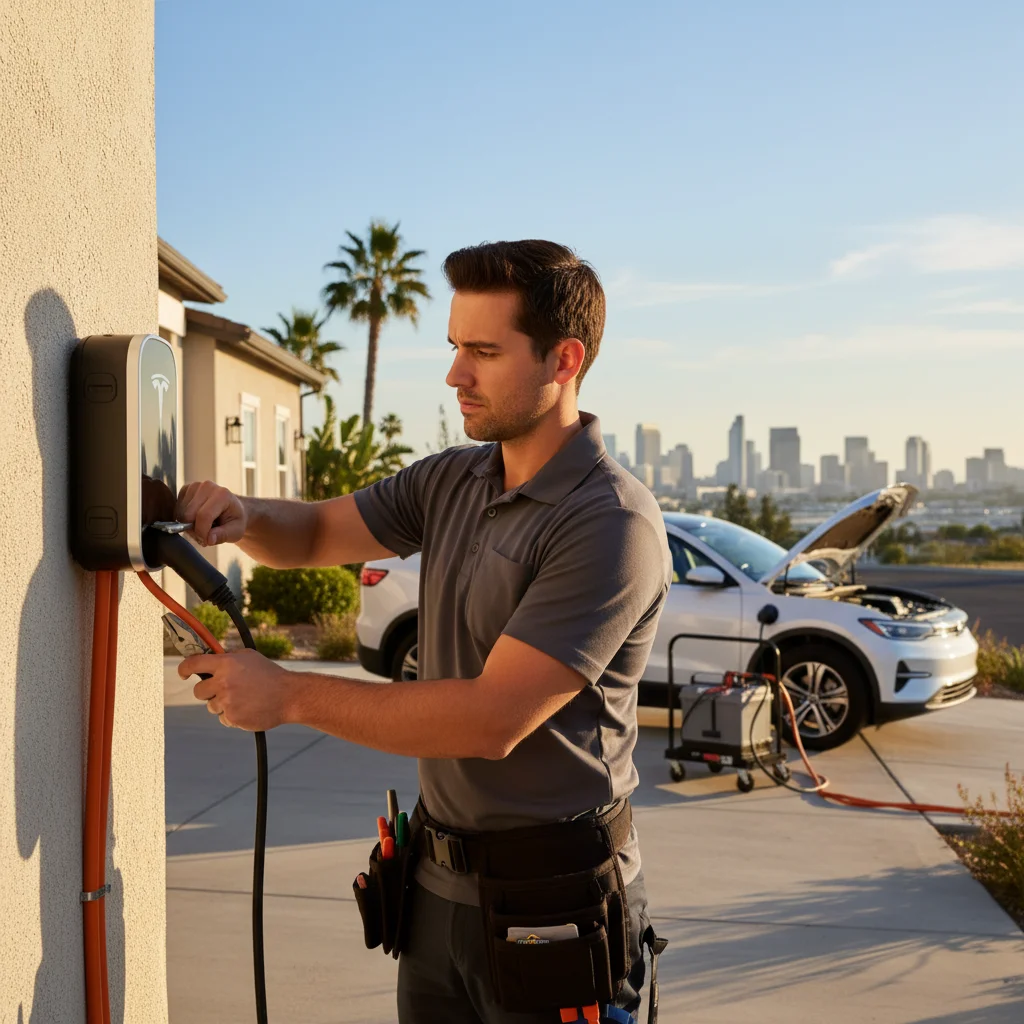
Two batteries, one dark dash
The EV9 uses two separate electrical systems that owners mix up. A high-voltage pack moves the wheels and stores the trip. A small 12V battery runs the electronics, locks, and screens. The cluster, infotainment, and charge-port handshake all live on 12 volts. Ready mode can’t start until those control modules boot.
Kia’s E-GMP platform is the same architecture as the EV6. It also underpins the Hyundai Ioniq 5 and Ioniq 6. None of those cars let the pack engage without a 12V wake-up. A dead auxiliary battery looks like a total brick. It isn’t a failed traction pack at all.
This is the event-garage pattern that strands EV9 owners. You park for a game, a flight, or a studio day. The car sits with telematics, cameras, and walk-away lock still sipping power. You come back hours later to a silent SUV.
Event garages across Los Angeles County
Inglewood’s SoFi Stadium structures are the version most owners describe first. You park before kickoff and walk into the bowl. The EV9 sits for hours in a dark stall. You return to a car that won’t unlock. Read EV dead in the garage after a SoFi Stadium event if that’s your stall.
Universal Studios Hollywood parking structures do the same after a long park day. A dead dash there is almost always the 12V, not a drained pack. Dead EV at Universal Studios walks through leaving that structure.
Griffith Observatory lots produce the same dark-dash call on busy weekends. Parked at Griffith Observatory and the EV won’t wake covers that hill lot. Chargers in a garage don’t prevent this failure. A 12V failure isn’t the same as an empty pack.
LAX is the longer sit, often a week or more. Terminal parking in structures P1 through P7 offers Level 2 and DC fast charging. The Economy Parking garage has more than 4,000 stalls, including 514 active EV chargers. Travelers still fly home to a car that won’t wake. The stall charger can’t talk to a car whose 12V won’t boot.
The same 12V-after-a-trip pattern shows up after flights through Hollywood Burbank and Long Beach. Burbank studio lots and downtown Los Angeles structures produce the same call. Culver City office garages and West Hollywood late-night sits do too. The EV9 is a large three-row family SUV. Owners put it in structures because street spaces run tight. That’s when the 12V sits unattended for hours.
What you’ll see from the curb
The start button does nothing when you press it. The instrument cluster never lights up at all. The gear selector feels limp in your hand. HVAC doesn’t spin, and the vents stay silent. Walk-away lock fails as you walk up. The Kia Connect app can’t unlock the car. The charge-port light doesn’t blink when you present a cable.
That full blackout is the 12V battery’s fingerprint. If the car starts and shows a low-voltage warning, the battery is weak, not dead. Plan a replacement before the next long sit.
A scheduled-departure setting can leave the car unresponsive at a time you didn’t pick. Cancel the schedule in EV settings once the dash is awake. A charge-port communication fault after a long sit can lock systems too. A brief 12V disconnect at the jump terminals often clears that layer. A high-voltage interlock fault is different from a dead 12V. The car may reach Ready and still refuse Drive. That needs a diagnostic scan at a shop. Don’t ignore it and get on the freeway.
Jump points under the hood, not the cargo bay
The auxiliary battery sits behind a trim panel in the rear cargo area. It’s on the driver’s side, just forward of the left wheel arch. You fold the third row and lift the cargo mat. That’s a poor job on a garage ramp or a freeway shoulder.
Kia puts remote jump terminals under the hood for this reason. The positive terminal sits under a red plastic cover toward the forward-right of the bay. The negative is an unpainted chassis bolt or a dedicated ground stud nearby. Check your owner’s manual for the exact stud. Clip the booster to those points, not to the buried battery. Use a quality jump pack or a running donor car. Leave it connected for two to three minutes so the modules can boot. Then press the start button and wait.
If you’re not sure of the sequence, stop. A reverse hookup can damage this platform’s electronics. A wider walkthrough is in how to jump start an electric car without damage. See also when an EV 12V dies if the dash stays dark.
The 12V battery saver is a habit, not a rescue
2024 and newer EV9s include a 12V battery save function. It trickle-charges the auxiliary battery from the traction pack while the car is parked. You turn it on in the infotainment menu under Vehicle. Then open EV Settings and 12V Battery Saver. When voltage dips, the car briefly wakes its DC-DC converter. That converter tops up the 12V side from the main pack.
If the 12V is already too low to boot, the menu never appears. The saver can’t run on a battery that already went dark. Turn it on before a concert, a flight, or a weekend in a structure. Treat it as a habit, not a backup.
Causes at a glance
| Cause | What you see | What you can try |
|---|---|---|
| Dead 12V battery | Full dark dash, no start | Jump at the under-hood terminals |
| Weak 12V battery | Slow boot, low-voltage warning | Short-term jump; plan a replacement |
| Scheduled departure conflict | Unresponsive at an odd time | Cancel the schedule in EV settings |
| Charge-port communication fault | Won’t charge, then won’t start after a sit | Brief 12V disconnect at the jump points |
| High-voltage interlock fault | Ready, but no Drive | Needs a diagnostic scan |
| Long event-garage sit | Dark dash after hours parked | Jump, then enable 12V Battery Saver |
Freeway patrol, private lots, and the last-call tow
If you stall on a Los Angeles County freeway, Metro Freeway Service Patrol can help. It can change a tire or offer a gallon of gas. It can also tow you at no charge to a CHP-chosen safe spot. FSP’s published list doesn’t include mobile EV charging or a 12V jump. Dial 511 and say Motorist Aid if you need that freeway tow.
California Vehicle Code 21718 lets a disabled vehicle stay once you’ve summoned help. CVC 21809 is the move-over law for stopped service vehicles. Other drivers must change lanes or slow when lights are on.
Under CVC 22658, a lot can tow you with the required 17-by-22-inch entrance signage. The owner or agent also has to authorize the removal in writing. If you return before the car leaves the lot, they have to release it. Don’t wait inside the venue hoping the EV9 wakes on its own.
A flatbed for a three-row EV9 is a last resort. The car is heavy, and you still have to fix the 12V at a shop. Charge Pro LA connects you with non-Tesla EV rescue operators for an on-site 12V jump. When the pack is actually low, they bring a 240V Level 2 source. They use a CCS or J1772 adapter for a non-Tesla EV like the EV9. They quote you before they start and bill you directly. If you’re choosing among a jump, a charge, and a tow, start here. Your electric car died: charge it, jump the 12V, or tow it?
What to do, in order
Work through this list before you wave down a flatbed.
- Confirm it’s a dark dash, not a low-pack warning.
- Check door handles, the app, and the charge-port light.
- If you have a jump pack and the manual, use the under-hood terminals.
- If the car wakes, turn on 12V Battery Saver before you park again.
- If it won’t wake, or you can’t work in the stall, call.
- Don’t call a tow unless you’re in a live lane.
Charge Pro LA is a referral line, not a shop. It matches stranded EV drivers with independent local mobile rescue operators. It doesn’t own trucks, employ technicians, or set prices. The operator on the call quotes you before work starts.
If your Kia EV9 won’t start in Los Angeles County, call (213) 410-1991. A dispatcher takes your location and connects you with an operator. That operator can jump the 12V or add range on site.
Frequently asked questions
How do you jump-start a Kia EV9?
Use the under-hood remote jump terminals, not the battery in the cargo area. Connect positive to the red cover in the engine bay. Connect negative to the nearby chassis ground stud. Apply a jump pack or a running donor car for two to three minutes. Then press start and let the modules finish booting. Follow the sequence in your owner’s manual so you don’t damage the electronics.
Does the EV9’s 12V save feature stop no-starts?
It helps, but it doesn’t guarantee protection on a long sit. The saver trickle-charges from the main pack when voltage dips. It only runs if the car can still wake. If the battery falls below the boot threshold first, the car stays dark. Use it as a preventive habit, not a backup plan.
Why would a charged EV9 go completely dark?
The high-voltage pack and the 12V battery are separate systems. The pack powers the drivetrain and charging hardware. The 12V powers every computer that allows the drivetrain to engage. A dead 12V creates a full-dark, unresponsive car even when the pack is nearly full. That’s how the E-GMP platform is built.