You park a Lucid Air in a downtown Los Angeles garage. You walk to a meeting and come back to a dark car. The fob does nothing. Flush handles stay in and the screens stay black. That’s almost always a dead 12-volt battery, not an empty traction pack.
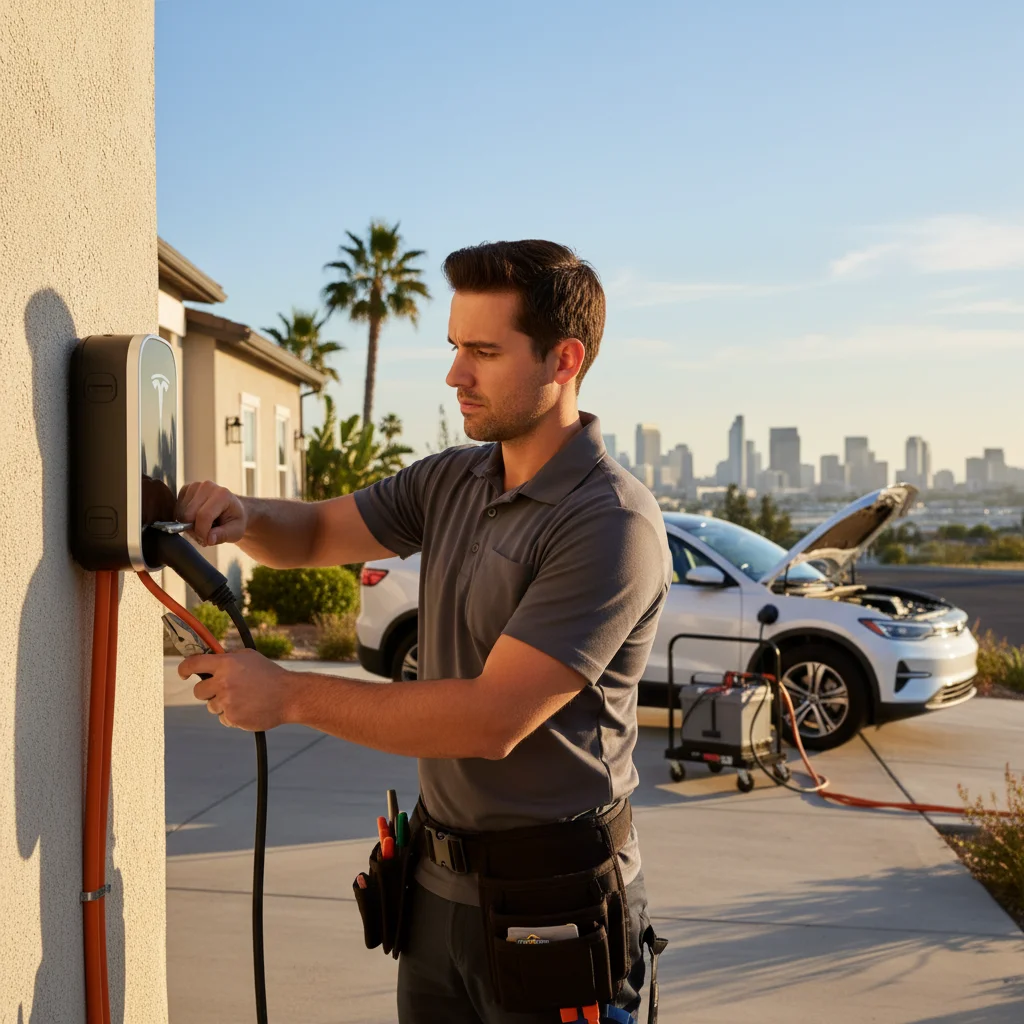
The Air is a luxury sedan with a large high-voltage pack. It still needs a small 12V battery to wake every module. Door motors, screens, locks, and the drive-pack handshake all run on 12V. When that battery is flat, the car acts like a brick. Range left in the pack doesn’t matter if the car can’t boot.
You’ll see the same thing after a Beverly Hills valet stay. A West Hollywood lot and a week in LAX parking produce it too. The pack can still hold plenty of miles. The car just can’t turn itself on.
Dark screens after a downtown park usually mean 12V
Start from the curb with one check: whether the car ever woke. If nothing responds, you’re looking at 12V. There’s no handle motion, no interior lights, and no unlock chirp. That’s a low-voltage failure.
If the screens came up and showed remaining range, that’s different. You likely emptied the traction pack. Or the car is protecting a low state of charge. A jump won’t add miles. You need range delivered on site. That’s the path in out-of-charge EV recovery.
A third pattern sits in the middle. Screens flash a 12V or system warning, then die. Handles twitch and then stop. That’s still the auxiliary battery. It’s got enough voltage to start the boot, and not enough to finish it. Don’t assume an empty pack because the car is silent. Silence is the 12V signature.
Why a Lucid Air 12V dies after it sits
The Air’s 12V feed runs the always-on electronics. Keyless entry keeps listening for the fob. Connectivity modules stay awake. Sensors draw a trickle even when you think the car is off. Park it, walk away, and that draw continues.
The high-voltage pack can recharge the 12V through a DC-DC converter. That only happens when the car is awake or charging. A sedan sitting in a structure is doing neither. After a long idle, the 12V falls below the voltage needed to boot.
Downtown Los Angeles makes this easy to miss. You’re not on a road trip. You parked for a meeting, a hearing, or a campus visit at USC. The car sat still while standby electronics kept sipping power. You return expecting a quiet unlock and get a silent sedan.
The same idle pattern shows up on the Westside. Beverly Hills street and garage stays. West Hollywood lots after a late night. Santa Monica structures near the coast. None of those require a drained pack. They require a 12V that sat too long.
About 71 percent of City of Los Angeles housing was built before 1980. That’s from Census ACS 2019-2023 figures. Many of those buildings were never wired for a dedicated EV circuit. If the Air rarely plugs in overnight, the 12V misses that top-off. A Level 2 session is what usually provides it. The city is on LADWP, which publishes home EV charger programs on ladwp.com. Confirm current rules there. Charge Pro LA doesn’t install chargers. A licensed electrician handles that work.
A 12V that’s already tired fails first. Age, heat, and weeks without a drive stack up. Get it load-tested at service time. Don’t wait for a dark garage to tell you.
Downtown garages, LAX, and the freeway exception
Downtown structures are the classic scene. You parked, locked, and walked inside. Hours later the Air won’t present a handle. The traction pack was never the problem.
LAX is the other common version. Terminal parking in P1 through P7 offers Level 2 and DC fast charging. The Economy garage has 514 active EV chargers, per Los Angeles World Airports. That doesn’t protect a 12V. A traveler can leave an Air for a week. They can still come home to a car that won’t wake. Charging the pack isn’t the same as keeping the auxiliary battery healthy.
Visitor parking at Cedars-Sinai or UCLA in Westwood can do the same thing. So can a Getty Center lot. The car sits through an appointment. You return to a silent sedan.
Westside luxury pockets see a lot of Airs. Beverly Hills, Santa Monica, Manhattan Beach, and Malibu are where these cars live. A weekend parked in Calabasas or Topanga is enough to flatten a tired 12V.
If you stalled on a freeway instead of a garage, the rules change. California Vehicle Code 21718 generally bars stopping on a freeway. A disabled vehicle is an exception when help has been summoned. Put on hazards and stay out of traffic. CVC 21809 tells other drivers to change lanes or slow down. That applies to a stopped service vehicle with flashing lights.
Metro Freeway Service Patrol is free on congested LA County freeways during published peak hours. Dial 511 and say Motorist Aid. FSP’s listed help is written for gasoline cars. It names a gallon of gas, a tire change, and a radiator refill. It can also tow you to a CHP-chosen safe spot. The published list doesn’t include mobile EV charging. An empty pack or a dead 12V sits outside that menu. The exception is the free tow to a safe location.
Private garages are a separate clock. Under CVC 22658, a lot can tow from private property. That requires entrance signage and written authorization. If you’re stuck in a downtown structure, don’t assume you can sit for hours. Call for help before the garage treats the Air as abandoned.
For the garage-specific version of this, read mobile EV charging in downtown Los Angeles parking garages.
Get inside, then reach the 12V jump points
Flush handles need 12V to motor out. With a dead auxiliary battery, they stay flush. You open the door the old way.
Use the mechanical key blade in the fob on the driver’s door. The physical key card works the same way. Once you’re in, the powered frunk release won’t work either. The Air has a manual frunk release for this exact failure. Location and cable path change by model year. Read the owner’s manual for your year before you pull anything. Guessing at cables is how people break latches.
The 12V access and the dedicated jump post sit in the front trunk. Lucid puts a positive jump post under a protective cap. The negative is a chassis ground. Layout isn’t the same as a Tesla, a Porsche, or a German sedan. Don’t copy another brand’s diagram.
Connect a jump pack in this order:
- Positive clamp to the Air’s marked positive post.
- Positive to the donor pack.
- Negative to the donor pack.
- Negative to the Air’s chassis ground, not a random metal point you haven’t confirmed.
Wait a full two minutes. Let voltage recover before you try to wake the car. Screens should boot, handles should present, and drive-ready should follow.
If a 12V warning stays on after the jump, the battery is likely failing internally. That’s a replacement at a shop, not a curb patch. A jump can get you off the street. It doesn’t rebuild a dying cell.
More on the physics sits in what happens when an EV 12V battery dies. The clamp sequence is in how to jump start an electric car safely. Don’t jump the high-voltage pack. Don’t keep retrying if the car never boots.
Empty pack versus a silent 12V
Owners mix these up because both leave you standing next to a car that won’t move. A dead 12V never wakes. You get no map, no range number, and no charge port. An empty traction pack still talks to you. It showed a falling range, then it stopped. Jumping the 12V won’t put miles in the pack.
If the pack is empty, the operator brings a 240V Level 2 source to the car. North American Airs typically use a CCS charge inlet. Confirm the port on your car. Operators bring a CCS or J1772 adapter for non-Tesla EVs. They also carry a native NACS plug for Teslas. Typical charging time on that Level 2 boost is 15 to 30 minutes. That window usually adds about 10 to 20 miles. That’s enough to reach a public DC stall or get home. That’s charging time, never an arrival time.
Don’t wait for a freeway patrol truck to charge you. That isn’t what FSP publishes. If you’re choosing among brand programs, start with Tesla, Rivian, and Lucid roadside compared. It lays out what each maker’s own channel tends to send. Confirm current Lucid roadside terms in the Lucid app or your owner’s materials. We don’t speak for Lucid.
What a matched operator does on site
Charge Pro LA is a referral line. It matches stranded EV drivers with independent local mobile rescue operators. It doesn’t own trucks, employ technicians, or set prices. The operator quotes you before any work starts and bills you directly.
For a silent Air, the operator brings jump gear for the dedicated 12V post. They confirm the car boots and can enter drive. If the 12V won’t hold, they can talk through a replacement path. Replacement itself is shop work when the battery is done.
For an empty pack, they bring Level 2 energy to the CCS inlet. You leave with enough range to move, not a full charge. Non-Tesla EV rescue is the service that covers the Air. It also covers other CCS and J1772 cars.
Operators serve cities across Los Angeles County. A downtown garage and a Beverly Hills street are the same 12V diagnosis. So is a Santa Monica structure or a Lancaster driveway. Stay with the car if you can do so safely. In a structure, tell the attendant you’ve called for help.
What to do before you call a tow
A tow should be last. Use a flat-bed only, and only if the car can’t be woken or charged in place. Wrong-end towing can damage an EV drivetrain. Confirm the shop or operator knows Lucid’s tow points.
City of Los Angeles impounds go through Official Police Garages. Release steps and fees are set by LAPD and the OPG system. Confirm those on lapdonline.org before you assume anything. Don’t let a simple 12V failure become an impound. Wake the car first if you still can.
Frequently asked questions
Why won’t my Lucid Air start when the pack still has charge?
The number you remember from the dash is the high-voltage pack. The car wakes on a separate 12V battery. When that 12V is flat, modules never power up, so the pack can’t connect. Jump the 12V and the Air usually boots.
How do I open a Lucid Air frunk with no power?
The normal button needs 12V. Use the mechanical key on the driver’s door first. Then use the manual frunk release in your year-specific owner’s manual. Jump posts are in that front trunk once it’s open.
Is this a jump, or do I need range delivered?
If the car never lit up, you need a 12V jump. If it woke, warned you, and then stopped, you need miles in the traction pack. The operator quotes that work before they start.
A silent Lucid Air after a downtown park is usually a 12V job. Call (213) 410-1991. Charge Pro LA matches you with an independent operator who can jump the post or deliver a Level 2 boost.