Your CCS EV just died in a Santa Monica beach lot, on PCH, or on the west end of the 10. Tesla-only stalls you can see from the aisle will not take that plug. Charge Pro LA matches you with a licensed local operator for non-Tesla EV rescue at that exact pin.
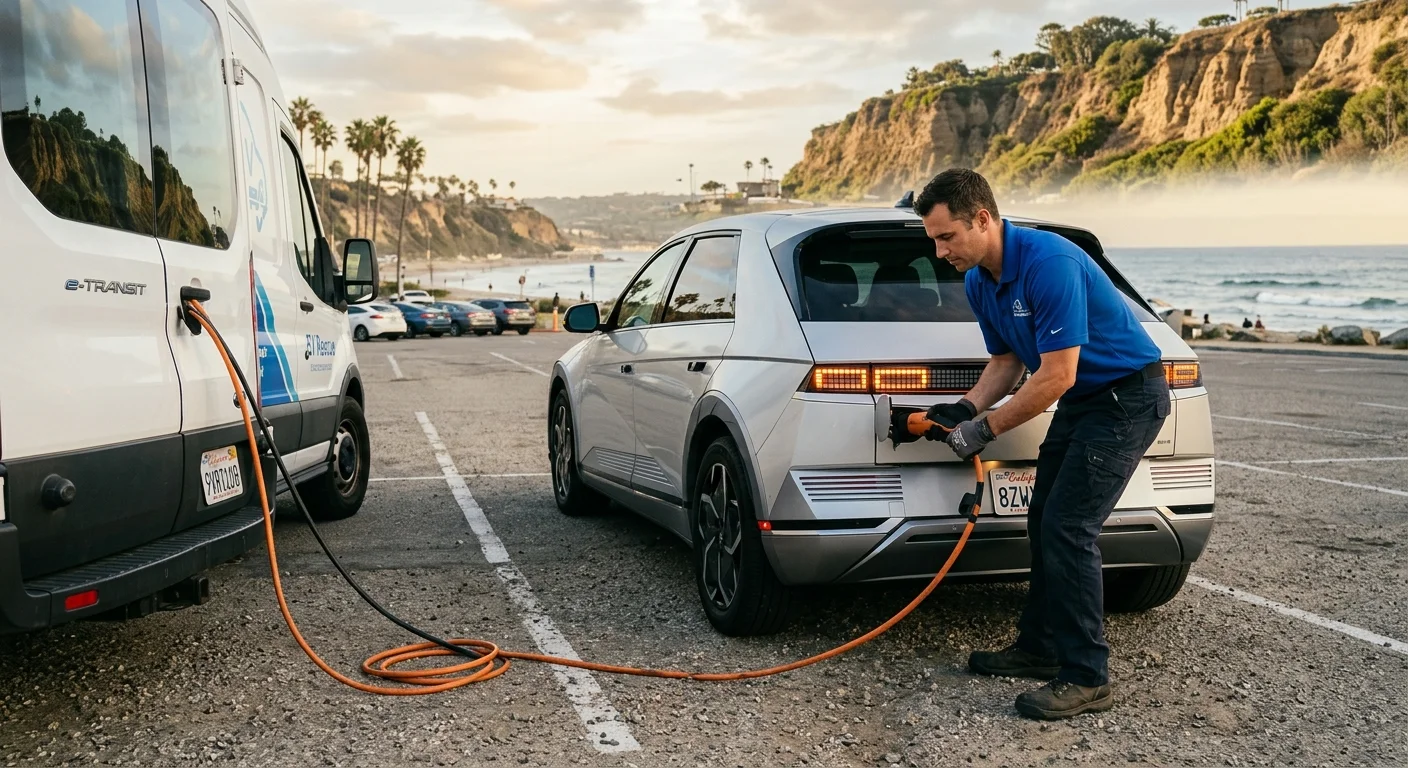
Empty CCS pack on PCH, the 10, or a beach lot
Santa Monica covers 8.409 square miles on the Westside coast. That is a small map with a lot of ways to stall. PCH hugs the sand. The 10 ends at the ocean and spills onto Ocean Avenue. Beach lots sit under the palisades with tight aisles, pay gates, and visitor traffic that does not care about your state of charge.
An empty CCS pack here is a connector problem as much as a range problem. A Hyundai, Kia, Ford, Chevy, Polestar, Nissan, or similar EV still needs a J1772 or CCS match. A Tesla-only stall does not count. If you are still rolling, get out of live lanes before the car goes silent.
On the 10, California Vehicle Code 21718 bars stopping on a freeway except for a disabled vehicle after you have summoned help. Stay belted inside with the hazards on. California Vehicle Code 21809 is the move-over law for stopped emergency, tow, or Caltrans vehicles showing flashing lights. If a vehicle sits more than four hours on a full-access freeway right-of-way, California Vehicle Code 22651(f) lets a peace officer have it removed.
Metro Freeway Service Patrol can help on designated Los Angeles County freeway beats. Dial 511 and say Motorist Aid. Metro’s published list is tire changes, jump-starts, radiator refills, up to a gallon of fuel, and a tow off the freeway to a designated safe spot. It does not name mobile EV charging. Hours on Metro’s page are Monday through Friday 6am to 7pm, and weekends 10am to 6:30pm. Do not wait on FSP for a CCS boost.
On PCH, name the nearest cross street, the lot if you can read a number, and your direction. North toward Malibu puts you on the city’s official 21-mile coastal stretch. South puts you toward Venice. Those pins are not the same job as a stall in Lancaster or Long Beach. This page is the beach-lot, PCH, and 10 version of non-Tesla EV rescue in Los Angeles County.
Typical rescue charging in this brand’s verified range is 10 to 20 miles of range in 15 to 30 minutes of Level 2 charging. That is charging time, not an arrival window. The U.S. Department of Energy Alternative Fuels Data Center says AC Level 2 equipment can range from 2.9 to 19.2 kW. Ask the operator what output they will run, and whether that boost reaches a compatible stall you can actually use. For how charging levels work in general, see the U.S. Department of Energy electric vehicles page.
Santa Monica Place and Civic Center garage traps
Downtown Santa Monica parks people in structures, not on open curbs. Santa Monica Place and the Civic Center garage are the two names drivers give most often when a CCS car will not wake on a ramp. Cell service drops between levels. Gates need a ticket, a code, or an attendant. Clearance, stall width, and the side your charge port sits on all matter before anyone rolls a charger in.
We could not confirm a live stall inventory for Santa Monica Place or the Civic Center garage from the sources in this site’s claims ledger. Do not treat a directory sign as a promise that a CCS or J1772 plug is free, working, and on your level. Walk the stall if you can still walk. If the car is already dark, record the garage name, the level, the nearest ramp, the stall number, and how a service vehicle gets past the gate.
Santa Monica’s housing stock makes public and garage charging a daily fact, not a tourist quirk. ACS 2019-2023 puts the city at 91,535 people, with 75.0% of housing built before 1980. A lot of those buildings never had EV stalls in the original design. Clean Power Alliance is the community choice aggregator here. Southern California Edison still delivers the power. That mix shapes home rates. It does not plug a dead CCS car on level P3.
A garage stall is also a 12V trap. You circle for a space, leave climate on, and sit in a queue on the 10 or PCH. The dash still looks fine until the low-voltage system drops and the car will not shift, unlock, or open the charge door. That looks like an empty pack. It may not be. Tell the operator both symptoms.
If a public CCS or J1772 stall is open on another level, a short mobile EV charging boost can be enough to reach it. If the structure has no working match, the operator may charge in place, or call for an EV-appropriate flatbed. Charge Pro LA does not own the truck and does not make that call. The licensed operator you are matched with confirms access, connector, method, price, and timing with you before any work starts.
For the broader Santa Monica roadside picture, including Tesla and mixed calls, read EV roadside assistance in Santa Monica. This page stays on CCS and J1772 cars that cannot use a Tesla-only stall.
12V brick versus a true zero pack
Many non-Tesla EVs have two energy systems. The high-voltage pack moves the car. A 12V (or other low-voltage) battery wakes the computers, locks, windows, and charge-port door. When the 12V bricks, the car can look fully dead even with range left in the pack. When the pack is truly at zero, the car may still wake and talk, but it will not take you to the next compatible charger.
Do not guess from the dash art. Write down the make, model, model year, port type, displayed percent, warning text, and whether the car will unlock, shift, or release the connector. A CCS inlet includes the J1772 face used for AC charging plus two lower pins used for DC fast charging. Mobile Level 2 rescue uses the AC side. Do not assume a DC adapter belongs on an AC truck.
A 12V wake and a pack top-off are different jobs. Jumping the low-voltage system, if the operator judges it safe for that model, can restore screens and the port door. It does not put 10 to 20 miles back in a flat pack. A Level 2 session on a confirmed J1772 or CCS AC connection is what adds that range, in 15 to 30 minutes of charging time in this brand’s verified typical window. Output still depends on the equipment, the car, and the electrical service on site.
High-voltage work is not a parking-lot experiment. Stay clear of orange cabling and a damaged pack. If the car sits in a live lane on the 10, call 911 first so CHP can protect the scene, then request a referral. If you are in a beach lot or a garage, stay with the car when it is safe, and keep the hazards on.
Manufacturer roadside programs, club memberships, and insurer add-ons are not interchangeable. GEICO Emergency Road Service is optional coverage. Its published list is towing to the nearest qualified repair facility (mileage limits apply), battery jump starts, tire changes with a working spare, lockout help (up to $100 for covered causes), winching near a publicly maintained roadway (distance limits apply), and fuel delivery (fuel cost not included). In most states, GEICO says towing is covered up to 15 miles. That page does not name electric vehicles or mobile EV charging. We could not confirm what other insurers or clubs send for a CCS stall in Santa Monica. Read your own policy and app, then keep an independent operator as a backup.
Tesla Superchargers nearby do not help a CCS car
Seeing Tesla-branded stalls from a Santa Monica aisle does not solve a CCS or J1772 stall. Those stalls are built around Tesla’s connector. A CCS-only Hyundai, Kia, Ford, Chevy, or Polestar does not plug in the way a Tesla does. Do not idle in that queue hoping the stall will adapt itself.
Some sites mix networks. Some cars later picked up NACS ports or maker-approved AC adapters. Ports and adapters change by model year, so a brand name is not a connector. Rivian, Ford, and others have published adapter rules that we could not independently confirm here for every year. The operator has to check your exact vehicle, the inlet, and any maker-approved AC adapter. Do not use a DC fast-charge adapter on an AC Level 2 rescue.
We also could not publish Supercharger counts, addresses, or “nearest stall” distances. Tesla’s site was not readable from this research pass, and the federal station database was unreachable on the day those figures were checked. Treat any map pin as something to verify in person. If the stall in front of you is Tesla-only, leave it for Tesla drivers and request CCS mobile charging instead.
Free public charging in Santa Monica is another rumor that did not clear this ledger. We could not confirm a citywide free-stall list, a dollar rate, or a live count at beach lots, Santa Monica Place, or the Civic Center garage. Read the posted tariff on the unit. If the stall is down, occupied, or the wrong connector, sitting there does not add range.
California rebate talk floats around beach parking too. The California Clean Vehicle Rebate Project stopped accepting new applications on November 8, 2023. There is no live CVRP check you can cash at the garage. The Clean Air Vehicle HOV decal program ended at midnight September 30, 2025, so a solo HOV pass on that basis is gone in 2026. For current state ZEV policy, use the California Air Resources Board zero-emission vehicle program and the California Energy Commission. Neither page will charge the car in front of you.
Matching a local operator through Charge Pro LA
Charge Pro LA is a referral service for Los Angeles County, including Santa Monica. It matches you with a licensed, independent local EV charging professional. It does not hold a trade license, own a truck, set a price, or promise an arrival time. You contract and pay the operator directly.
Call with the facts the operator needs. Make, model, and year. CCS or J1772, and whether you have a maker-approved AC adapter. Displayed pack percent and any 12V or warning text. Whether the car unlocks, shifts, or will release the cable. Exact pin: PCH and direction, the 10 and last exit, beach lot name, Santa Monica Place or Civic Center level, stall, gate, and clearance.
We match that request to a local operator. That operator confirms the connector, any approved AC adapter, the service method, the price, and the timing before you rely on the visit. They decide whether mobile Level 2 charging, a model-specific low-voltage wake, or an EV-appropriate flatbed fits the car and the site. Availability, payment, parts, physical work, and any warranty stay with that independent operator.
Ask three questions before they start. What AC connector will you use on this car? Will this session add enough range to reach a compatible stall I can name, or are we charging only to move off this pin? Can you access this garage, lot, or shoulder as described? If they cannot confirm the port, do not assume the visit will work.
Santa Monica is a CCS-heavy beach market on a Westside street grid, not an Antelope Valley highway run. Tourist lots, downtown structures, PCH, and the 10 terminus all show up in the same afternoon. Give the operator the local pin, not just “Santa Monica.” Then stay where it is safe until they tell you what they can do.
When to call us
Call when a CCS or J1772 EV is dead or too low to reach a compatible stall on PCH, the 10, a Santa Monica beach lot, Santa Monica Place, or the Civic Center garage. Call when a Tesla-only stall is the only plug you can see, or when you cannot tell a 12V brick from a true zero pack. Call us at (213) 410-1991 and we’ll connect you with a local EV rescue operator.