The pack hits zero on US-101 in Cahuenga Pass, hazards blinking into the hill shadow. You’re on a live freeway with walls on both sides. Stay with the car if it’s safe, summon help, then get a rescue charge that can move you.
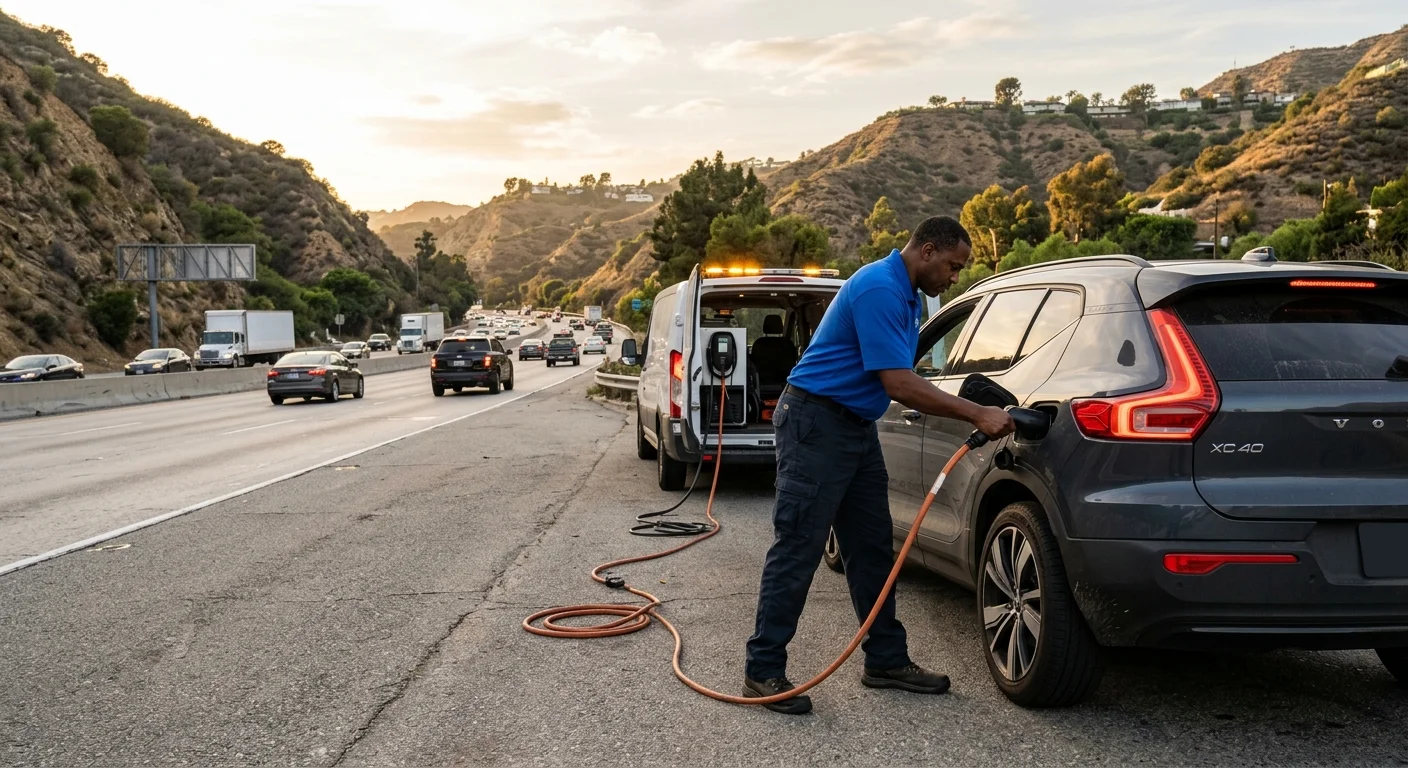
Zero pack on the 101 through Cahuenga Pass
Cahuenga Pass is the pinch. The 101 drops from Hollywood toward Universal City and the Valley floor, then climbs the other way. A low charge that looked fine on Sunset can vanish on that grade. Westbound into the Valley, you’re still in a cut with ramps, concrete, and fast traffic. Eastbound toward Hollywood, the same pack has to work uphill. Barham, Lankershim, and the Universal City ramps stack here. Shoulders get thin in the pass. There is little room to be wrong.
If the car stops, get it as far right as you can. Hazards on. California Vehicle Code 21718 bars stopping on a freeway, with an exception for a disabled vehicle once help has been summoned. That exception is why you call from the car. Stay belted in if the shoulder is narrow and traffic is close. If you can stand behind a barrier, do that. Other drivers have a move-over duty under CVC 21809 when a stopped emergency, tow, or Caltrans vehicle is showing flashing lights. Your dark EV with hazards is still a hazard in this cut.
Metro Freeway Service Patrol runs designated beats on LA County freeways. Dial 511 and say Motorist Aid. FSP is free on those beats. Published hours are Monday through Friday 6am to 7pm, and weekends 10am to 6:30pm. The published list is flat tires, jump-starts, radiator refills, up to a gallon of fuel, and a tow to a designated safe spot off the freeway. Mobile EV charging is not on that list. A gallon of gas does nothing for a battery pack. A jump may wake a 12-volt system. It will not put range in a zero pack.
If FSP can tow you to a designated safe location off the 101, that gets you out of the travel lanes. It does not finish the trip. Out of charge recovery is the job after that, or in place of it, when the car can take a charge on the shoulder. After FSP hours, the beat may be empty. CHP and a matched local operator are still the path. Tell them you are in Cahuenga Pass, which direction you were pointed, and the last exit you saw.
Burbank sits just east of this pass on the 134. Studio traffic feeds the 101 here all day. If you were heading toward the lots and the car died in the cut, the same freeway rules apply. For the city streets once you are off the freeway, see EV roadside assistance in Burbank.
Valley grades from Encino toward Calabasas
West of the pass, the 101 runs the south edge of the San Fernando Valley. Studio City and Sherman Oaks come first. Then Encino, Tarzana, Woodland Hills, and the rise toward Calabasas. That westbound stretch is where a “I can make it home” guess fails. The floor around Encino feels easy. Then the grades start. Speed, cabin heat, and the climb all eat the last bar. A 12-mile estimate with 11 miles to go can still leave you on the shoulder.
Name the corridor when you call. The 101/405 split at Sherman Oaks is one landmark. West of that, drivers use Balboa, White Oak, Reseda, Tampa, Winnetka, Shoup, Topanga, and Parkway Calabasas. Calabasas is a different drive from Studio City. You leave the Ventura grid and climb toward the western hills. Pull right as soon as the car warns you. Coasting in the number 4 lane while you hunt an off-ramp keeps a powerless car in live traffic.
Off-ramps along this stretch dump you onto Ventura Boulevard or into hillside streets. A safe right-side stop on the 101 is still a freeway stop. CVC 22651 lets a peace officer remove a vehicle that is obstructing a freeway. CVC 22651(f) also covers a vehicle left on a freeway right-of-way for more than four hours when the driver cannot move it under its own power. Waiting without a call is how a stall turns into a removal.
Charge Pro LA is a referral service. We match you with a licensed, independent operator. That operator quotes you and bills you. We do not set a price. We do not publish an arrival window. Give a pin, a direction, and a landmark. Westbound 101 at Encino, eastbound in the pass, pack at zero, hazards on. That is enough to start a match.
US-101 through the Valley is a regular freeway, with carpool lanes in places. Metro ExpressLanes in this county run on I-10 and I-110, and they need a FasTrak transponder tied to a funded account. The California Clean Air Vehicle HOV decal program ended at midnight September 30, 2025. There is no solo HOV access on that basis in 2026. None of that puts energy in a dead pack on the 101.
Public stalls off Ventura, and what to do when they are full
Ventura Boulevard is the surface street that shadows the 101 through much of this Valley stretch. If you still have a mile or two, many drivers limp to a shopping center, a grocery lot, or a garage off Ventura. That is the right instinct when the car can still move. It is a dead end when the pack is already at zero on the freeway.
Public stalls along Ventura fill up. Apps go stale. A stall that showed open can be occupied, blocked by a gas car, or broken. We have not measured a stall count for this corridor, and we will not invent a nearest-charger distance. Check your charging app while you still have power. The U.S. Department of Energy keeps a national overview of electric vehicles and charging at energy.gov. The California Energy Commission tracks zero-emission vehicles and charging policy. Neither one will tell you which Ventura lot is empty at 6 p.m.
If you made it off the 101 and every stall is taken, sit in a legal parking space. Keep the drive aisle clear. Keep the fire lane clear. A mobile operator can add a rescue charge in a lot the same way they can on a shoulder, when the site allows it. The typical rescue charge in our verified ledger is 10 to 20 miles of range in 15 to 30 minutes of Level 2 charging. That is charging time, not a promise of when someone arrives. AC Level 2 equipment can range from 2.9 to 19.2 kW, per the U.S. DOE Alternative Fuels Data Center. The operator on scene will tell you what their gear can do on your car.
If you are still on the 101, stay with the car. Do not walk Ventura looking for a plug. The freeway is the hazard. Summon help from the seat. For the surface-street version of this problem once you are off the freeway, mobile EV charging in the San Fernando Valley covers lots, apartments, and side streets from the east Valley to the west hills.
A short charge that restores 10 to 20 miles is often enough to reach a working public stall, a workplace plug, or home. Ask the operator where they want you to drive after they unplug. Do not plan a second freeway grade on a thin buffer. Encino to Calabasas is still a climb after you leave a Ventura lot.
Charge in place versus a tow off the 101
Two jobs get mixed up here. One is getting the car out of the lanes. The other is putting enough energy in the pack to drive. FSP and a tow truck can do the first. They do not automatically do the second.
Charge in place fits when the car is stable on the right shoulder, you have already called for help, and the pack will accept a charge. The operator we connect you with brings mobile charging equipment, plugs in, and adds enough range to reach a safer stall or home. Fifteen to 30 minutes of Level 2 charging is the typical window for that 10 to 20 miles of range. Your car, the state of the pack, and the operator’s equipment all change the result. Ask the operator on the call. A Cahuenga Pass shoulder and a Ventura grocery lot are different work sites. Say which one you are in.
A tow fits when the car cannot sit, the shoulder is too narrow, CHP wants it moved, or the car will not take a charge. FSP’s published help includes towing disabled vehicles to designated safe locations off the freeway. That is a short, official move, not a ride to a dealer in another city. A private tow after that is a separate job, quoted by that tower. We do not publish tow rates. There is no single statewide cap we can cite.
Insurance roadside is a third mix-up. GEICO Emergency Road Service, when you bought it, lists towing to the nearest qualified repair facility (mileage limits apply), jump-starts, tire changes with a working spare, lockouts, winching near a publicly maintained roadway, and fuel delivery. That page does not name electric vehicles or mobile EV charging. In most states GEICO says towing is covered up to 15 miles to the nearest qualified repair facility. A repair facility is not a charging stall. Confirm your own policy. We could not verify from primary sources what AAA, USAA, or other carriers send on an EV out-of-charge call.
Emergency EV roadside assistance is the broader match when you are not sure whether you need a charge, a 12-volt wake, or a tow. Tell the operator what the dash shows. A zero traction pack and a dead 12-volt are different failures. One needs energy in the high-voltage battery. The other needs the car to wake so it can accept a charge at all.
Matching a local operator without a time promise
Charge Pro LA connects stranded drivers with licensed, independent local EV rescue operators. A licensed operator owns the equipment and does the charging. That operator quotes the work and collects from you. We make the match. We do not hold a trade license, and we do not warrant the job.
Call with a pin, a direction, and a landmark. Westbound 101 at Encino. Eastbound in Cahuenga Pass. Hazards on. Pack at zero. If you already spoke to 511, say so. If CHP is on scene, say that too. The operator needs to know whether they are charging on the shoulder or meeting you in a lot off Ventura. Studio City, Sherman Oaks, Encino, Woodland Hills, Calabasas, and Burbank all sit on this same 101 story. The pin still has to be yours.
We do not publish business hours. We do not publish an arrival window. Traffic on this stretch stacks at the pass, at the 405 split, and through the Calabasas grades. The person who can speak to timing is the operator on the phone. You stay inside CVC 21718 by having summoned help. You stay out of the lanes. You get moving again when the matched operator adds range or arranges the tow they think is right.
Have the car ready for them. Charge port unlocked if the car will still do that. Occupants on the safe side of a barrier when there is one. A clear description of the last exit. That is the whole loop on this freeway: legal stop, a real call, then a local operator who can put 10 to 20 miles back in the pack.
When to call us
Call when the pack is dead or dying on the 101 through Cahuenga Pass, Encino, or the Calabasas grades, and you need a licensed local operator for a charge in place. If FSP already moved you to a lot off Ventura and the stalls are full, that is still an out-of-charge recovery call. Call us at (213) 410-1991 and we’ll connect you with a local EV rescue operator.