An EV driver on the I-110 who sees the dash dropping toward zero doesn’t have many options. They get the shoulder, the hazards, and the call. Here’s what to do when your EV runs out of battery on the 110, step by step.
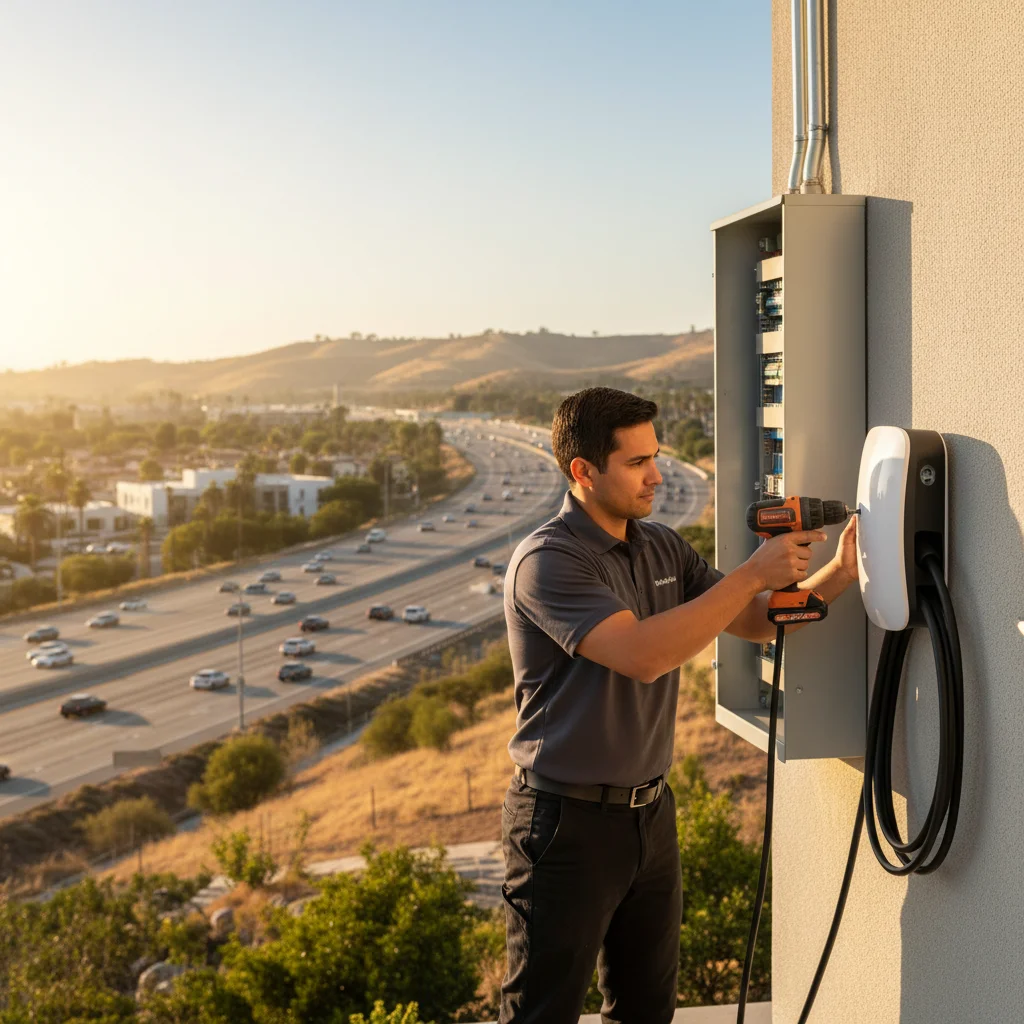
The 110 in LA County
The I-110 runs from San Pedro and the harbor up through Carson, the South Bay, Downtown Los Angeles, and into South Pasadena. It’s one of the busiest corridors in the county. The freeway carries harbor truck traffic, Dodger Stadium game traffic, and the everyday commute from the harbor to Downtown.
A driver who misjudges the climb up from San Pedro to the Harbor Gateway transition runs short at the worst moment. The 110 has long uphill sections on both sides. AC on a 95F day plus the grade pulls range out of any EV. The dash reads one number, and the actual range trails it.
A driver who gambled on the next exit sits there with hazards on. That’s where this list starts.
Step one: pull as far right as you can
Don’t stop in a travel lane. California Vehicle Code 21718 bars stopping on a freeway. A disabled vehicle that has summoned help is an exception. Get out of the live lanes and onto the shoulder. Set your hazards. If you can pull into an exit lane or a wide spot, do that.
If you can’t make it to the shoulder, stay in the car with your seatbelt on and call 911. The CHP needs to know you’re stopped in a live lane.
Step two: stay with the car or get out safely
If the shoulder is wide enough to stand on, get out on the right side of the car. Stay clear of the live lanes. CVC 21809 is the move-over law. Other drivers must change lanes or slow when a service vehicle has lights on, but not all of them do.
If the shoulder is too narrow to stand on, stay in the car with your seatbelt on. Wait for help.
Don’t walk the lanes. Don’t try to push the car. Don’t accept a ride from a stranger.
Step three: call for help
Call (213) 410-1991. Leave your mile marker or your nearest cross street. Leave your vehicle make and model. We’ll match you with a local operator already covering the 110 corridor.
The 110 sees regular operator coverage from the South Bay operators and the Downtown operators. The dispatch is the same call.
Step four: consider Metro Freeway Service Patrol
On a Los Angeles County freeway, Metro Freeway Service Patrol is one free option. Dial 511 and say Motorist Aid. FSP’s published list is a gallon of gas, a radiator refill, and a tire change. It also tows a disabled car to a safe CHP-chosen spot, free.
Mobile EV charging isn’t on that list. FSP can tow your car to a safe spot. It doesn’t bring a Level 2 charger. Pair a tow with a mobile operator at the destination if the car needs electrons.
FSP runs on the 110. Their beats cover most of the corridor during daytime hours. A Tuesday afternoon call gets a faster FSP response than a Sunday morning call.
Step five: what the operator brings
We’re a referral line for Los Angeles County. We match stranded EV drivers with independent local operators. The pros we connect you with are licensed and insured. We hold no license for the work. We own no trucks and employ no technicians. We set no prices and publish no arrival time.
The operator quotes you before they start. They bill you directly. No dollar figure belongs here. They quote you on the phone and confirm access before they roll.
What they bring is a 240-volt Level 2 source to the car. Teslas take a native NACS plug. Other EVs use a CCS or J1772 adapter. A typical session adds 10 to 20 miles of range. Charging time is usually 15 to 30 minutes, and that clock starts when the plug is in. It isn’t a clock for when the truck shows up.
That boost is enough to reach a charger in Downtown, South LA, or the harbor. It’s the job mobile EV charging is built for.
Operators also jump or replace a dead 12-volt battery on site. That’s a different failure mode than an empty pack, but the operator handles both.
Step six: drive off under your own power
Once the operator adds 10 to 20 miles, you drive off. Pull out of the shoulder carefully. Match the speed of the live lanes. Don’t stop again until you reach a charger.
The closest public chargers on the 110 corridor depend on where you stopped. Downtown has a charger at most parking garages. San Pedro has chargers near the waterfront. South LA has chargers at strip malls. The 10 to 20 miles from the operator gets you to one of those.
When a tow is the honest answer
If the car has physical damage or a charge port fault, the operator can’t help. A crash or a bent wheel needs a shop. A charge port that won’t accept power needs a tow.
If you can’t stay with the car safely, accept FSP’s tow. The car lands at a CHP-chosen spot, and you can call a mobile operator from there.
How to avoid this next time
Charge before you reach 10 percent on the 110. The corridor has long gaps between chargers. A driver who plans to arrive at the next stall with 20 percent buffer usually makes it. A driver who plans to arrive at zero usually doesn’t.
Out of charge on the 405 Sepulveda Pass covers a similar gap on the 405. Out of charge on the 5 near Santa Clarita covers the 5 corridor.
The number to call is (213) 410-1991. We’ll match you with a local operator. They quote before any cable goes in.