The traction pack hits zero on the Foothill Freeway and the car goes quiet between Lake Avenue and Santa Anita. Hazards on, you’re on the 210 through Pasadena or Arcadia, and the next call is the one that keeps you inside the law and gets a charge to the car.
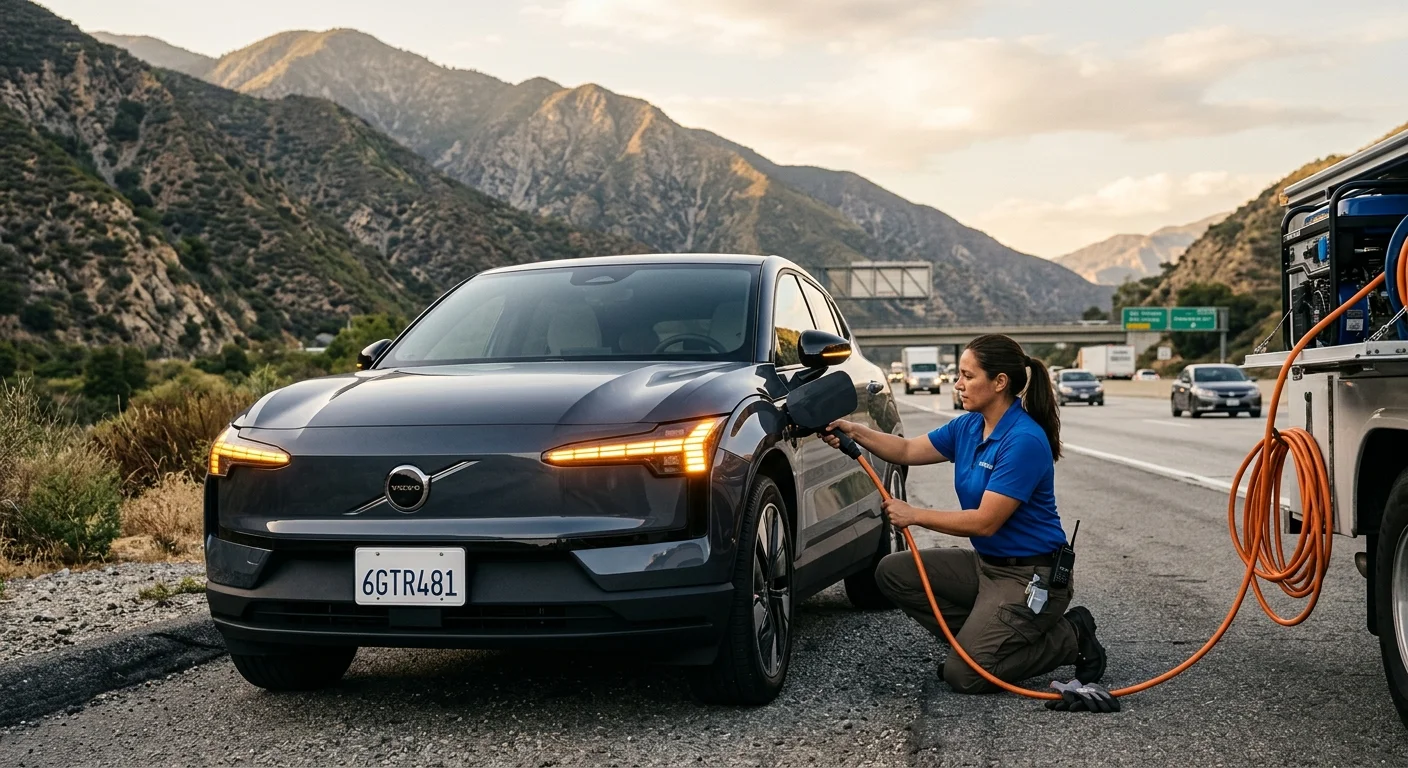
Zero pack on the 210 through Pasadena and Arcadia
A zero pack on the 210 is a freeway problem. It is not a stall on a city curb. Eastbound, the Foothill Freeway runs through Pasadena and into Arcadia toward Santa Anita. Westbound, you hit the 134 split in Pasadena. From that split the 210 continues toward La Cañada and the north Valley. The 134 heads toward Glendale and Burbank. The 210 meets the 5 at its western end in the north Valley. That meeting is not this Pasadena stretch.
If the car is disabled, California Vehicle Code 21718 is the rule that matters. It prohibits stopping on a freeway, with an exception for a disabled vehicle when help has been summoned. Put the hazards on. Get as far right as you can. Stay out of the travel lanes. Call for help before you walk toward an exit. Once help is summoned, you are in that exception.
Metro Freeway Service Patrol covers designated Los Angeles County freeway beats. Dial 511 and say Motorist Aid. Metro publishes hours as Monday through Friday, 6am to 7pm, and weekends, 10am to 6:30pm. The published help list is tire changes, jump-starts, radiator refills, up to a gallon of fuel, and a tow to a designated safe location off the freeway. Mobile EV charging is not on that list. A gallon of fuel does nothing for a battery. A jump may wake a 12-volt system. It will not put miles back in a dead traction pack.
If the car sits on a full-access freeway right-of-way for more than four hours, Vehicle Code 22651(f) lets a peace officer remove it. That clock is real. Do not wait it out on the shoulder hoping a stall on Colorado Boulevard will free up. Other drivers have a move-over duty under Vehicle Code 21809 when emergency, tow, or Caltrans vehicles show flashing lights. You still want the car out of the lane as soon as a legal option exists.
Pasadena’s 2024 Census estimate is 137,195 people across 22.96 square miles of land. Arcadia sits just east of that, with an ACS 2019-2023 population of 55,550. This beat is dense. It is still a mountain-facing freeway. Treat it as the 210, not as downtown Pasadena.
Foothill grades versus a dead 12V in an Old Pasadena garage
The San Gabriel Mountains sit on the north side of this stretch. The 210 is a foothill grade, not a flat basin cruise. Climbing toward La Cañada, or holding speed through Pasadena on a low state of charge, uses range faster than a run on the 10 through El Monte. Recurrent Auto’s winter analysis across dozens of models found EVs keep about 78 percent of range at 32F, and about 70 percent at 20F, with cabin heat as the main driver. Foothill mornings can be the coldest part of a Pasadena commute. If you left home close to empty, that is often how the pack hits zero here.
A dark car in an Old Pasadena garage is usually a different failure. Census ACS 2019-2023 figures show 73.0 percent of Pasadena housing was built before 1980. Those buildings have tight garages, alley lots, and long sits after dinner on Colorado. The 12-volt battery can drop while the traction pack still holds energy. The dash stays black. Doors may not unlatch the way you expect. That is a 12-volt problem, not an empty pack.
Tell the operator which one you have. On the 210, you were driving and the range went to zero: treat it as the pack. In a garage off Fair Oaks or Raymond, the car sat and then would not wake: treat it as 12-volt until someone tests it. EV roadside assistance in Pasadena covers the city streets, lots, and Old Pasadena blocks. This page is the freeway.
Charge Pro LA is a referral service. The local operator you get matched with does the test, the charge, or the tow. The brand does not send its own truck, and it does not hold a trade license. “The pros we connect you with are licensed and insured” is the true claim. A Charge Pro LA crew on the shoulder is not.
Public stalls on Colorado, and what to do when they are full
Colorado Boulevard is the surface street people picture first. Old Pasadena sits on it. Arcadia’s commercial stretch sits on it too, over toward Santa Anita. Public Level 2 and DC stalls show up in charging apps along that corridor. This page does not publish a stall count for Colorado. Inventories change, and a live count was not verified here. Check your app while the phone still has battery. The U.S. Department of Energy keeps a clean national explainer of how EV charging works if you need the Level 2 versus DC fast picture while you wait.
Full stalls are common on a weekend night near the playhouses and restaurants. A plug that looks open can still refuse a session. If you already made it off the 210 and you are at a curb in Old Pasadena with a few miles left, it is worth one attempt at an open stall. If every stall is taken, or the session never starts, stop burning the last miles looping the block.
Do not leave the car on the 210 to walk to Colorado. The freeway is not a parking lot for that errand. FSP can move a disabled vehicle to a designated safe location off the freeway. That drop is still not a charge. Once you are on a surface street, a mobile operator can often charge in place. That is the out-of-charge recovery path: enough energy to reach a working stall or to get home, not a full pack.
If you are still rolling and you can take an exit at Lake, Hill, or Santa Anita before the car dies, take it. A dead EV on Colorado is a city-street problem. A dead EV in a 210 lane is a CHP problem. Get to the right shoulder first if you cannot make the ramp. The California Energy Commission tracks zero-emission vehicles and charging policy statewide. It does not dispatch a truck to the Foothill Freeway.
Charge in place versus a tow off the 210
Two legal ways off a dead 210 sit in front of you: charge where you are, or tow to a safe spot and charge there. A typical rescue charge is 10 to 20 miles of range in 15 to 30 minutes of Level 2 charging. That figure is charging time, not an arrival time. AC Level 2 equipment, per the U.S. DOE Alternative Fuels Data Center, can range from 2.9 to 19.2 kW. The operator who does the work quotes it. Charge Pro LA does not set that price and does not waive a fee.
A tow makes sense when the car is blocking, when CHP wants it moved, or when a charge truck cannot stage on that shoulder. FSP’s published service includes towing disabled vehicles to designated safe locations off the freeway. That drop is often a surface street, not a charger. From there you still need energy in the pack. Vehicle Code 22651 also lets a peace officer remove a vehicle that is obstructing a freeway. Waiting for a perfect stall on Colorado while the four-hour clock runs is a bad trade.
The 10 through the San Gabriel Valley is a different freeway with the same empty-pack pattern. If your commute is the 10 instead of the 210, read stranded EV on the 10 in the San Gabriel Valley. Same county, different ramps, different surface streets after the tow.
Do not assume an insurance roadside add-on will send a charger. GEICO’s published Emergency Road Service list names towing to the nearest qualified repair facility (mileage limits apply), battery jump starts, tire changes when you have a working spare, lockouts, winching near a publicly maintained roadway, and fuel delivery. In most states GEICO says towing is covered up to 15 miles to the nearest qualified repair facility. That page does not name electric vehicles or mobile EV charging. Other carriers were not verified here. Ask the person on the phone what they will actually do on the 210, then pick charge-in-place or a tow.
Matching a local operator without a time promise
Charge Pro LA matches you with a licensed, independent local operator. You contract with that operator. They quote. They bill. The brand does not publish arrival windows, business hours, or a fee. Travel on the 210 at the 134 split is its own traffic. A truck coming from the west side of Pasadena is not the same run as one coming from Azusa.
When you call, say you are out of charge on the 210, not “somewhere in Pasadena.” Give the direction, eastbound or westbound. Give the last exit you passed: Lake, Hill, Allen, San Gabriel, Santa Anita. Say whether you are on the shoulder or still in a lane. Say whether the dash is alive. That is how the operator knows pack versus 12-volt, and freeway versus Old Pasadena.
Emergency EV roadside assistance is the broader county path when the failure might be a tire, a 12-volt, or a pack. Out-of-charge recovery is the path when the traction battery is empty and you need miles, not a jump. Either way, the person who does the work is the local pro. There is no Charge Pro LA fleet, yard, or warehouse.
Pasadena is big enough, and Arcadia is close enough, that a local match is a reasonable request. It is still a freeway against the mountains. Plan the call as a Foothill Freeway rescue. Let the operator tell you if a surface-street charge is the safer setup once the car is off the 210.
When to call us
If the pack is empty on the 210, or the car will not wake in an Old Pasadena garage, you need a mobile EV rescue operator, not a gas can. Call us at (213) 410-1991 and we’ll connect you with a local EV rescue operator. Tell them you are on the Foothill Freeway through Pasadena or Arcadia, and they will quote the charge or the tow directly.