The walk-up unlock does nothing. The screen stays black. The Tesla app still shows a healthy range number. That is a Tesla Model 3 12V failure, and it is the usual reason a Model 3 in Los Angeles looks dead while the drive pack is fine. Replacement is a Tesla Service job. A local jump is how many drivers get the car to wake first.
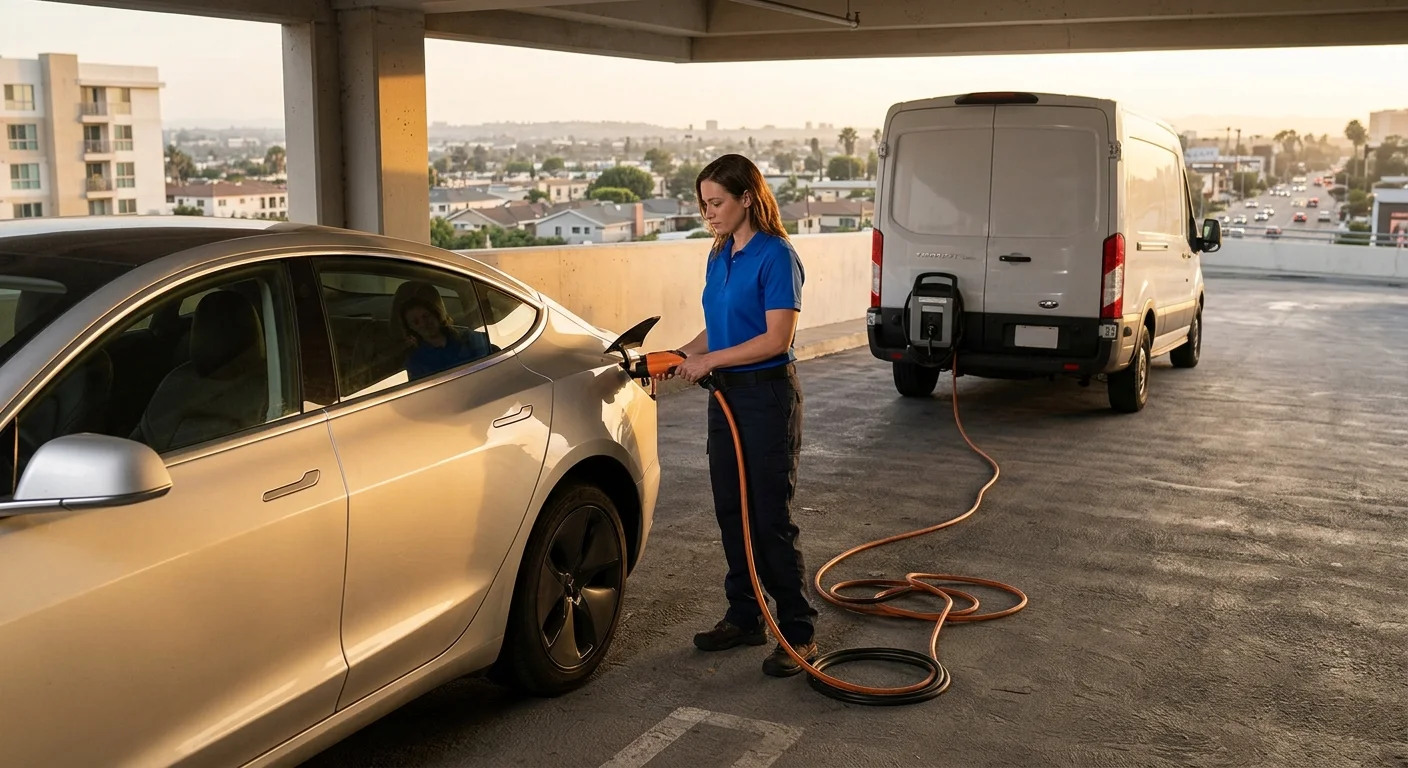
Lead-acid versus lithium 12V on the Model 3
Every Model 3 still has a small 12V battery. It wakes the computers, pops the handles, and closes the contactors on the high-voltage pack. It is not the drive pack under the floor. If you need the physical layout, we already mapped where the Model 3 12V and pack sit.
Tesla has used more than one 12V chemistry on the Model 3. Some cars use a conventional lead-acid 12V. Later cars use a small lithium 12V. tesla.com could not be read for this page, so a year-by-year cutover could not be confirmed here. Do not pick a part from a forum thread. Open the owner’s manual for your VIN. Ask Tesla Service in the app. Match the chemistry to that car.
Chemistry is not trivia. A clamp jump that is normal on lead-acid can be the wrong move on a lithium 12V. A lithium unit may need a wake procedure, not a crank. Follow Tesla’s steps for your year. If the manual is silent on a home jump, stop. Book Service instead of guessing with jumper cables.
Charge Pro LA does not replace Tesla 12V batteries. It does not stock parts. It does not run Tesla Mobile Service. A local operator can often provide a Tesla 12V battery jump so the car will wake. The replacement itself stays with Tesla Service, or with a shop that will confirm the exact part for that VIN.
No Tesla part number, parts price, or labor hour is listed here. None of those figures could be verified from Tesla for this page. If a quote appears in the Tesla app, that is Tesla’s number. Confirm it with Service before you pay. For the all-model version of this topic, see what to expect from a Tesla 12V replacement.
Background on how electric cars are built lives at the U.S. Department of Energy. It does not replace your Model 3 manual.
Signs the 12V is done, not the drive pack
A weak Model 3 12V rarely announces itself with a single clean alert. You get a brick that still looks charged in the app. Range is still there. Cabin climate still looks available on the phone. The car itself will not wake.
These are the signs drivers actually see in Los Angeles County. Handles stay flush. Walk-up unlock does nothing. The center screen stays dark after you try the door. The charge port will not motor open. The app can see the car, then drops, then sees it again. You needed a jump last month, and the car went dark after another sit. A 12V or electrical-system warning showed up before the last shutdown.
A dead drive pack looks different. Range is at or near zero. The car may still unlock if the 12V is healthy. You can often still sit in the cabin. You cannot drive far. Those are pack or charge problems, not a Tesla Model 3 12V battery replacement.
Sitting is what kills a 12V in this county. A Model 3 parked for a week in a Culver City subterranean garage, or left at LAX in a terminal structure, keeps computers and security hardware on a trickle. The 12V does that work. The drive pack does not. Heat in a closed garage speeds the same failure.
Do not treat a dark Model 3 as an empty pack and call for a long-distance charge first. Confirm the 12V. A roadside jump is the step that tells you whether the car will wake. If it wakes and then dies again after a short sit, the 12V is done. Replacement is next, not another jump.
Tesla does not publish a verified voltage cutoff or a replacement interval we could confirm for this page. If the car shows a 12V message in the app, read that message. Then book Service. Do not wait for a second brick in a Santa Monica alley or a Burbank driveway.
What Tesla Service versus a local jump can do
These are two different jobs. Mixing them up is how people sit in a garage for hours.
Tesla Service replaces the 12V. That is the path when you need to replace a Tesla 12V battery on a Model 3. Service confirms the chemistry for your VIN, installs the part Tesla specifies, and clears whatever the car logged. Tesla Mobile Service may or may not do that visit at your address. tesla.com could not be read for this page, so Mobile Service coverage, hours, and wait times could not be confirmed. Check the Tesla app. Ask Service. Do not plan your day on a rumor.
A local jump does not replace anything. The operator brings equipment and wakes the 12V so the contactors can close. If the car comes up, you can often drive it to Service, or sit until Tesla arrives. If it does not come up, you are past a jump. Then you need Tesla, or a Tesla roadside rescue so the car can be moved without being dragged on its drive wheels.
Charge Pro LA is a referral service. The brand does not carry Tesla 12V batteries. It does not dispatch Tesla technicians. It connects you with a licensed local operator who can attempt the jump, or a mobile charge if the pack is the real problem. The operator quotes you. You pay that operator. The brand sets no price.
Do not ask a jumper to swap the battery in a Westside garage stall. The tray, the fasteners, and the software after a lithium swap are Tesla’s. A wrong chemistry, or a unit that never gets coded, leaves you with another dark car tomorrow.
If you are already on a freeway, California Vehicle Code 21718 bars stopping on a freeway except for a disabled vehicle when help has been summoned. Stay with the car if it is safe. Put on hazards. Metro Freeway Service Patrol runs designated Los Angeles County beats and lists jump-starting cars among its published help. Dial 511 and say Motorist Aid. FSP hours are Monday through Friday 6am to 7pm, and weekends 10am to 6:30pm. FSP’s published list does not include mobile EV charging. It is a freeway patrol, not Tesla Service.
Heat-soaked Westside and Valley garages
Los Angeles County is not one climate for a 12V. A Model 3 in a Santa Monica or West Hollywood garage lives a different life than one in Palmdale.
On the Westside, a lot of Model 3s sleep underground. Census ACS 2019-2023 figures show 75.0% of Santa Monica housing was built before 1980, 80.5% in West Hollywood, and 85.5% in Culver City. Those buildings were not designed around EVs. The stalls are tight. Air barely moves. A white Model 3 with the frunk latched still soaks heat after a PCH or 10 commute. The 12V sits in that box all night. Repeated heat cycles are hard on lead-acid. They are not kind to a small lithium 12V either.
The San Fernando Valley is a different oven. Burbank, Glendale, and San Fernando put more cars in driveways and carports, but the afternoon soak is worse once you leave the marine layer. ACS 2019-2023 puts pre-1980 housing at 72.8% in Burbank, 70.7% in Glendale, and 82.3% in San Fernando. Older garages there still trap heat. A Model 3 that commutes over the 405 Sepulveda Pass or sits at Universal Studios Hollywood between shifts is a classic 12V brick the next morning.
Farther out, the housing is newer and the heat is meaner. Only 34.0% of Lancaster housing and 19.7% of Palmdale housing predates 1980, per the same ACS file. More cars sit in open drives and attached garages that bake. A 12V that is already tired does not like a week of Antelope Valley sun plus a cabin that never fully cools.
None of that is a published Tesla failure rate. Tesla did not confirm a heat-related replacement interval we could cite. It is why a Model 3 that was fine in June goes dark in a closed Westside garage in September, or after a long sit near LAX. LAX terminal structures P1-P7 offer Level 2 and DC fast charging, and Economy Parking has 514 active EV chargers, but a parked Model 3 still leans on its 12V the whole time the car is asleep.
If the car wakes after a jump and dies again in that same stall, stop jumping it. Book the replacement. Another clamp in a 90-degree garage does not fix a battery that can no longer hold a charge.
How Charge Pro LA connects a roadside operator
Charge Pro LA matches stranded drivers with licensed, independent local operators. It performs no work, owns no trucks, and holds no Tesla parts. You call. We take the location, the model, and whether the car will wake. Then we connect you with an operator who can attempt a 12V jump, or a rescue if the car has to be moved.
The operator quotes the job and bills you directly. We set no fee and we promise no arrival window. If the car is in a Culver City subterranean garage, say so. If it is on a shoulder of the 5 near Santa Clarita, say that too. Access, HOA gates, and freeway rules change what the operator can do on site.
Be ready with three facts. You drive a Model 3. The app still shows range, or it does not. You already tried Tesla Roadside in the app, or you have not. That last point matters. Tesla Service is still who replaces the 12V. A local jump is the bridge when the car is a brick and you need it to wake so you can get to Service, or so Tesla can finish the visit.
If the pack is actually empty, a jump will not help. Then the operator’s job is a mobile charge, not a 12V clamp. Typical rescue charging, when that is the job, is 10 to 20 miles of range in 15 to 30 minutes of Level 2 charging. That figure is charging time on site, not a promise about when someone arrives.
We serve Los Angeles County, including the Westside, the Valley, the South Bay, and the Antelope Valley. The brand does not replace a Tesla Model 3 12V battery. The pro we connect you with does not become Tesla Service by showing up. Use them to wake the car. Use Tesla to replace the battery.
When to call us
Call when the Model 3 will not wake, the app still shows range, and you need a licensed local operator on site to attempt a 12V jump or a rescue if the car has to move. Stay off a freeway lane if you can. If you cannot, summon help and stay with the car if it is safe. Call us at (213) 410-1991 and we’ll connect you with a local EV rescue operator.