Tesla’s roadside program has real limits. The basic program is included with every new car, but it doesn’t cover every situation. Here’s what it covers and what it leaves out for LA County drivers in 2026.
What the basic program covers
Tesla’s basic roadside covers lockouts, tire changes for cars with run-flat tires or the tire repair kit, and tows to a Tesla Service Center. The program is included for the first four years or 50,000 miles, whichever comes first.
The basic program covers tows to a public charger for out-of-charge situations as a courtesy in many cases. The cost isn’t always guaranteed. Long-distance out-of-range tows may not be covered.
The basic program covers 12V jumps in some cases. The contractor decides on the call whether to bring a jump pack. Most contractors carry one.
What the basic program doesn’t cover
The basic program doesn’t cover accidents. A driver in a crash needs to file a claim with their insurance. Tesla’s program tows to a Service Center, but the cost may not be covered if the tow is related to an accident.
The basic program doesn’t cover flat tires without run-flats or the tire repair kit. A Model 3 with a flat tire on the 405 gets a tow to a tire shop. The driver pays for the tire repair at the shop.
The basic program doesn’t cover lost keys. A driver who lost their key fob needs a Tesla Service Center visit. The Service Center replaces the fob and programs it to the car.
The basic program doesn’t cover vandalism. A driver whose car was broken into needs a police report and an insurance claim.
The basic program doesn’t cover high-voltage faults. A driver with a traction pack issue needs a tow to a Service Center. The Service Center runs diagnostics.
The contractor gap
The basic program dispatches through third-party contractors. The contractor decides on the call what to bring. Most contractors in LA County carry a flatbed. Some carry a mobile charger.
A driver who needs electrons at the pin may get a tow. A driver who needs a 12V jump at the pin usually gets a jump. The dispatch is uneven.
Tesla roadside who actually shows up covers the contractor gap in more detail.
What about out-of-charge
The basic program covers tows to a charger as a courtesy. A driver who runs out of charge at a curb gets a tow. The tow goes to the nearest charger the contractor identifies.
The courtesy doesn’t always cover long tows. A driver who runs out of charge on the Grapevine or in the Antelope Valley may pay out of pocket for the tow across the county.
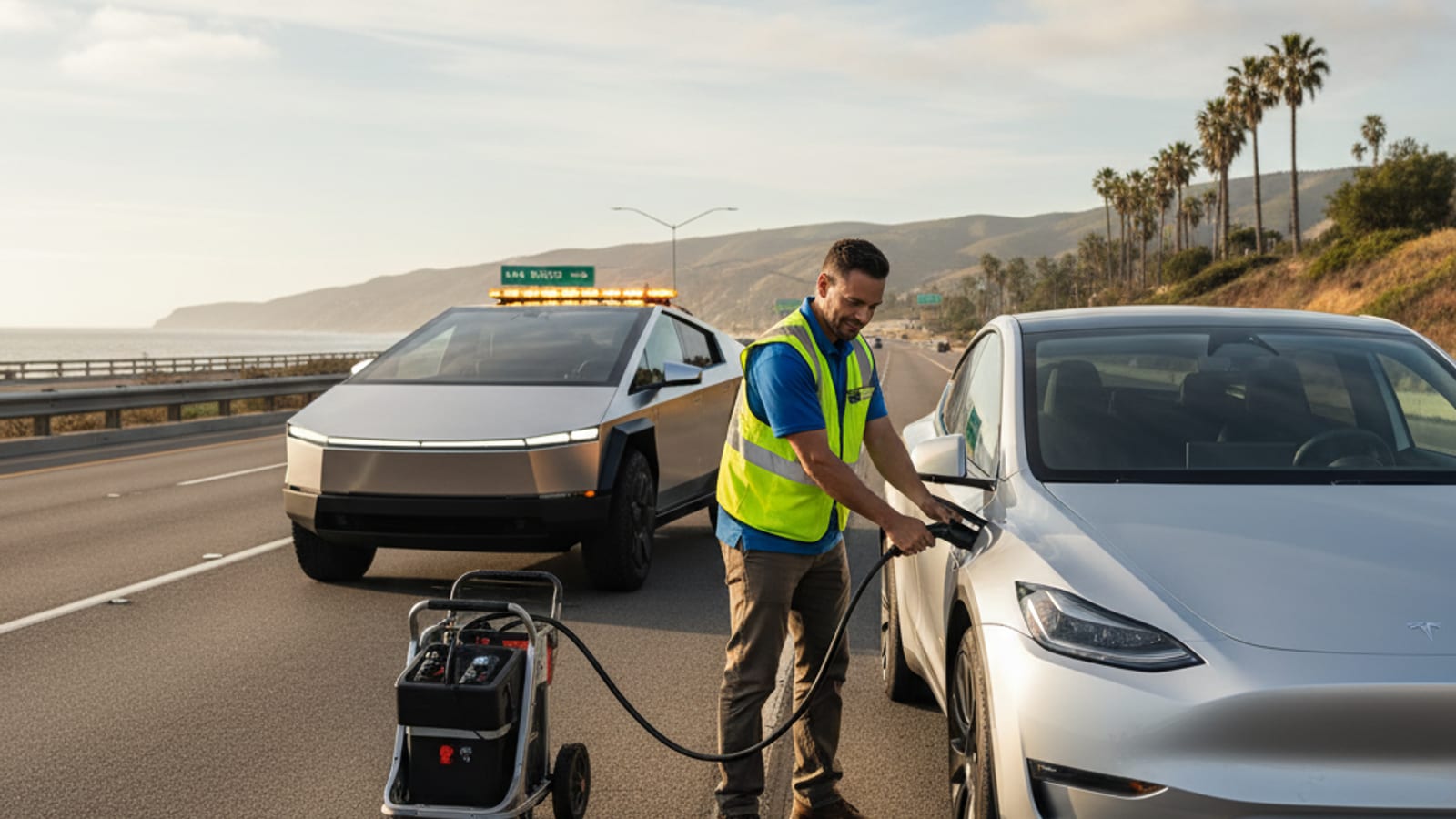
A local mobile rescue is the right call when the driver needs a charge at the pin. The operator brings 240V Level 2 to the car. The driver leaves under their own power.
We’re a referral line for Los Angeles County. We match stranded EV drivers with independent local operators. The pros we connect you with are licensed and insured. We hold no license for the work. We own no trucks and employ no technicians. We set no prices and publish no arrival time.
The operator quotes you before they start. They bill you directly. No dollar figure belongs here. They quote you on the phone and confirm access before they roll.
What about high-voltage faults
The basic program covers tows to a Service Center for a fault. The cost is covered under the basic program if the fault is mechanical. The cost may not be covered if the fault is the result of an accident or modification.
A driver with a traction pack issue gets a tow to a Service Center. The Service Center runs diagnostics. The driver pays for the diagnostics and any repair.
A driver with a 12V issue gets a tow to a Service Center or a jump at the pin. The contractor decides on the call.
What about lockouts
The basic program covers lockouts. A driver who locked the key fob in the car or who has a dead fob can call Tesla roadside. The dispatch sends a contractor or, in some cases, a remote unlock through the Tesla app.
The Tesla app can unlock the car remotely in some cases. The driver uses the app to unlock the doors without a contractor visit. This is faster and free under the basic program.
A driver with a dead 12V can’t use the app to unlock. The contractor needs to come out and access the car manually.
What local mobile rescue adds
A local mobile rescue fills the gaps the basic program leaves. The local operator brings a charger to the car. The driver gets 10 to 20 miles at the curb.
Tesla, AAA, or a local mobile rescue: how the three actually differ compares the three columns in more detail.
The combined answer
Tesla’s basic roadside covers lockouts, tire changes for cars with run-flats, and tows to a Service Center. It doesn’t cover accidents, flat tires without run-flats, lost keys, or vandalism. A local mobile rescue fills the gap when the basic program sends a tow instead of a charger.
The number to call is (213) 410-1991. We’ll match you with a local operator. They quote before any cable goes in.